
A trading firm runs real-time voice over a lossy transoceanic link with 4% packet loss and jitter spikes, tolerating extra bandwidth but not retransmission delay. Engineers must choose Application Quality of Experience mitigation for sustained loss versus single-packet gaps. Which App-QoE choice correctly contrasts packet duplication versus forward error correction for lossy links?
Select an answer to reveal the explanation.
Short Explanation
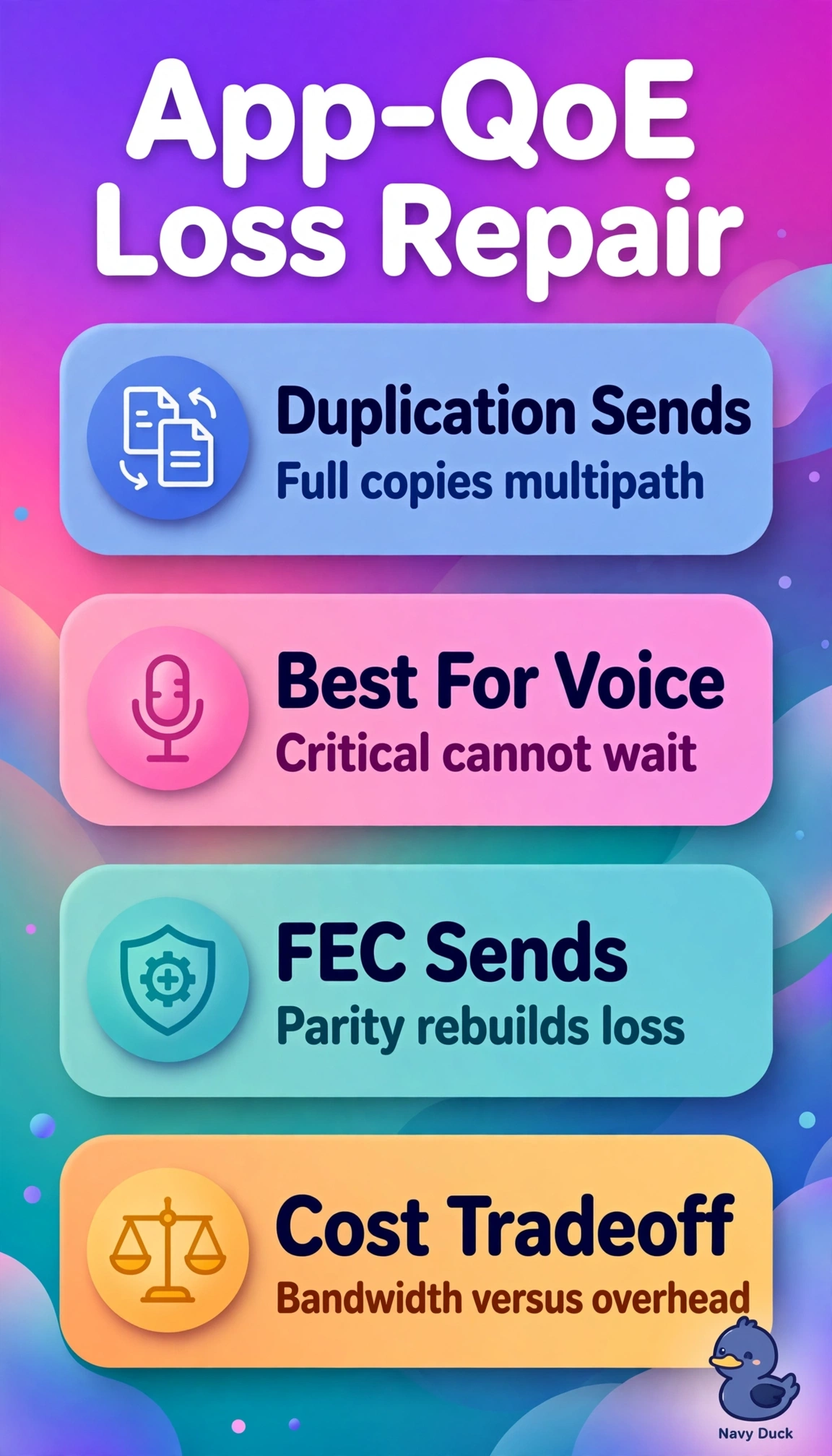
Lossy voice can't wait for resends, so you patch it mid-flight. Duplication doubles your shot while parity fills cracks — pick your safety-net by loss pattern.
Full Explanation
The correct Application-QoE choice works because packet duplication sends full redundant copies preferably over disjoint paths, so the receiver can instantly use the survivor to mask sustained 4% and burst-correlated loss on the transoceanic link without retransmission delay, trading accepted extra bandwidth for immediate recovery, while forward error correction adds low-overhead parity to reconstruct isolated single-packet gaps on the fly, which is bandwidth-efficient for random loss. The reversed-roles approach assigning parity correction to sustained loss and duplication to isolated gaps fails conceptually because lightweight parity cannot efficiently rebuild prolonged loss without excessive overhead, while duplicating every packet for rare single gaps wastes bandwidth. The large-block interleaving approach fails conceptually because although diverse-path duplication is correct, buffering many packets before decoding violates strict real-time and jitter constraints for trading voice, a method suited to one-way streaming video. The same-link duplication approach fails conceptually because copies sharing one fate-share link remain vulnerable to sustained congestion or path failure, losing the diversity gain that motivates duplication, though its parity for small gaps is correct. Exam caveat: recovery without retransmission is not guaranteed recovery; both trade bandwidth for resilience and fail if all paths lose the same interval. Practical check: verify diverse autonomous paths, measure residual loss and jitter-buffer depth after parity, and confirm added bandwidth stays within budget without increasing mouth-to-ear delay.