
A managed service provider monitors 600 WAN Edge routers from a NOC dashboard and needs hourly serial-to-site inventory, interface statistics and tunnel health without manual clicks in SD-WAN Manager. Scripting must scale with pagination and filtering. Which REST API monitoring approach should the automation engineer select for efficient bulk collection?
Select an answer to reveal the explanation.
Short Explanation
You’re thinking at the right scale, and pagination is your friend here. Bulk API pulls work like a warehouse inventory scanner instead of checking shelves by hand, so you can master pagination.
Full Explanation
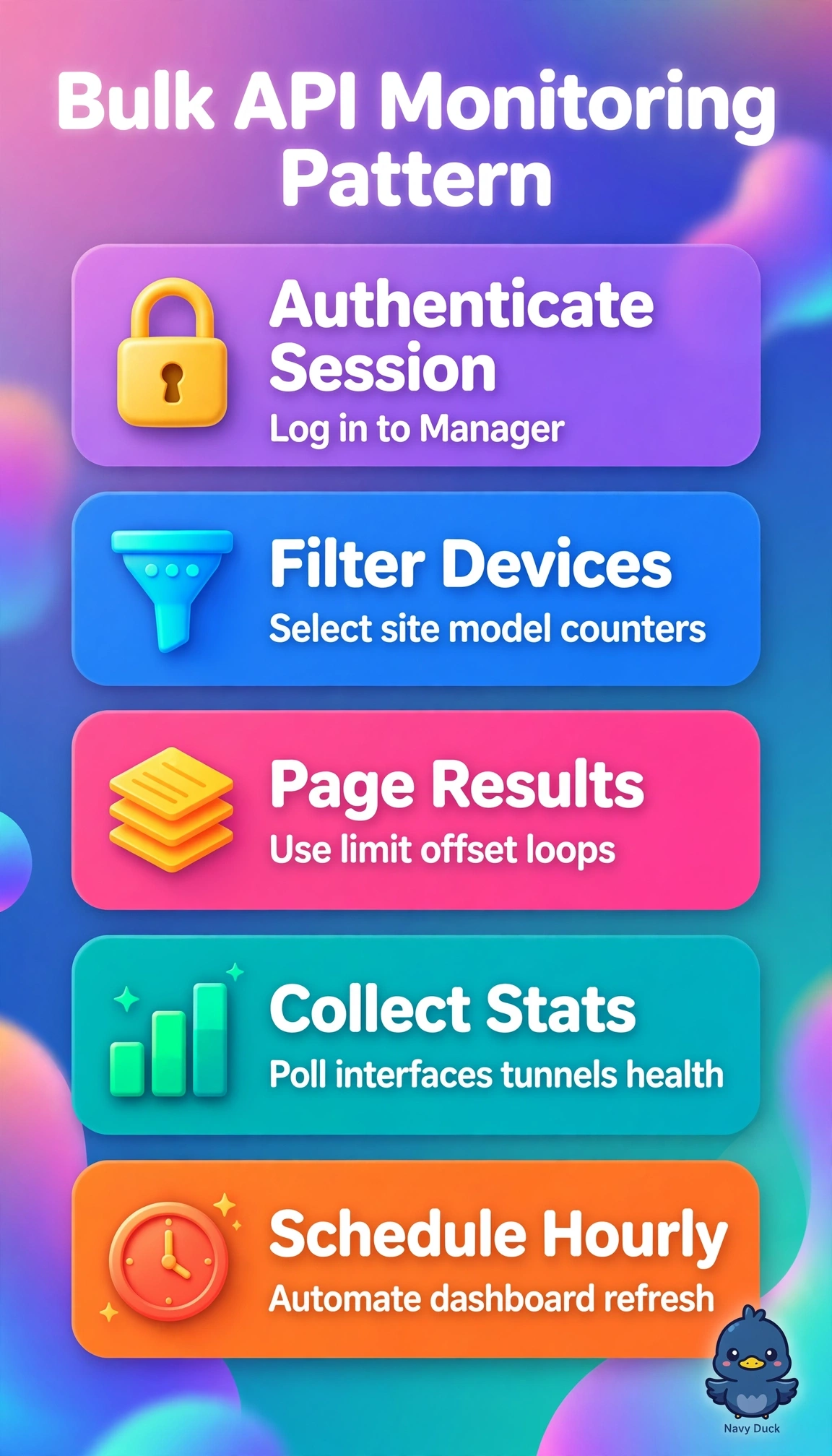
Authenticated REST calls with server-side filtering and pagination are the right fit for hourly serial-to-site inventory, interface statistics, and tunnel health across 600 WAN Edge routers. They retrieve only relevant devices and counters page by page, supporting bulk collection without manual clicks as volume grows. Paged filtered alarm and event calls do not provide the needed data: alarms describe faults and state transitions, rather than authoritative inventory mappings and quantitative interface and tunnel counters. Continuously streaming filtered device statistics favors immediate updates, not deterministic hourly snapshots, and adds connection-management and deduplication overhead that scheduled polling avoids. Polling filtered statistics router by router multiplies request overhead and runtime across 600 routers, increasing throttling and timeout risk compared with aggregated bulk responses. An exam caveat is that filtering alone does not make alarm and event APIs suitable for inventory and metrics; distinguish operational inventory and statistics from fault data. As a practical check, authenticate a service account, apply the required filters, follow the scroll cursor (scrollId) through each page until the last one, and verify that the hourly run returns complete serial mappings and the expected counters.