
A new engineer sees SD-WAN Controller advertising three tables and confuses customer prefixes with tunnel endpoints and firewall services. The fabric uses MPLS and internet TLOCs with a firewall service at HQ. Which description correctly maps OMP routes, TLOC routes and service routes to what each carries?
Select an answer to reveal the explanation.
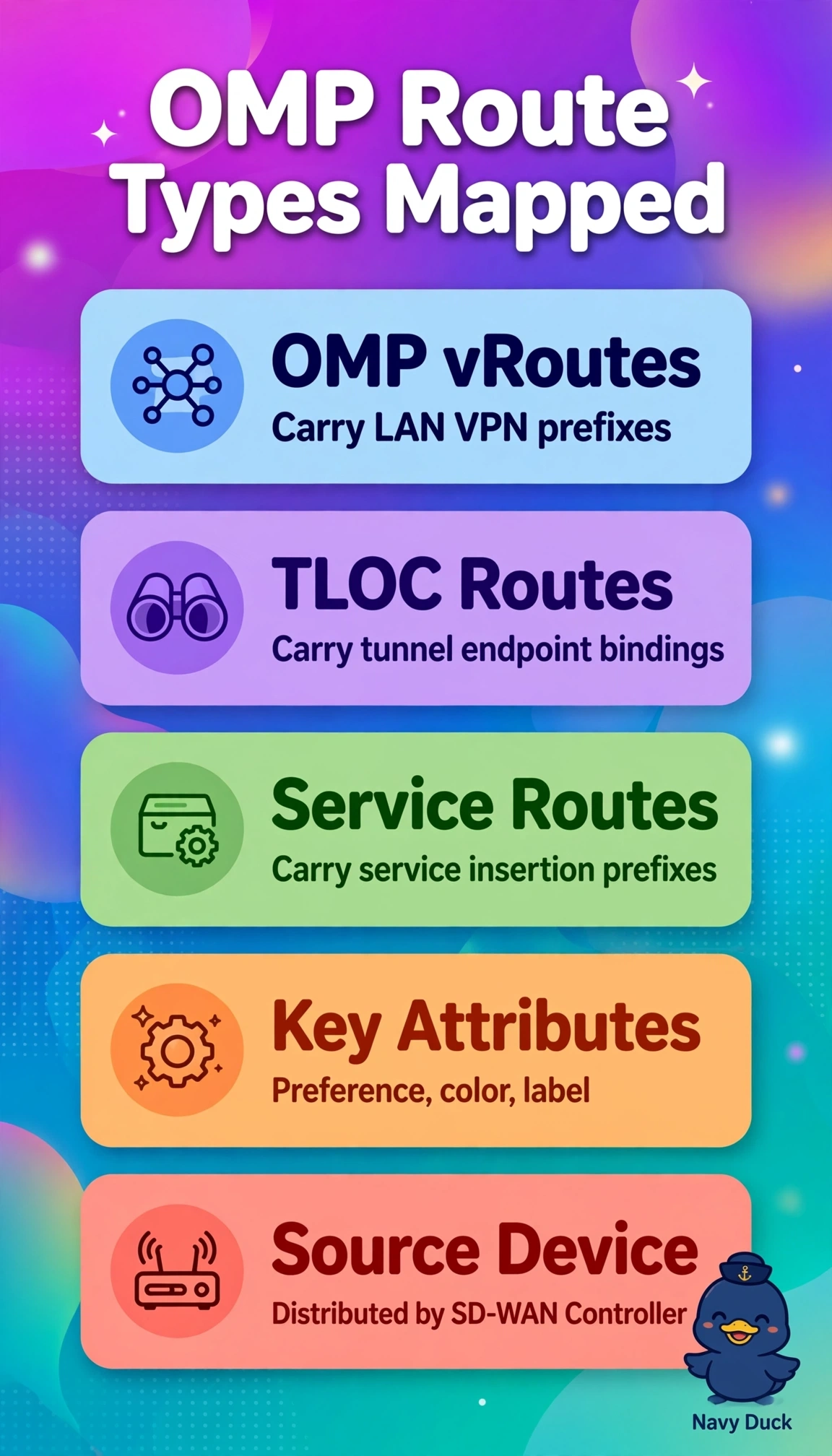
Short Explanation
Sorting the three lists saves hours later. vRoutes are your destinations, TLOCs are your on-ramps, services are your detours.
Full Explanation
In Cisco SD-WAN, the Controller (formerly vSmart) distributes OMP routes also called vRoutes that carry service-VPN prefixes with attributes like preference and VPN ID, TLOC routes that carry system-IP, color and encapsulation bindings that tell edges where tunnels can terminate, and service routes that carry service VPN network addresses reachable via service nodes for insertion such as firewall or IDS. The swapped mapping fails by concept because it reverses control and transport roles, making prefixes unusable for tunnel setup. The color-as-service mapping fails by concept because color and encapsulation are TLOC attributes, not advertised services, while firewall chaining requires service labels. The prefix-as-encapsulation mapping fails by concept because VPN labels and encapsulation identify forwarding behavior but do not themselves advertise reachability for insertion. For the exam, remember TLOC equals transport locator and never carries LAN prefixes, and in practice compare show omp routes, tlocs and services on the Controller.