
A regional bank is installing Cisco SD-WAN controllers on-premises in its own data center with an isolated management network, three static public IPs for VPN 0 reachability, and a single registered enterprise name to bind all devices. The engineer must bring up SD-WAN Manager, SD-WAN Controller, and SD-WAN Validator consistently. Which initial installation sequence correctly applies system IP, VPN 0, and organization name for controller on-premises deployment?
Select an answer to reveal the explanation.
Short Explanation
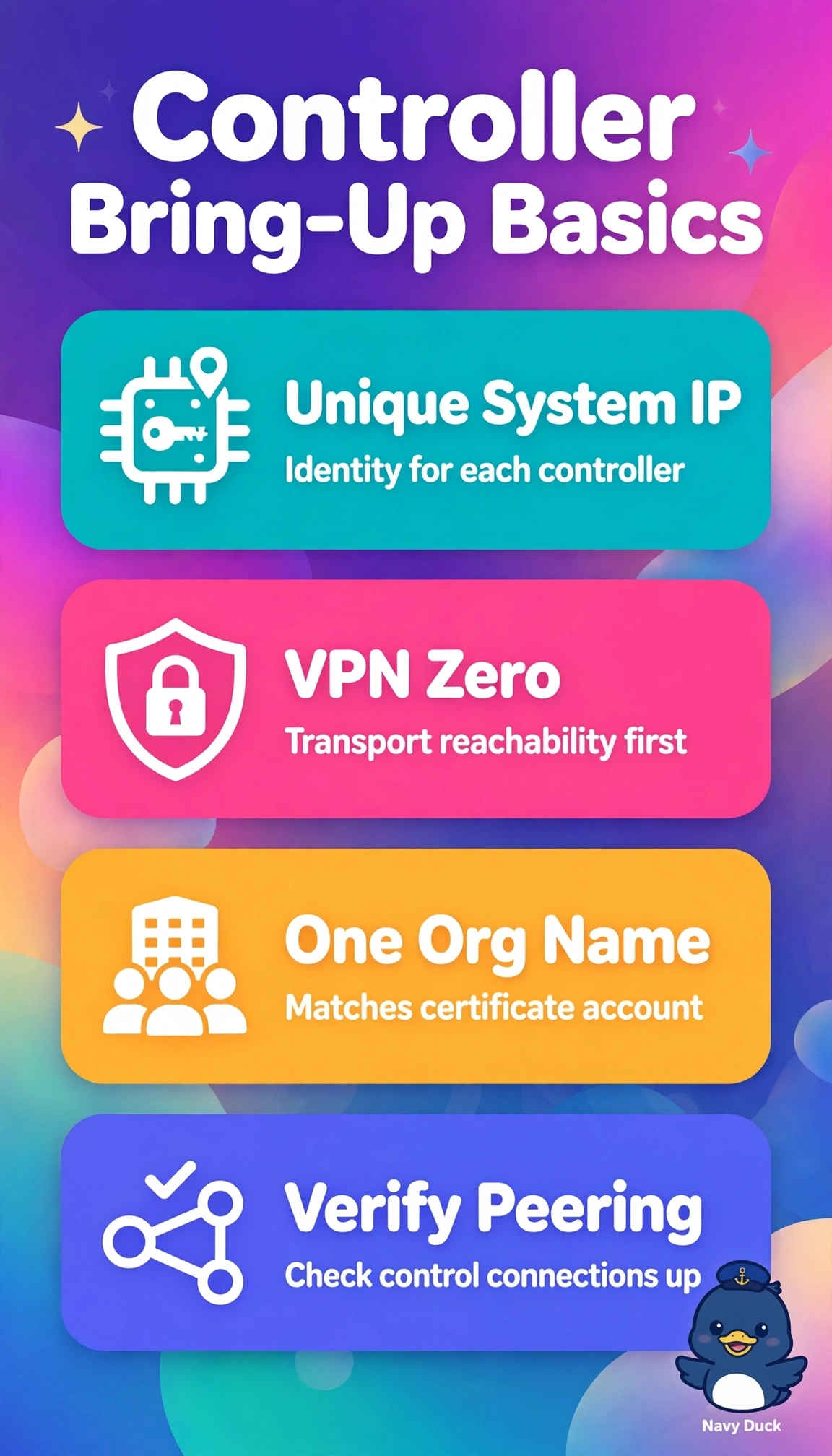
You’ve got this—consistency is the anchor here. Give each controller a unique system IP, use VPN 0 for static-address transport, and set the same organization name on all three to tie the family together like a surname.
Full Explanation
For this on-premises deployment, give SD-WAN Manager, SD-WAN Controller, and SD-WAN Validator distinct system IPs, configure VPN 0 with the assigned static public IP and gateway, and set the identical enterprise organization name on all three. The system IP is each device’s persistent control-plane identity for OMP and DTLS; VPN 0 carries control connections; and the organization name is the shared domain identifier used to bind devices during certificate onboarding and validator authorization. Deriving the organization name from each certificate issuer would substitute issuer details for the common enterprise identity and break the shared trust domain. Putting the static IP and gateway on VPN 512 confuses isolated management access with transport: VPN 512 is for out-of-band management and does not source control connections, so VPN 0 would lack the required reachability. Reusing one system IP for clustering would create duplicate router-identifier behavior, OMP origination conflicts, and prevent the control topology from distinguishing the controllers. Exam caveat: cloud-hosted defaults such as DHCP or NAT do not override an explicit on-premises static VPN 0 design, and organization-name spelling and case must match exactly. As a practical check, confirm each system configuration has a unique system IP, verify VPN 0 has the assigned static address and operational gateway, and compare the running organization name on all three devices character for character before generating CSRs.