
A manufacturing firm deploys 80 WAN Edges with dual transports to redundant Managers, Controllers, and Validators. Operations requires encrypted control and expects each edge to keep persistent control connections to its Manager and Controllers. Which WAN Edge data-plane and connection behavior should the engineer verify to meet the design?
Select an answer to reveal the explanation.
Short Explanation
Control versus data gets mixed up under pressure. You prove health when IPsec carries user traffic and DTLS/TLS guards each controller session.
Full Explanation
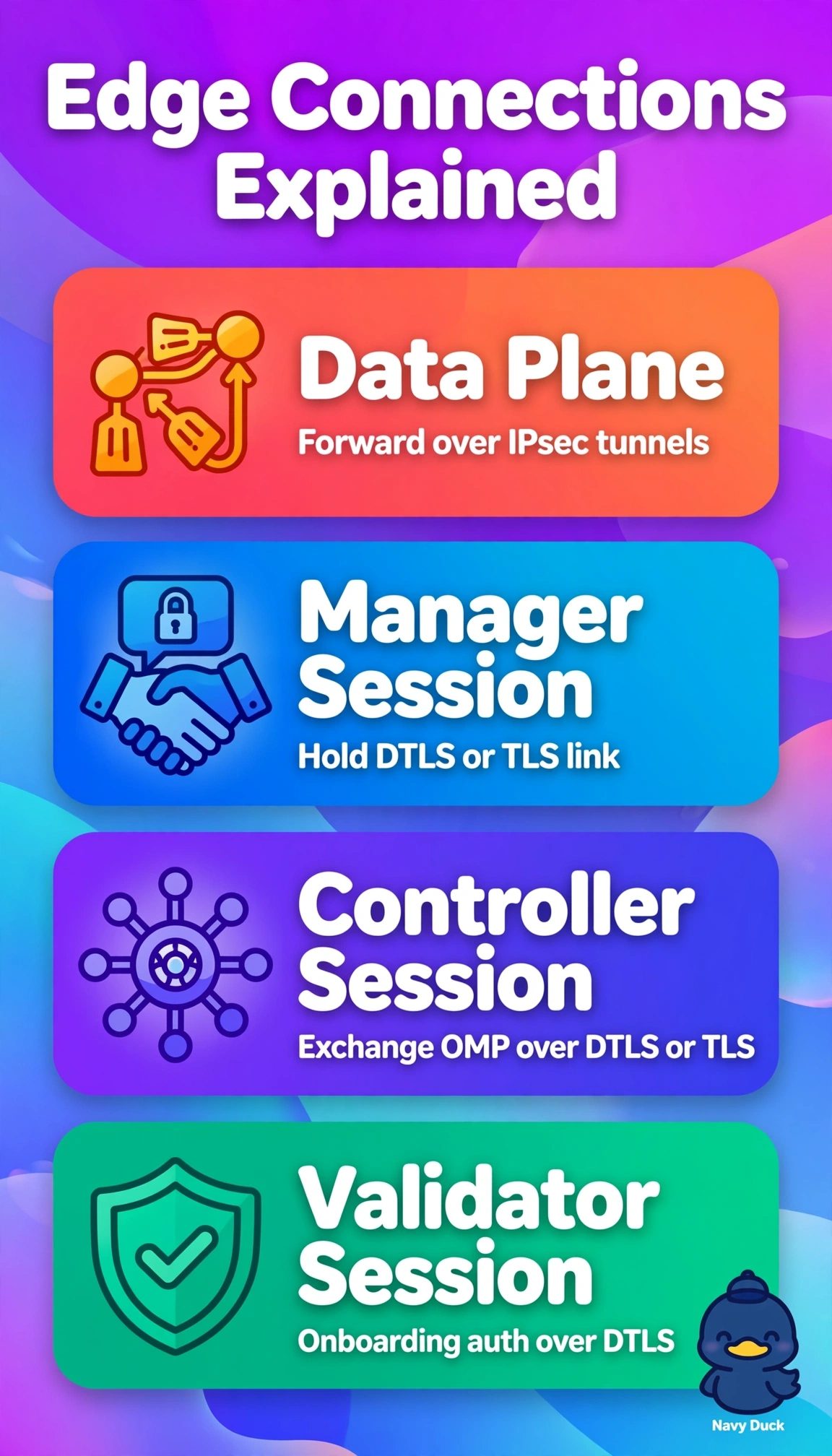
WAN Edge routers form the data plane by building IPsec tunnels to peers for user traffic while maintaining persistent control connections, DTLS by default or TLS if configured, to SD-WAN Manager (formerly vManage) for management and to SD-WAN Controllers (formerly vSmart) for OMP. The edge also contacts the SD-WAN Validator (formerly vBond) over DTLS, but that session is used for authentication and discovery during onboarding rather than as a long-lived control session. Forwarding data over OMP fails because OMP is the routing control protocol carried inside control connections, not the encapsulation for user packets. Holding OMP to the Manager fails because OMP peers exist only with Controllers; the Manager session carries management traffic over DTLS or TLS. Forwarding data over DTLS while holding IPsec to controllers fails because it reverses the encapsulations; data uses IPsec and control uses DTLS or TLS. Exam caveat is that port and certificate issues often break one control session while data still flows, and practical check is to show control connections and tunnel endpoints per transport on the edge.