
A retailer needs a control policy where Site 10 advertises 10.10.0.0/16 to Sites 20-30, but Hub Site 5 must filter TLOCs with lossy MPLS color and prefer broadband TLOCs for that prefix. Which match-and-set combination implements the site, prefix, and TLOC requirement?
Select an answer to reveal the explanation.
Short Explanation
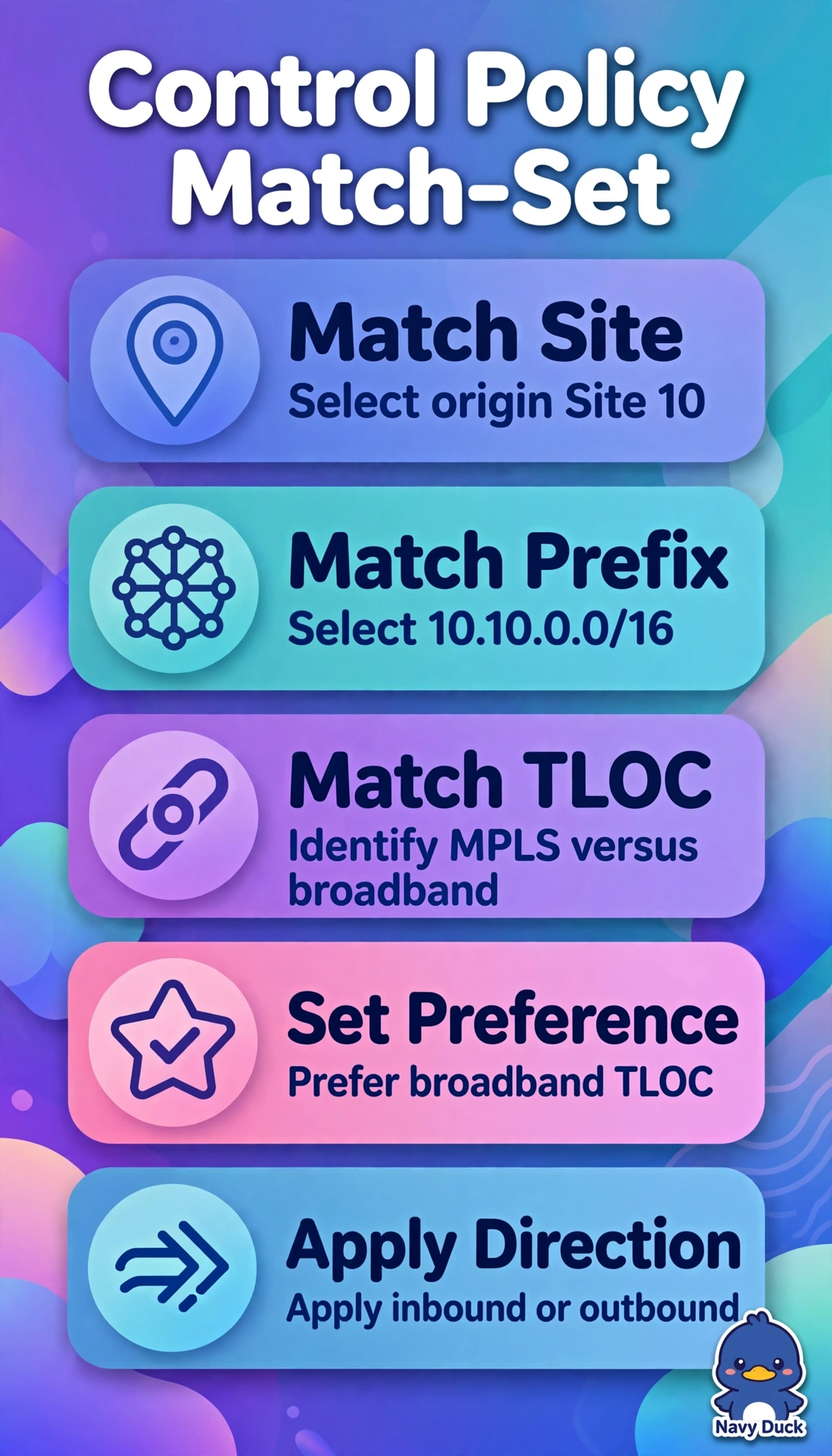
You’ve lined up all three matches cleanly: site, prefix, and TLOC narrow the route, and TLOC preference steers traffic toward broadband without breaking reachability. That lets the policy address the advertised route and its transport together.
Full Explanation
The site-list, prefix-list, and TLOC-list match combination identifies the route advertised by Site 10 and the relevant transports, while setting TLOC preference lets the policy favor broadband for that prefix and influence OMP best-path selection. TLOC attributes can include color and carrier, allowing the policy to distinguish lossy MPLS from broadband; filtering the lossy MPLS TLOCs and preferring broadband meets the control goal at Hub Site 5. Setting the OSPF metric does not rank OMP TLOCs: OSPF cost applies to service-side routing redistribution, not control-policy transport selection. Setting VPN membership moves a route into another VPN rather than ranking transports for path preference. Matching a device serial list with a community list does not express the required site-and-prefix scope or identify TLOC color; this policy needs site identity, the advertised prefix, and transport attributes. For the exam, remember to match site, prefix, and TLOC, then use TLOC preference to favor the desired transport. One caveat is that preference influences best-path selection; it is not itself a substitute for filtering a disallowed TLOC. In practice, preview the policy and check the resulting OMP route and TLOCs on the receiving sites.