
A retailer needs hardware routers for 80 stores, virtual appliances on VMware in its data center, and auto-scaling gateways inside AWS to terminate SD-WAN tunnels. Which WAN Edge platform mix matches hardware, virtual and cloud-hosted needs?
Select an answer to reveal the explanation.
Short Explanation
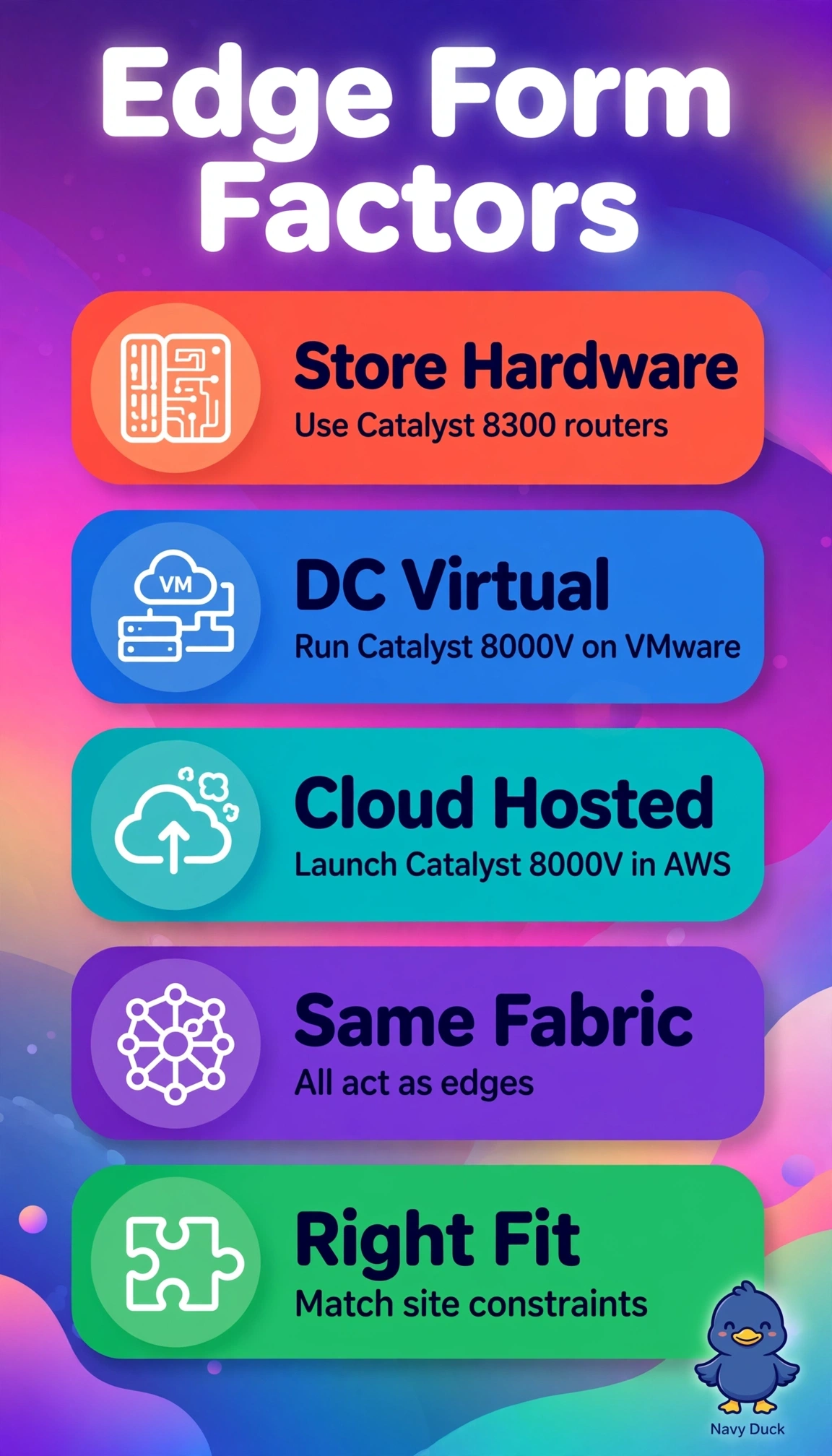
Stores, data centers, and clouds each want a different shape. Matching the Edge form to the home — hardware, virtual, cloud — keeps tunnels clean, with form-factor guiding your pick.
Full Explanation
Hardware Catalyst 8300 platforms suit physical stores with WAN ports and branch needs, virtual Catalyst 8000V suits VMware in the data center with hypervisor scaling, and Catalyst 8000V instances suit AWS with cloud networking and auto-scale constructs, so the mix aligns each Edge form-factor to its environment while all provide WAN Edge tunnel and policy functions. Controllers in stores fails by concept because SD-WAN Controller, formerly vSmart, is a control-plane element requiring data-center hosting, not a branch forwarding Edge. Physical Catalyst 8500 on VMware plus Manager in AWS fails by concept because a hardware platform cannot run as a VM and Manager, formerly vManage, is centralized management, not an AWS tunnel terminator. Validators in AWS fails by concept because Validator, formerly vBond, is orchestration, not a data-plane gateway for branch tunnels. Exam caveat is to classify Catalyst 8300 and 8500 as hardware (the older ASR 1000 is end-of-sale), and Catalyst 8000V as the virtual or cloud-hosted Edge, never mixing controllers or managers into Edge roles. Practical check is to confirm image type, cloud instance size, and tunnel bring-up per environment before cutover.