
A global enterprise with 300 sites needs a single pane for provisioning templates, software upgrades, certificate management, and historical performance graphs plus programmatic access for its NetOps tools. No data-plane forwarding can depend on this element. Which SD-WAN Manager capability satisfies the centralized management requirement?
Select an answer to reveal the explanation.
Short Explanation
You're picking the control tower, not the runway. Central management means you configure and watch everything from one dashboard without carrying traffic.
Full Explanation
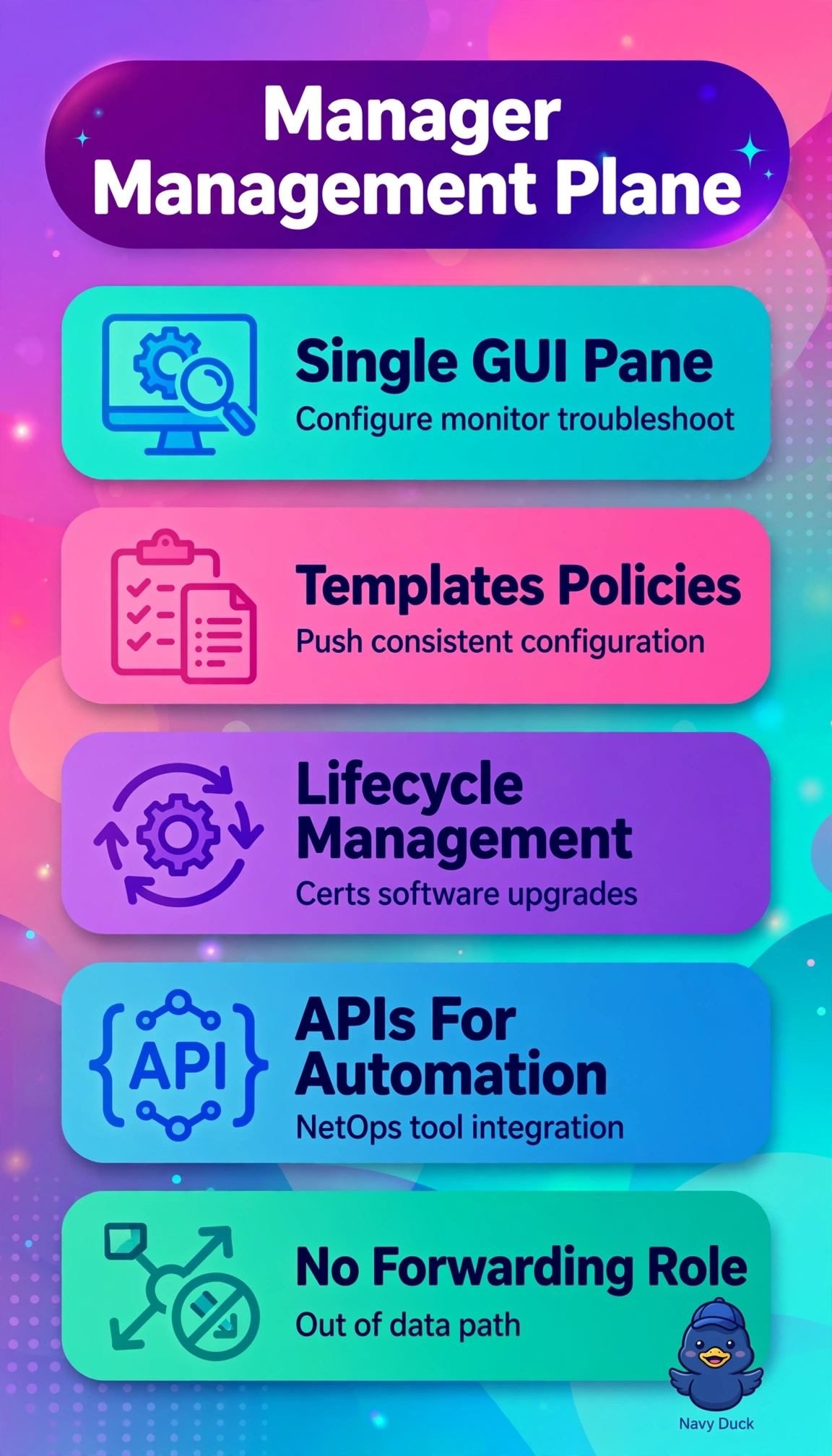
The correct capability describes the dedicated SD-WAN Manager in the management plane, which centralizes provisioning templates, orchestrated software upgrades, certificate lifecycle, fault and performance monitoring with retained historical graphs, and programmatic REST APIs while staying outside OMP and forwarding so its loss never impacts data-plane traffic. The controller-oriented distractor fails by concept because OMP peering, route exchange and policy distribution define the control-plane controller, introducing the exact control dependency the scenario forbids for survivability across 300 sites. The real-time telemetry distractor fails by concept because live graphs and streaming alerts provide present-state visibility only without retained history needed for baselining, SLA verification and capacity planning. The compliance-auditing distractor fails by concept because readiness reports and conformance checks validate intended state but lack orchestrated image repository management, staging, activation and rollback required for fleet upgrades. As an exam caveat, separate planes by function rather than marketing labels, since management centralizes intent and lifecycle, control distributes reachability, and edge forwards traffic, so any mixing of template and upgrade duties into OMP is misplaced. As a practical check, isolate the manager in lab, confirm tunnels still forward, then verify template push, scheduled upgrade, certificate renewal, a 30-day graph and a NetOps API query.