
A bank plans a weekend fabric upgrade from 20.9 to 20.12 across redundant Manager, Validator, Controllers, and 80 WAN Edges with no maintenance window for rollback failures. Compatibility and control-plane stability are mandatory. Which software upgrade sequence from SD-WAN Manager should the change plan enforce?
Select an answer to reveal the explanation.
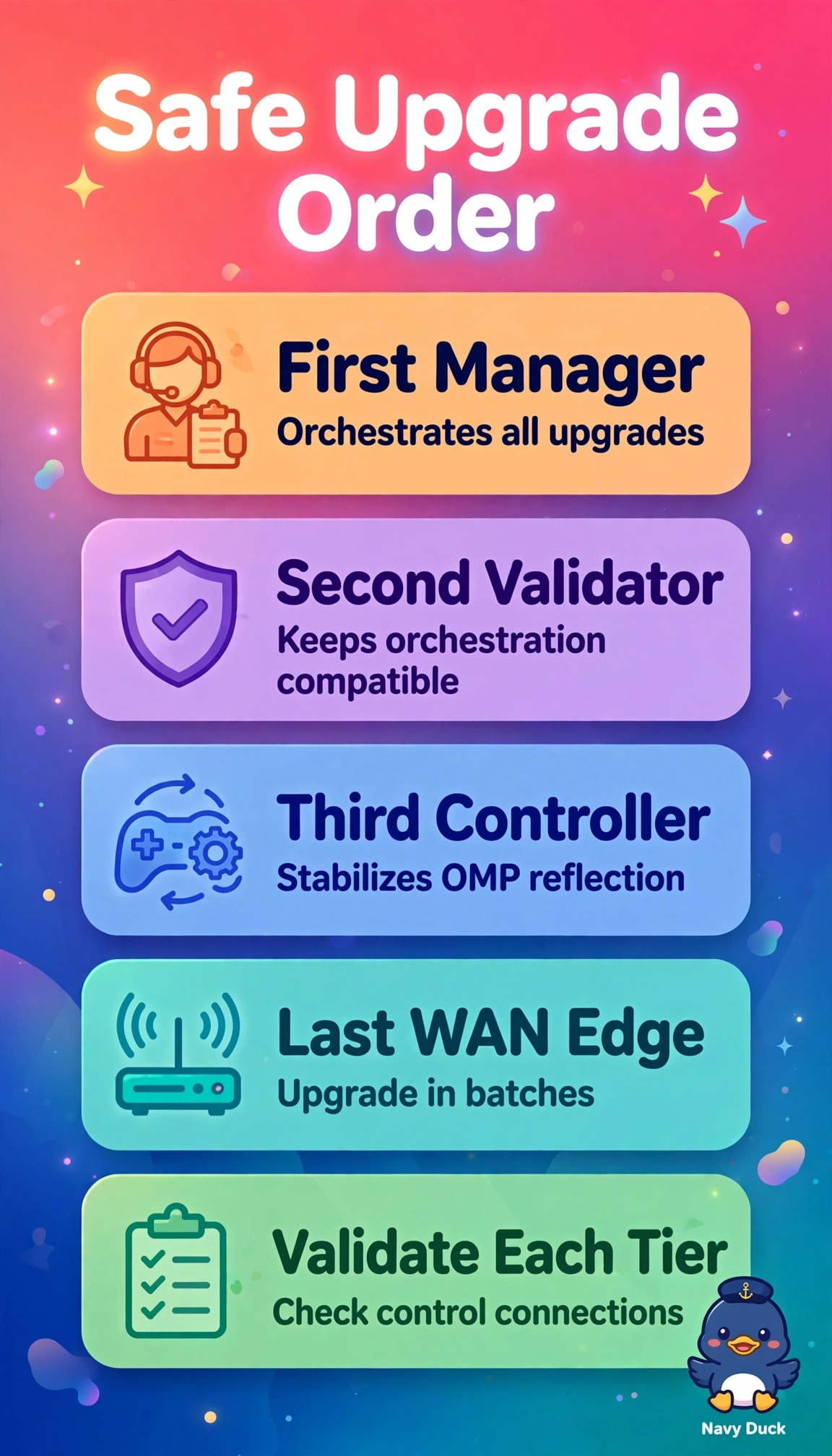
Short Explanation
You're protecting the control tower before the planes. Upgrading top-down keeps compatibility so older Edges stay managed. It's like updating air traffic software before new cockpit instruments.
Full Explanation
The safe upgrade hierarchy starts with SD-WAN Manager, formerly vManage, because it orchestrates image distribution and must understand newer schemas, followed by the SD-WAN Validator, formerly vBond, and SD-WAN Controller, formerly vSmart, so authentication and OMP reflection support both old and new Edge versions, with WAN Edge routers upgraded last in batches to minimize data-plane churn and allow validation between groups. Upgrading Edges first fails by compatibility because newer Edge code may use features or OMP capabilities the older Manager and Controllers cannot parse or manage, risking failed template pushes and control disconnects. Upgrading Controller before Manager fails by management order because the Manager must be at equal or higher version to stage, validate and activate controller images reliably across the fabric. Upgrading Validator first while leaving Controller last fails by control-plane stability because Controllers reflect OMP during Edge upgrades and must be ready before large Edge groups reboot, otherwise reconvergence and policy delivery suffer. Exam caveat: memorize Manager, Validator, Controller, Edge as the only supported Manager-driven sequence for major upgrades. Practical check: in Manager Software Maintenance verify each tier shows success and control connections are up before starting the next tier.