
A 30-site retailer wants cloud-delivered controllers to avoid managing Linux, hypervisors, and controller upgrades, but must retain control of policies, device configs, and WAN Edge routers. Which shared-responsibility split describes that cloud deployment?
Select an answer to reveal the explanation.
Short Explanation
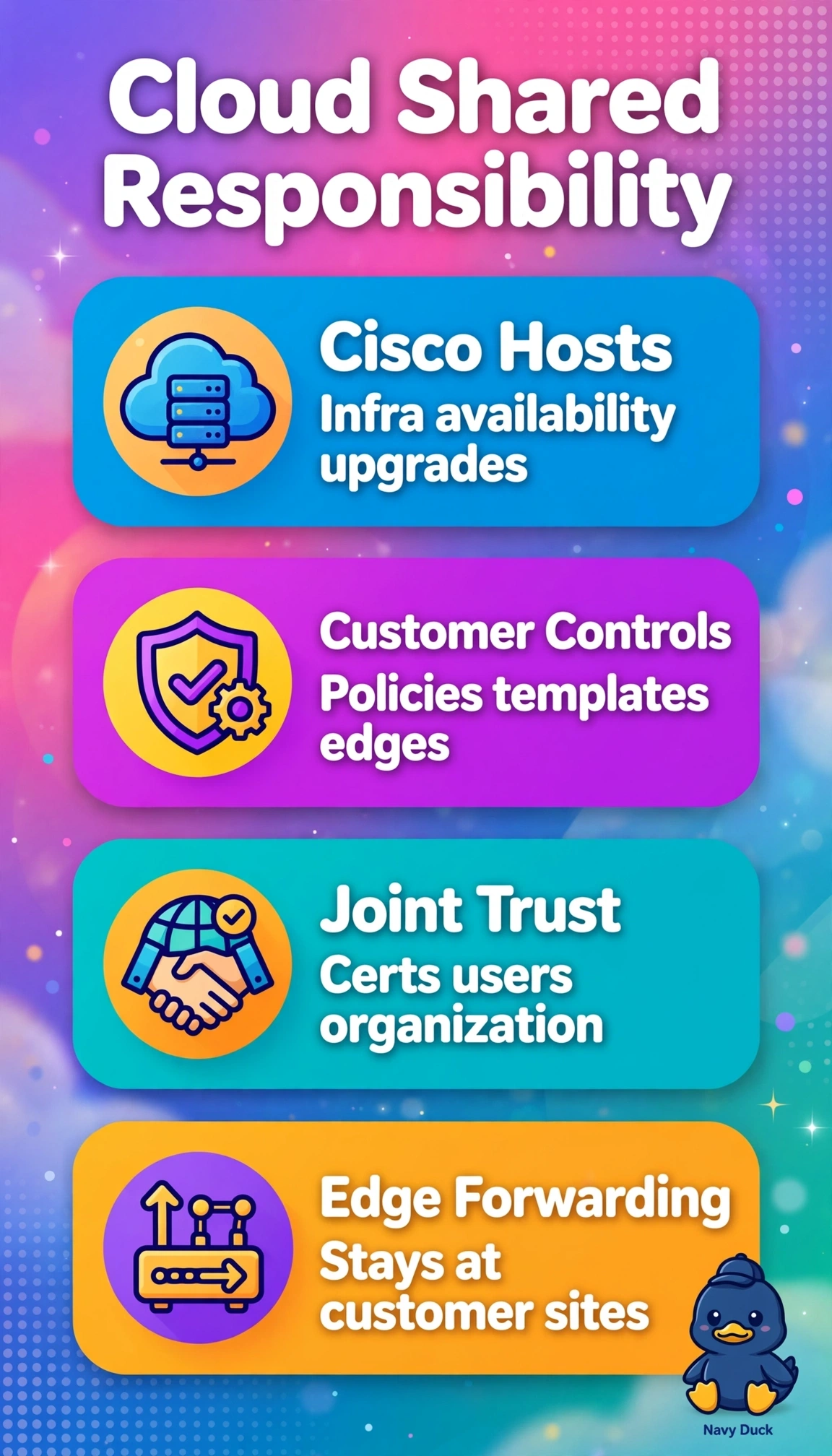
Cloud here means less plumbing for you! Cisco keeps the controller platform healthy while you stay in charge of policies and edges. You steer the fabric, they maintain the engine room.
Full Explanation
The correct split reflects Cisco-hosted cloud controllers where Cisco operates the underlying Linux, hypervisors, availability and controller software lifecycle as SaaS, while the retailer retains full administrative control of overlay policies, configuration templates, and its WAN Edge routers at 30 sites, which satisfies both the desire to avoid infrastructure operations and the requirement to keep policy ownership. The distractor describing customer-handled upgrades fails on cloud operations concept because it reintroduces the on-premises lifecycle burden that the stem explicitly seeks to offload, resembling IaaS or self-managed hosting rather than Cisco-hosted SaaS. The distractor describing centrally managed policies by Cisco fails on control-plane ownership because it describes a fully managed service where the provider authors policies, which violates the stated must-retain control of policies even though monitoring and hosting by Cisco are normal in managed offers. The distractor describing provider-managed edge routers fails on device ownership because provider-managed CPE transfers configuration and lifecycle of the WAN Edge to the provider, contradicting the requirement that the retailer keeps device configs and routers even though that model is common for lean IT. As an exam caveat, distinguish who hosts the controllers from who administers policies, since hosting location does not automatically determine policy authorship across on-premises, Cisco-hosted cloud, and partner-managed variants. As a practical check, confirm the operating model in contract and SD-WAN Manager RBAC by verifying Cisco owns controller upgrades and infrastructure health while customer accounts hold rights to create policies, attach templates, and manage edge certificates and software.