
A school district with one hub and 25 spokes needs spokes to reach each other only through the hub for inspection, while the hub reaches all spokes directly. Spokes currently learn each other's TLOCs and form direct tunnels. Which control policy construction creates the hub-and-spoke topology requirement?
Select an answer to reveal the explanation.
Short Explanation
You're forcing all side streets through Main Street for a checkpoint. Clever TLOC rewriting keeps the hub in the middle without breaking routing.
Full Explanation
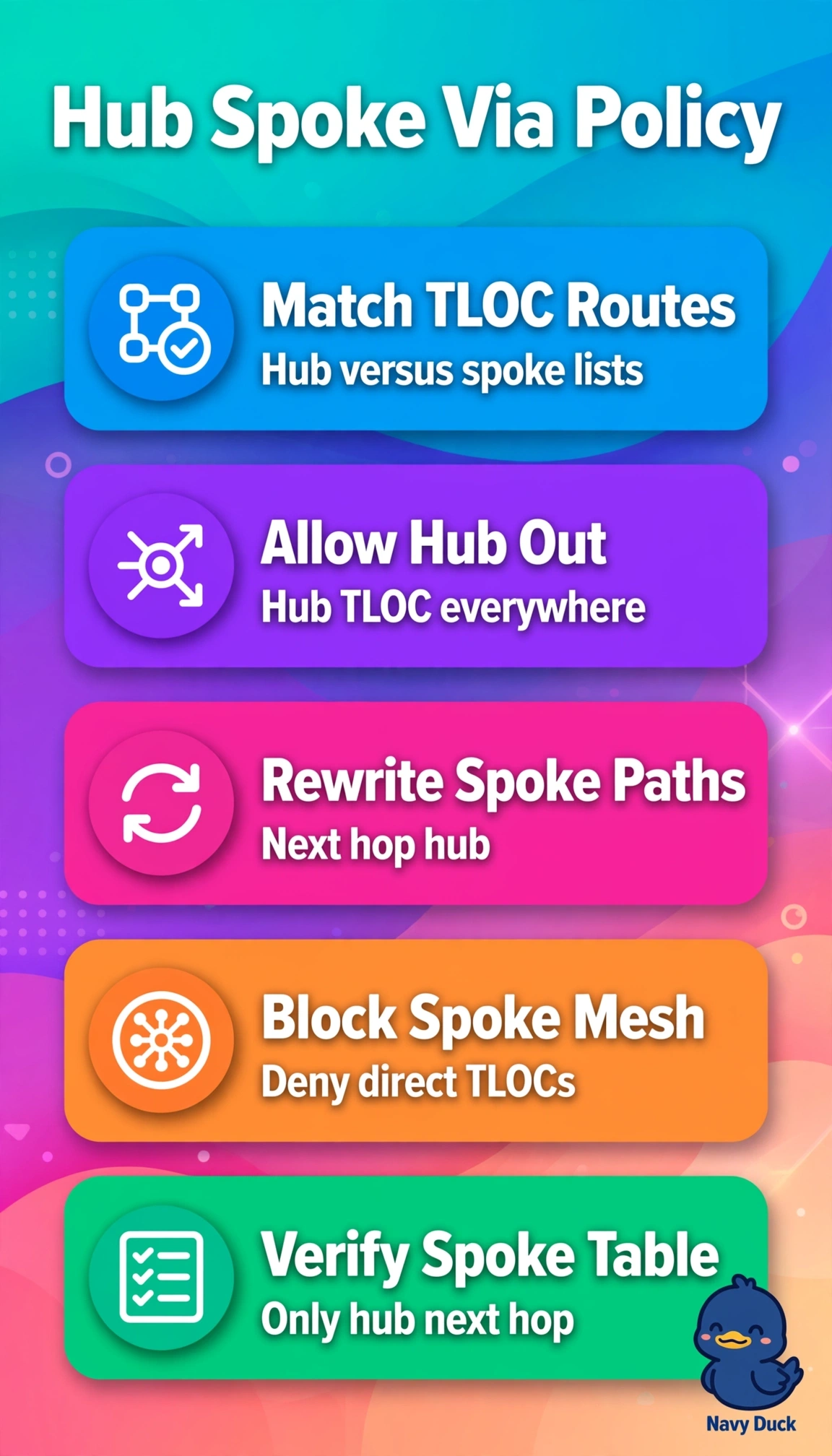
Hub-and-spoke via control policy is built on the SD-WAN Controller (formerly vSmart) by matching TLOC routes and allowing hub TLOC advertisement to all while denying or rewriting spoke-to-spoke TLOCs so spokes install only the hub as next hop, which preserves spoke-to-hub reachability but forces inter-spoke traffic through the hub for inspection. Permitting all TLOCs bidirectionally fails by concept because that explicitly preserves full-mesh tunnel establishment and defeats the inspection requirement even if routes are visible. Using app-aware routing on spokes fails by concept because it steers forwarding among already learned paths based on SLA, but does not hide spoke TLOC advertisements that create direct tunnels. Using localized data policy on the hub without TLOC changes fails by concept because data policy controls forwarding actions locally and cannot suppress OMP TLOC learning between spokes. For the exam remember topology equals TLOC control on the controller, and in practice verify with OMP TLOCs received on a spoke that only hub TLOCs appear.