
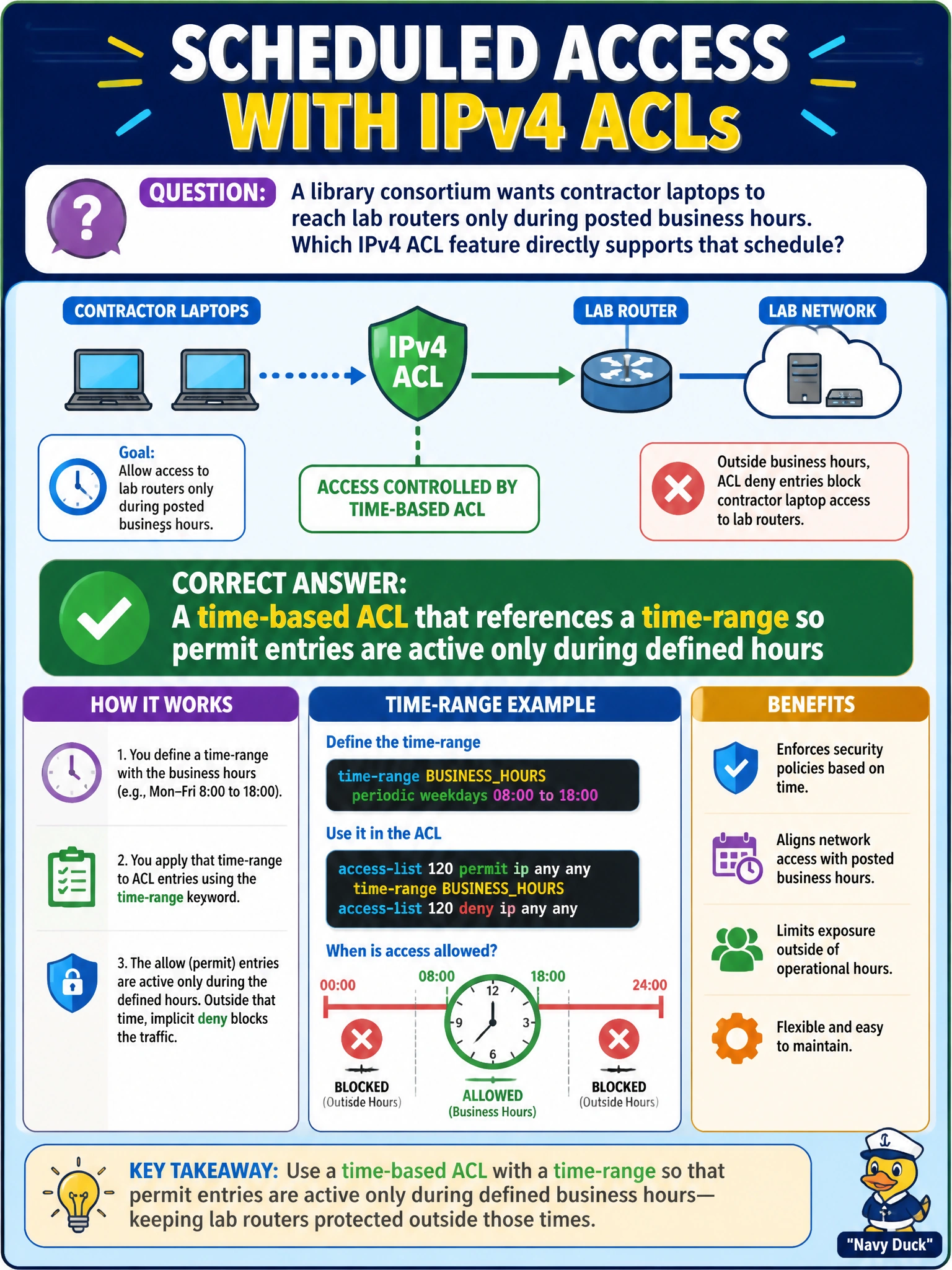
A library consortium wants contractor laptops to reach lab routers only during posted business hours. Which IPv4 ACL feature directly supports that schedule?
Select an answer to reveal the explanation.
Short Explanation
Think of a library door that unlocks on a timer. Time-based ACLs hang a schedule on the permit so contractors only get in during business hours.
Full Explanation
A library consortium that wants contractor laptops to reach lab routers only during posted business hours needs a time-based ACL that references a time-range so permit entries are active only during defined hours. That feature directly attaches a schedule to ACE evaluation: outside the range, the time-qualified permits do not match, and traffic falls through to later entries or the implicit deny. The correct approach works because the requirement is calendar/clock-driven access, not merely static address matching. Prefix-list sequence numbers alone fail because prefix-lists select prefixes for routing policy and do not schedule TCP sessions by wall clock. BGP conditional advertisement fails conceptually as a replacement for timed ACL entries on VTY or data-plane filters—it controls when prefixes are advertised, not when contractor packets are permitted to lab routers. IP SLA udp-jitter probes that supposedly rewrite ACL source wildcards hourly fail because IP SLA measures performance; it does not automatically rewrite ACL wildcards on a schedule. Exam caveat: router clock/NTP accuracy matters—wrong time makes time-based ACLs open or close at the wrong civic hours. Operational check: define a time-range for business hours, reference it on the contractor permit ACEs, verify show time-range status, and test access both inside and outside the window while watching ACL hit counters on the time-qualified entries.