
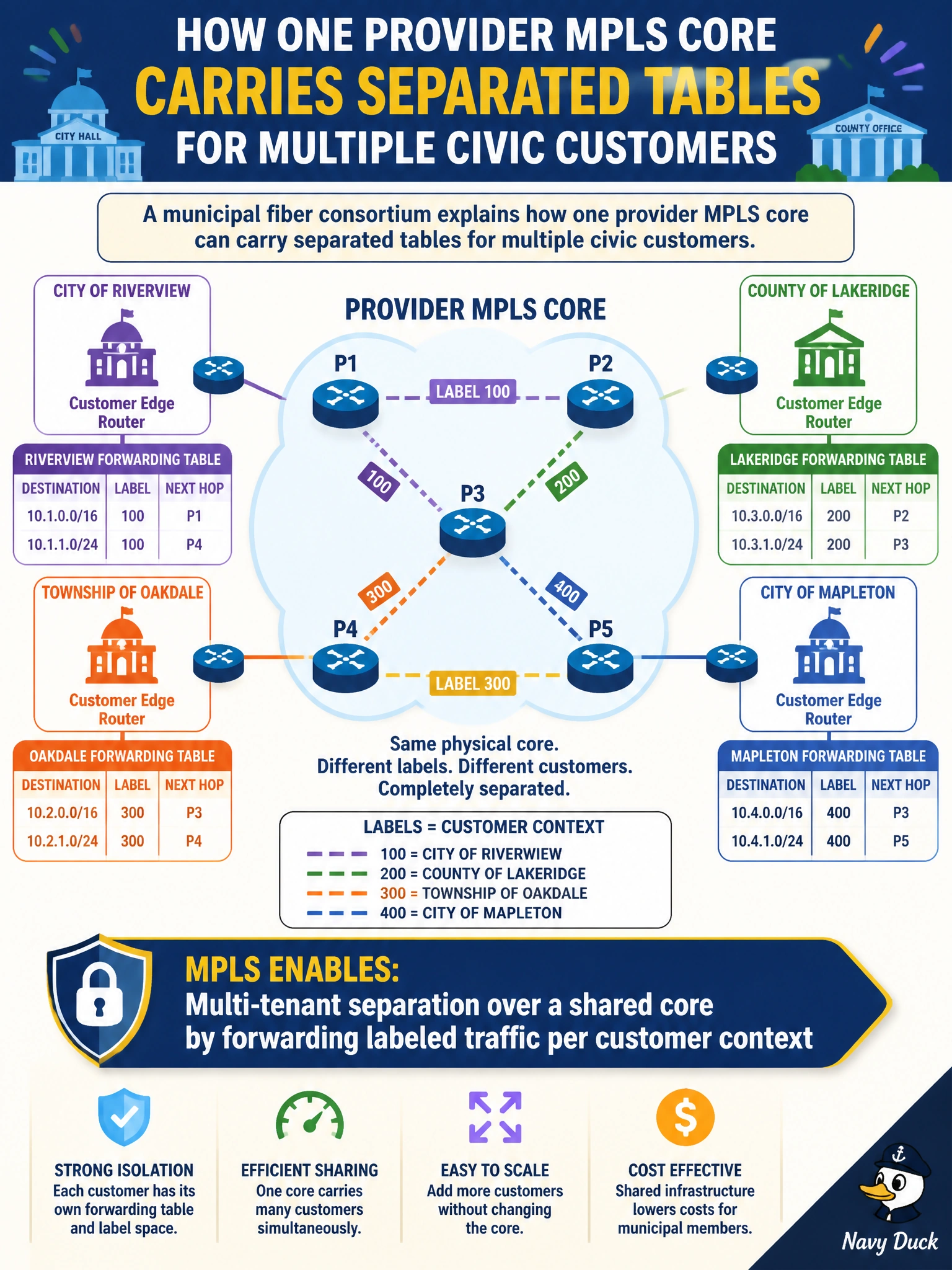
A municipal fiber consortium explains how one provider MPLS core can carry separated tables for multiple civic customers. What capability is MPLS enabling at that describe level?
Select an answer to reveal the explanation.
Short Explanation
You can think of one provider core carrying separate customer routes without building a unique physical network for each agency. MPLS forwards labeled traffic in each customer’s context, keeping their routing tables separate.
Full Explanation
A municipal fiber consortium describing one provider MPLS core carrying separated tables for multiple civic customers is describing multi-tenant separation over a shared labeled core. MPLS forwards traffic in per-customer contexts, using VRFs on provider-edge routers, VPN labels, and MP-BGP, so each agency does not need a unique physical network. Provider core routers switch transport labels without merging customer routing tables; this is the describe-level capability of MPLS L3VPN multi-tenancy. Requiring IPsec for every labeled packet while sharing one global routing table is incorrect: MPLS does not mandate IPsec, and a global table contradicts customer separation. Replacing provider-edge routers with customer routers and running LDP directly between sites over the public Internet is not how managed MPLS VPN service works; customer-edge routers do not create the provider LSP this way. Automatic OSPF-to-EIGRP conversion when customers share a provider core router is also incorrect: no such protocol mutation occurs, and customer IGPs remain isolated in provider-edge VRFs. Exam caveat: separation is logical through VRFs, RDs, RTs, and VPN labels, not encryption; overlapping RFC1918 addresses are normal. Do not confuse MPLS multi-tenancy with DMVPN overlays or CoPP as an isolation mechanism. Practical check: verify that provider-edge routers hold distinct VRFs with overlapping prefixes, VPNv4 routes have distinct RDs, provider core routers lack those VRF tables, and one agency’s customer-edge router cannot resolve another’s routes without intentional route leaking.