
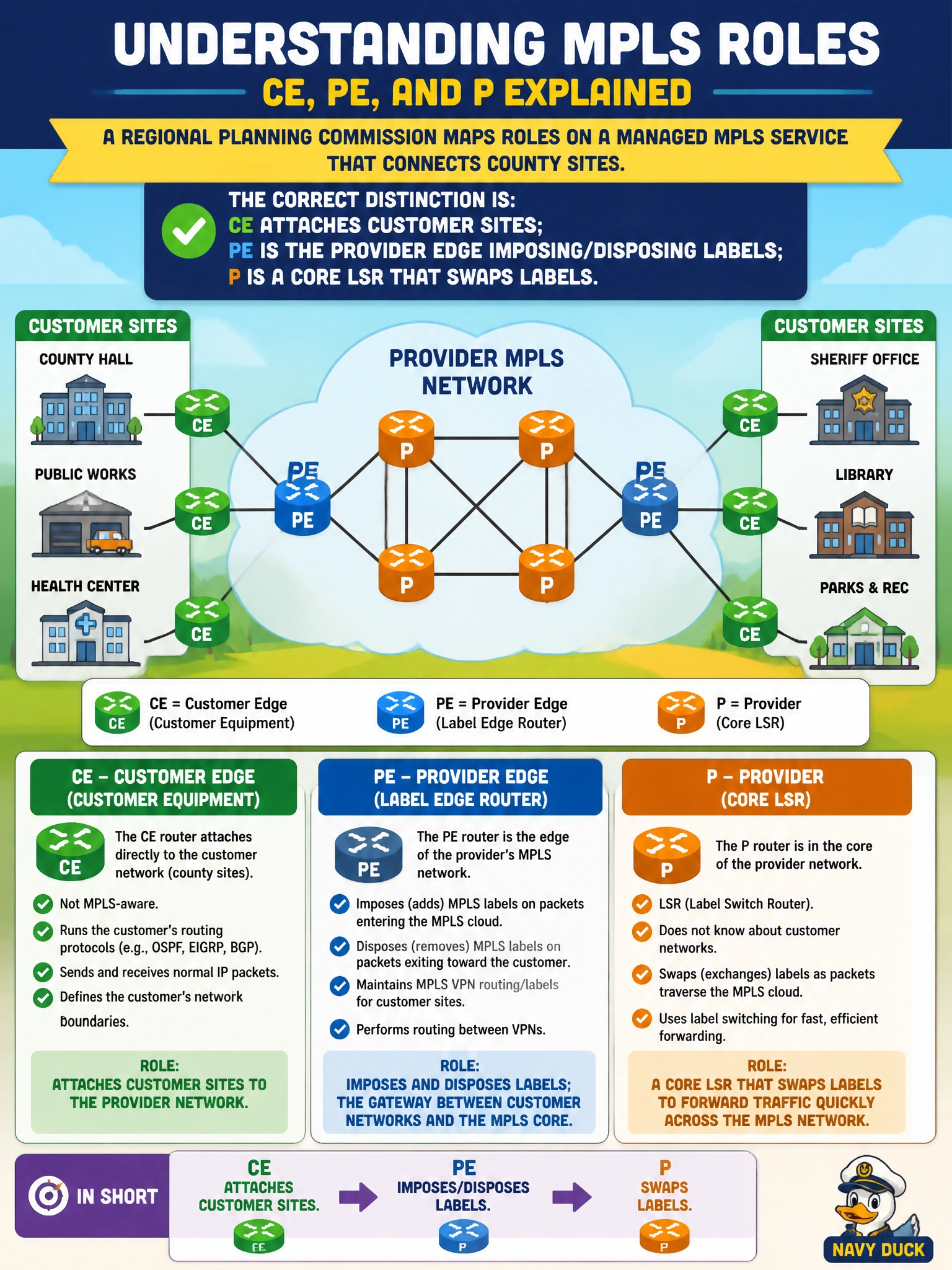
A regional planning commission maps roles on a managed MPLS service that connects county sites. Which distinction is correct at describe depth?
Select an answer to reveal the explanation.
Short Explanation
Easy roster: CE is the customer's gear, PE is the provider's edge door (labels on/off), P is the core switchboard that mostly swaps labels and stays out of the customer's VRF business.
Full Explanation
A regional planning commission mapping roles on a managed MPLS service should use the standard CE/PE/P distinction. The customer edge (CE) attaches county sites and peers with the provider on the attachment circuit using IP routing (static/OSPF/BGP/EIGRP as designed). The provider edge (PE) sits at the MPLS domain boundary: it imposes and disposes labels, hosts VRFs for L3VPN, and participates in MP-BGP for VPN routes. Provider (P) routers are core LSRs that primarily swap transport labels and do not terminate customer VRFs. That roster matches describe-depth ENARSI terminology.
P routers terminating all customer VRFs while CE routers run LDP across the provider core reverses roles. VRFs terminate on PEs; CEs do not run LDP across the provider core in the usual managed L3VPN model.
PE devices never participating in MPLS, with only CEs and P routers forming the LSP, is incorrect. PEs are essential MPLS edge LSRs for imposition/disposition and VPN services.
CE and P being interchangeable names for any router that peers eBGP with the ISP erases the model. CE is customer-side; P is provider core; eBGP to an ISP is a different attachment pattern than core P roles.
Exam caveat: in VRF-Lite there may be no P/MPLS core at all—do not force P roles onto a Lite design. In carrier hierarchies, PE may face CE while P remains hidden; still keep CE≠PE≠P mentally.
Operational check: inventory devices by where VRF interfaces and MP-BGP VPNv4 sessions exist (PE), where only LDP/IGP label swap appears (P), and where only PE-CE routing appears without provider LDP (CE). Mislabeling a PE as P often leads to wrong expectations about VRF visibility.