
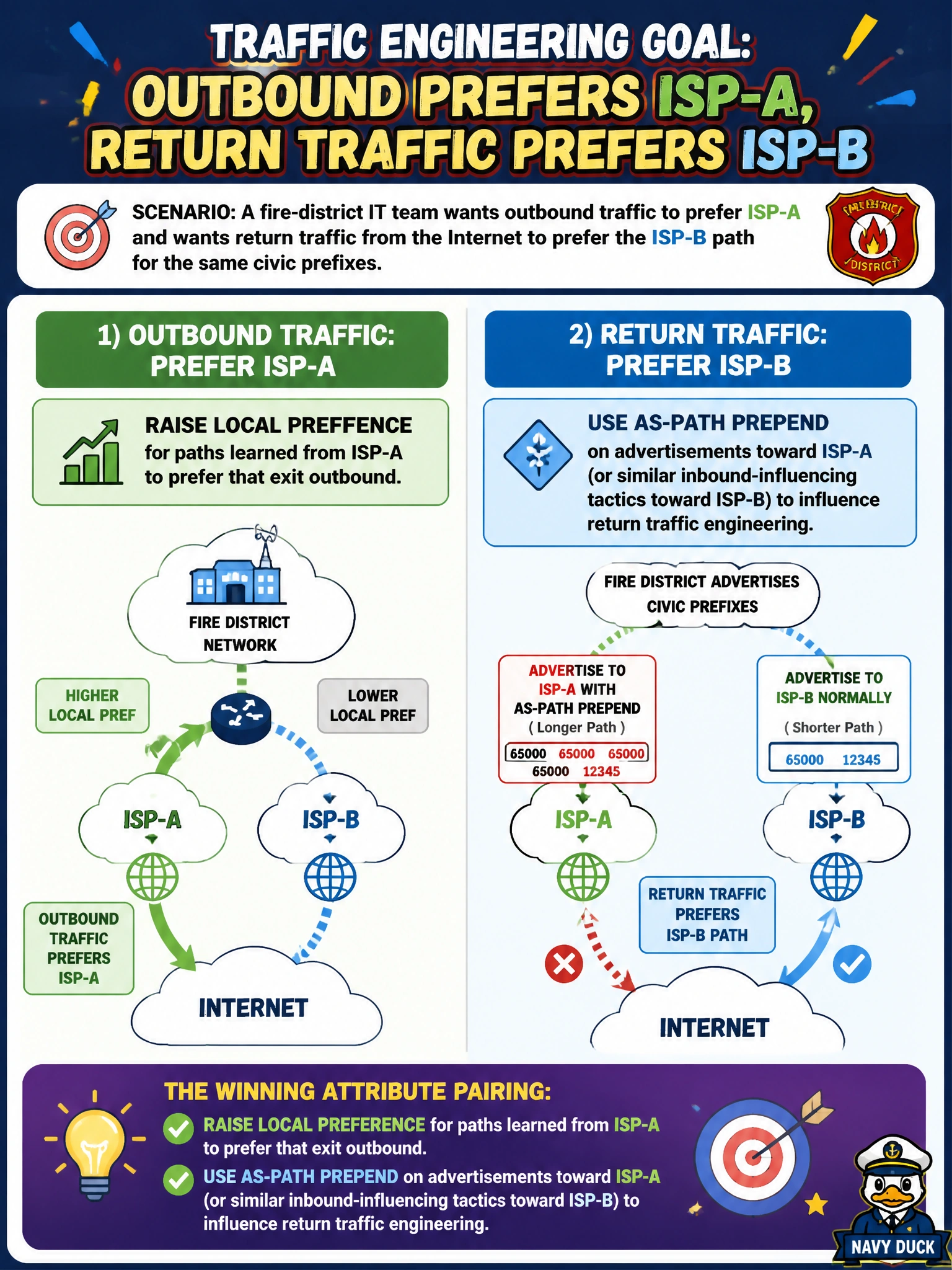
A fire-district IT team wants outbound traffic to prefer ISP-A and wants return traffic from the Internet to prefer the ISP-B path for the same civic prefixes. Which attribute pairing matches those goals?
Select an answer to reveal the explanation.
Short Explanation
Local preference is your inside vote for which ISP exit to use leaving the fire district. AS-path prepend is a longer "scenic route" advertisement that nudges outsiders how they come back—two different levers for two directions.
Full Explanation
A fire-district IT team that wants outbound traffic to prefer ISP-A while wanting Internet return traffic to prefer ISP-B for the same civic prefixes must use different tools for each direction. Raising local preference for paths learned from ISP-A influences the fire district’s outbound exit choice because local preference is evaluated early inside the AS. Influencing return traffic requires changing how the prefixes look to the outside—commonly AS-path prepend on advertisements toward ISP-A (making ISP-A’s path less attractive inbound) and/or preferential advertisements toward ISP-B—so remote ASes prefer ISP-B to reach the civic prefixes. That pairing matches outbound versus inbound traffic-engineering goals. MED alone setting both outbound exit choice and inbound return preference identically in every AS overstates MED: MED is optional, often compared only within the same neighboring AS, and does not replace local preference for outbound exit selection inside the fire district. Weight on ISP-B plus Origin incomplete on ISP-A forcing identical inbound and outbound results mixes a local-only Weight (outbound on that router) with Origin and does not reliably engineer return paths. Claiming AS-path prepend toward ISP-A and local preference toward ISP-B always swap both directions the same way confuses which attribute affects which direction. Exam caveat: local preference = inside outbound preference; AS-path prepend / MED / communities = common inbound-influencing tactics; neither attribute alone controls both directions universally. Operational check: set higher local pref for ISP-A-learned paths and confirm outbound exit with traceroute/show ip bgp; apply prepend toward ISP-A (or preferential ads toward ISP-B); validate external preference via looking glasses or ISP feedback for return path.