
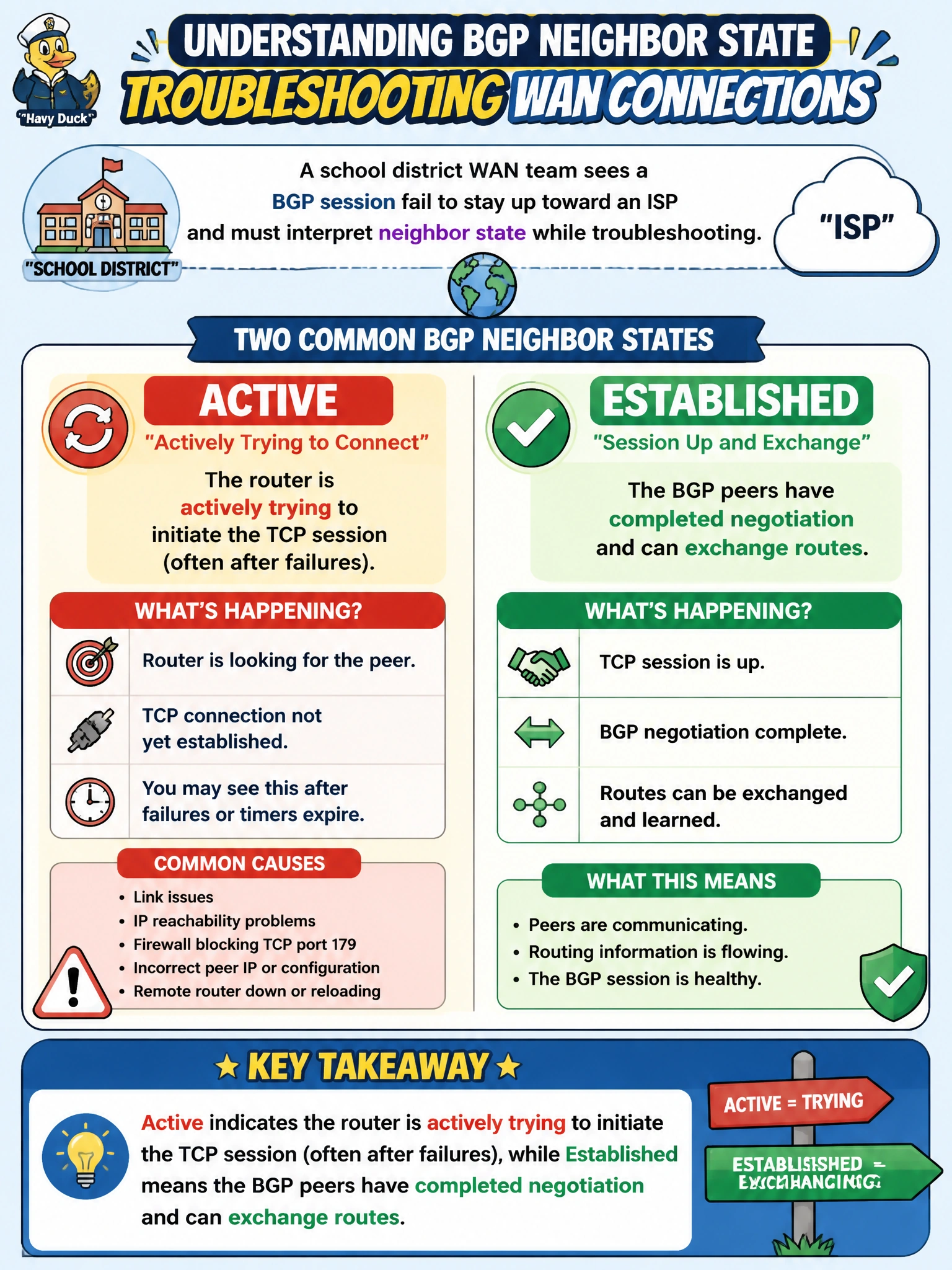
A school district WAN team sees a BGP session fail to stay up toward an ISP and must interpret neighbor state while troubleshooting. Which statement best matches common state meaning?
Select an answer to reveal the explanation.
Short Explanation
BGP states are a story arc: Idle/Active mean "still hunting for a working TCP/BGP handshake," and Established is "we are friends and can trade routes." If you are stuck Active, chase reachability, ACL, or auth problems.
Full Explanation
School-district engineers interpreting BGP neighbor state toward an ISP must map states to session progress. Active indicates the router is actively trying to initiate the TCP session—often after failures or when the peer is unreachable—while Established means the BGP peers have completed OPEN negotiation and can exchange routes. That contrast is the practical troubleshooting meaning tested here and why the correct statement matches common state interpretation. Idle always meaning prefixes are fully installed is false; Idle means BGP is not running a successful session for that peer (administratively down or waiting to retry), not that the RIB is complete. Established meaning TCP is down and OPENs never sent reverses Established’s meaning entirely. OpenConfirm being the final state where only OSPF hellos are exchanged confuses BGP FSM states with OSPF and invents a terminal OpenConfirm role that Established actually holds for route exchange. Exam caveat: also recognize Connect versus Active nuances, OpenSent/OpenConfirm during negotiation, and that stuck Active usually points to reachability, ACL/TCP 179, TTL/multihop, or misconfigured neighbor IP. Operational check: show ip bgp summary and show ip bgp neighbors; if Active, verify routing to peer IP, filters on TCP/179, update-source, and multihop; only after Established validate prefix exchange.