
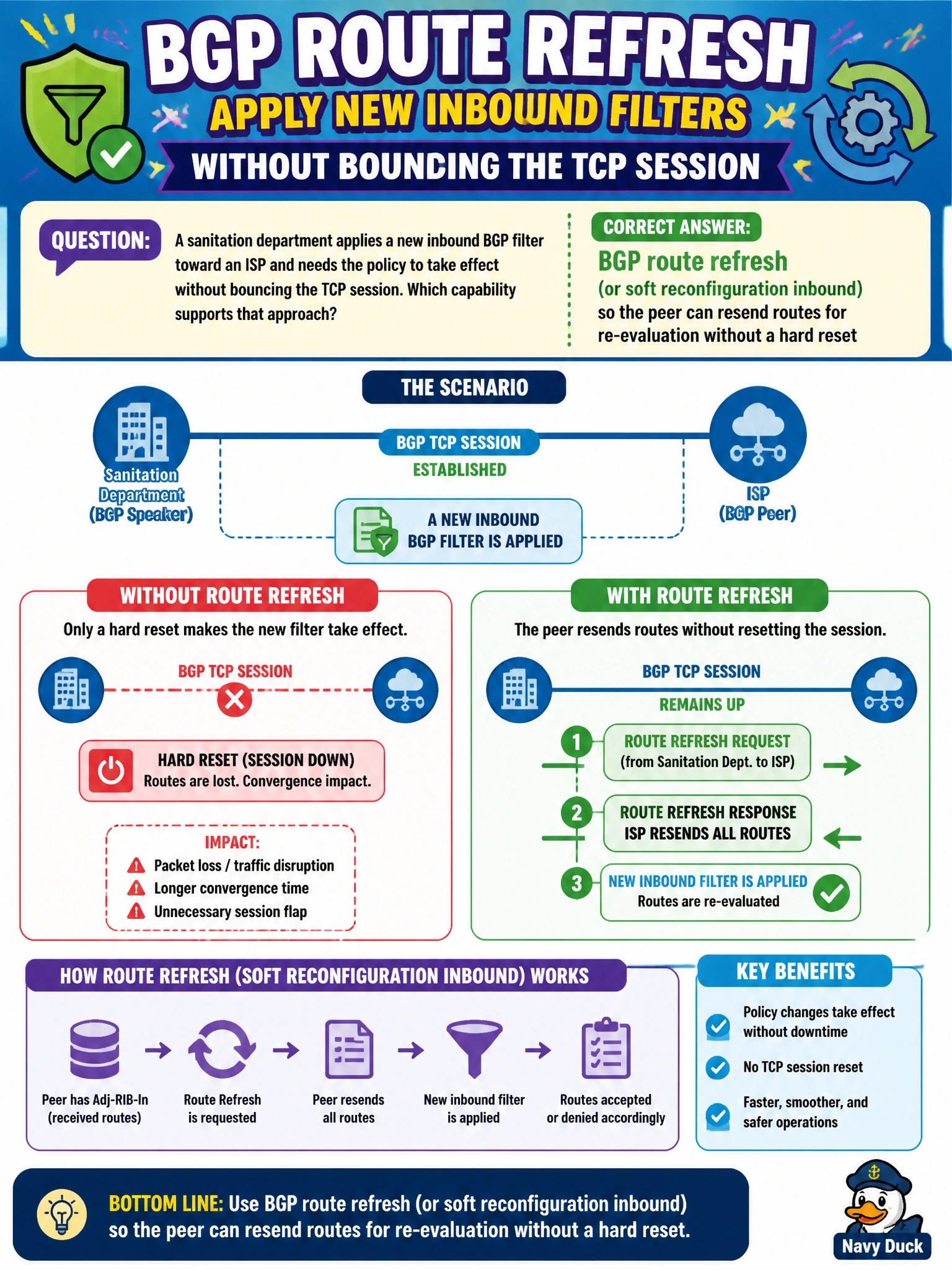
A sanitation department applies a new inbound BGP filter toward an ISP and needs the policy to take effect without bouncing the TCP session. Which capability supports that approach?
Select an answer to reveal the explanation.
Short Explanation
Route refresh is the polite do-over: you ask the ISP to resend routes so your new inbound filter can check them again. No hard-reset drama on the sanitation edge; soft reconfiguration inbound is the related approach that keeps a pre-policy copy.
Full Explanation
When you apply a new inbound BGP filter toward an ISP and need it to take effect without bouncing the TCP session, BGP route refresh (or soft reconfiguration inbound) supports re-processing. Route refresh asks the peer to resend NLRI so your new inbound policy can evaluate routes again without a hard reset. Soft reconfiguration inbound stores a pre-policy copy so your router can rerun the filter locally. Either capability avoids session teardown while applying the new inbound filter. Clearing the OSPF process on the ISP handoff interface does not refresh BGP policy and may unnecessarily disrupt the IGP underlay. Permanently lowering the BGP keepalive timer to one second does not re-evaluate inbound filters and adds churn risk. Changing the BGP router ID to force only outbound updates is disruptive, unrelated to inbound filter reapplication, and can reset sessions rather than softly refresh them. Exam caveat: prefer route refresh when the capability is negotiated; soft-reconfiguration inbound consumes memory; a hard clear such as clear ip bgp * is the blunt tool ENARSI wants you to avoid for routine policy changes. Practical check: confirm route-refresh capability in show ip bgp neighbors, apply the new prefix-list or route-map, issue a soft inbound refresh, then verify accepted prefixes with show ip bgp and confirm the TCP session remained Established.