
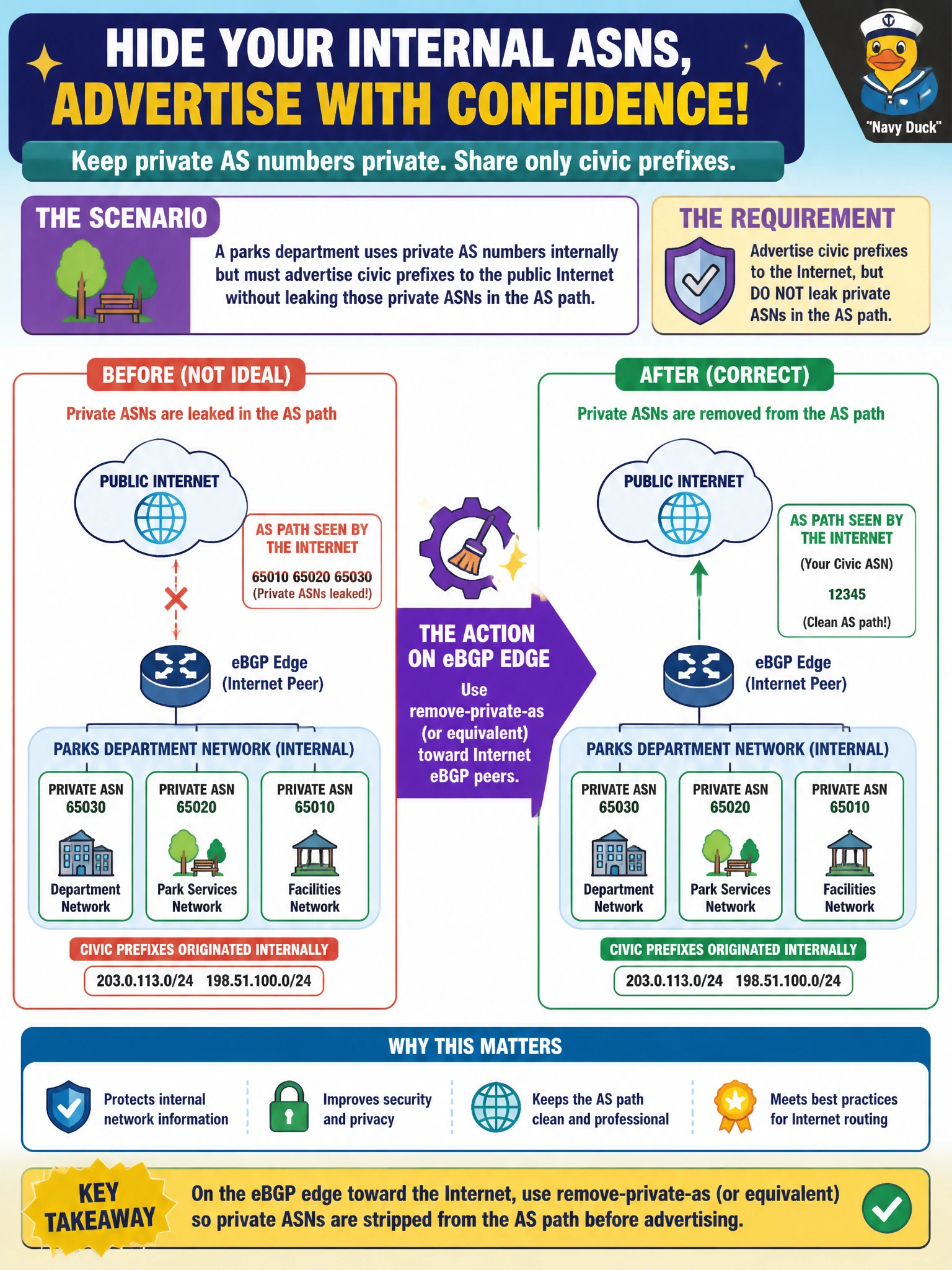
A parks department uses private AS numbers internally but must advertise civic prefixes to the public Internet without leaking those private ASNs in the AS path. Which action addresses that requirement on the eBGP edge?
Select an answer to reveal the explanation.
Short Explanation
Your private ASNs can stay inside the parks WAN, while civic prefixes are advertised publicly without exposing them in the AS path. Remove-private-as strips those private hops at the eBGP edge before the routes go to Internet peers.
Full Explanation
The parks department can keep private AS numbers in its internal design while advertising civic prefixes publicly by using remove-private-as on the eBGP edge toward Internet peers. This action strips private ASNs from the outbound AS path, so global BGP does not see RFC 6996 private ASNs in the path while the civic prefixes can still be advertised. Setting local preference to 0 on all Internet advertisements does not remove ASNs from the path; local preference is not sent to eBGP peers in the way needed for this cleanup. Configuring a full iBGP mesh does not translate public ASNs into private ranges: a mesh provides internal route exchange, not AS-path rewriting for external advertisements. Enabling OSPF totally stubby mode affects OSPF route handling, not BGP AS paths, so it cannot prevent private ASNs from leaking to the Internet. Exam caveat: apply remove-private-as toward the relevant eBGP peers, and ensure private ASNs do not appear in routes advertised to the global table. Practical check: inspect the BGP advertised routes toward the ISP before and after enabling the feature; confirm the private ASNs are absent from the AS path and the civic prefixes are still advertised.