
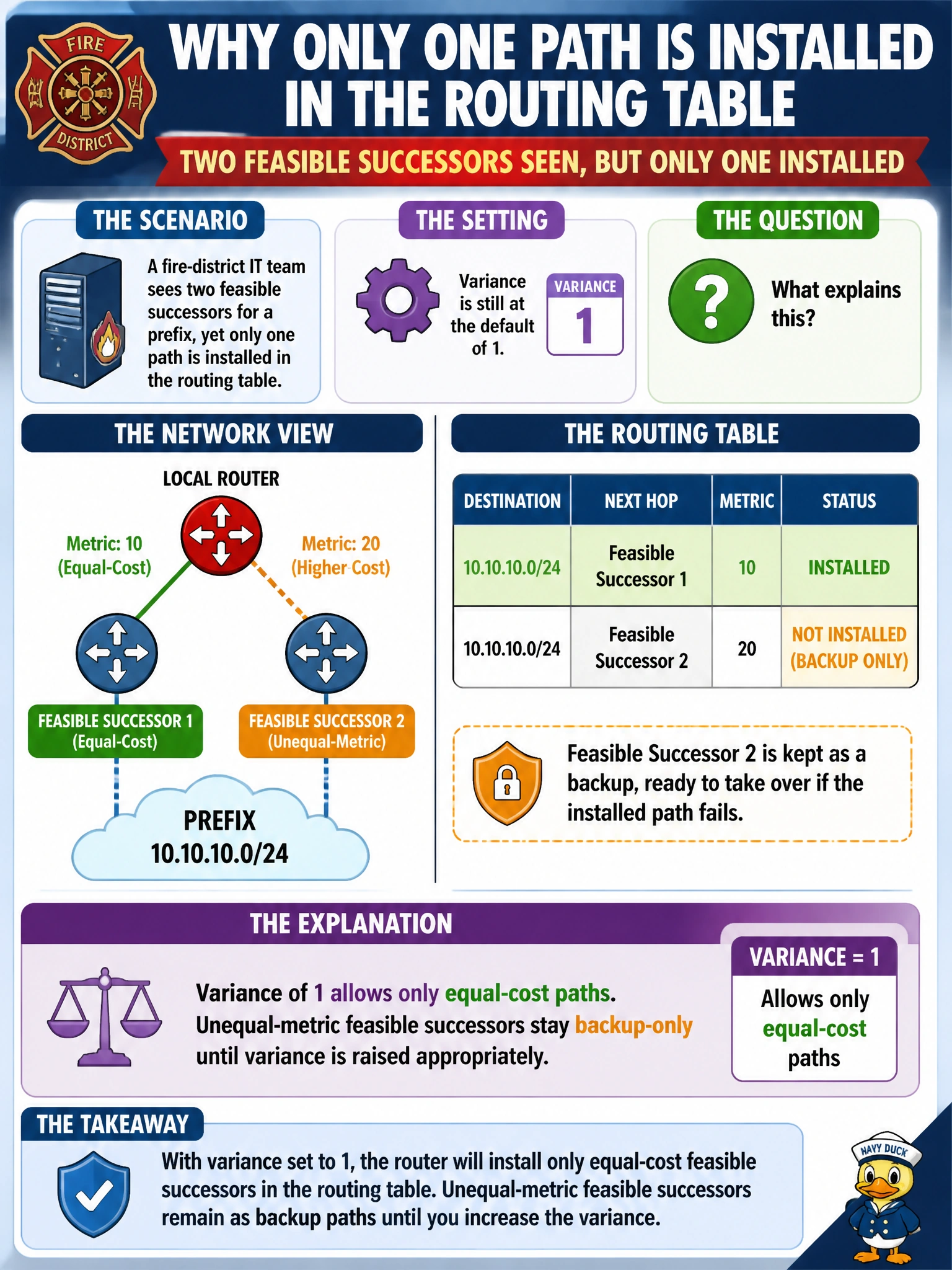
A fire-district IT team sees two feasible successors for a prefix, yet only one path is installed in the routing table. Variance is still at the default of 1. What explains this?
Select an answer to reveal the explanation.
Short Explanation
Variance 1 means "ties only." Those other feasible successors can save you in a failure, but they will not share traffic while their metrics are worse. Crank variance with care if the fire district truly wants unequal-cost sharing.
Full Explanation
With variance at the default of 1, EIGRP installs only paths whose metrics equal the successor metric (equal-cost multipath). Feasible successors with worse metrics remain in the topology table for fast failover but are not used for forwarding until variance is raised enough that those FS metrics fall within variance × successor metric. A fire-district team seeing two FS entries yet one RIB path is therefore expected behavior at variance 1—not a broken FS installation.
Claiming feasible successors are never eligible for load balancing under any variance fails by concept: raising variance is exactly how unequal-metric FS paths can share traffic. Claiming default variance installs every FS regardless of metric ratio fails—the default is restrictive (1). Claiming only OSPF can install multiple paths and EIGRP always keeps a single RIB entry fails; EIGRP supports ECMP and, with variance, unequal-cost multipath.
Exam caveat: an FS at variance 1 is still valuable for convergence; absence from the RIB does not mean absence of backup. Operational check: show topology versus RIB for the fire-district prefix, confirm FS metrics versus successor, decide whether unequal-cost sharing is desired, set variance deliberately if so, and re-check RIB next hops and forwarding.