
A housing authority has two identical MetroE links into city hall running EIGRP with matching metrics. What behavior provides equal-cost multipath?
Select an answer to reveal the explanation.
Short Explanation
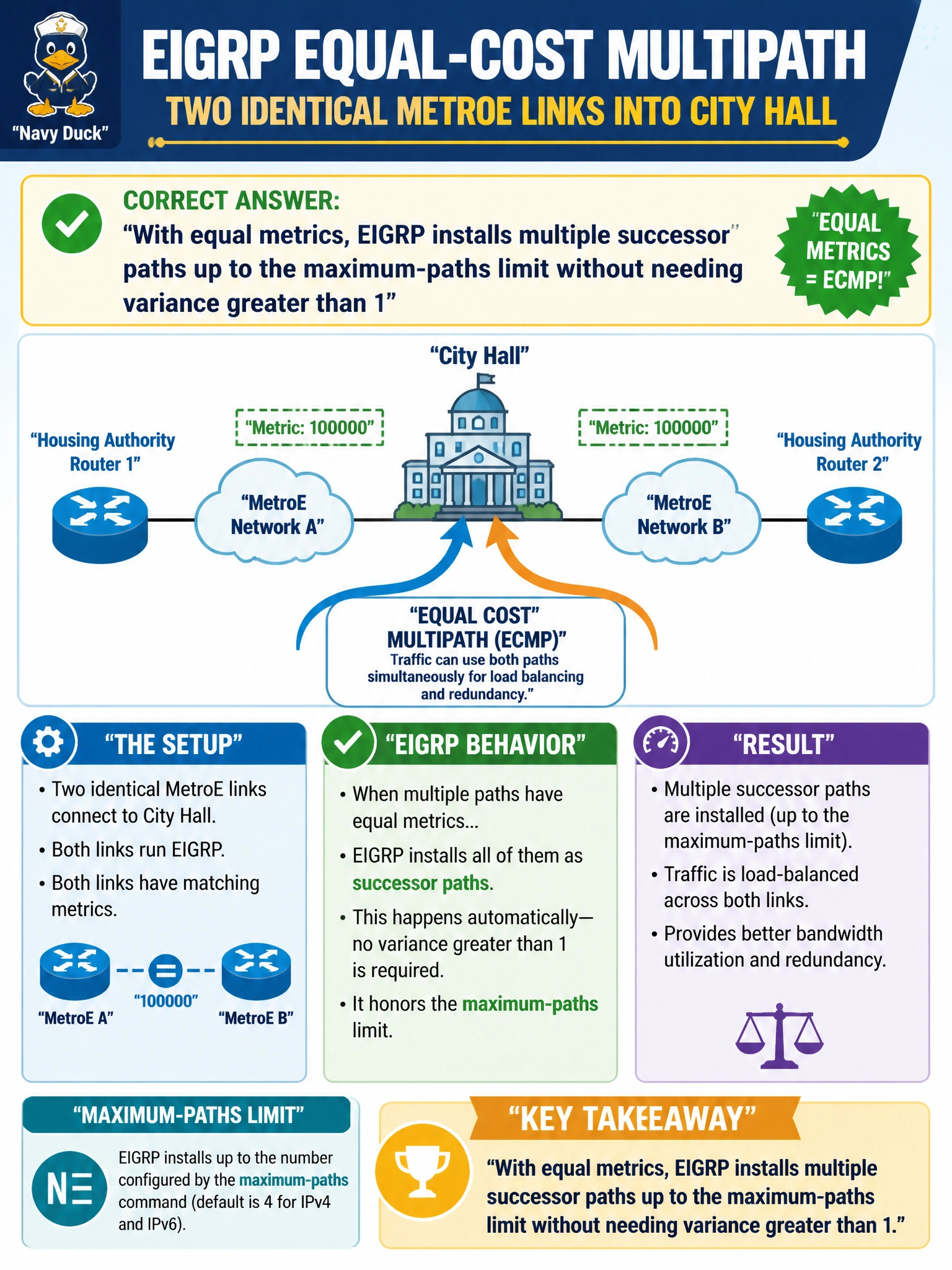
Same speed, same delay, same metric—EIGRP treats both MetroE pipes as co-successors and load-shares them. Variance is for unequal costs; when the numbers already match, you are in classic equal-cost multipath territory.
Full Explanation
When two identical MetroE links into city hall have matching EIGRP metrics, EIGRP treats them as equal-cost successors and can install multiple paths up to the maximum-paths limit without requiring variance greater than 1. Variance is the unequal-cost knob; equal metrics already satisfy equal-cost multipath (ECMP). A housing-authority dual-homed design with symmetric circuits therefore load-shares across both links once neighbors are up and metrics match, subject to platform maximum-paths.
Claiming variance must be above 1 or EIGRP never installs more than one equal-cost path fails by concept: variance > 1 is for unequal metrics; ECMP works at variance 1. Converting both links to OSPF broadcast and electing a DR is an unrelated protocol change and not required for EIGRP ECMP. Claiming only the lowest interface number can forward until unequal-cost variance is configured invents a false single-path rule for equal metrics.
Exam caveat: “identical” means the composite metrics match—not merely that both are MetroE; bandwidth/delay mismatches still produce unequal metrics and then need variance or metric tuning. Operational check at city hall: verify both neighbors are up, compare EIGRP metrics for the housing prefixes on each MetroE path, confirm multiple equal-cost entries in the RIB within maximum-paths, and spot-check forwarding share under load.