
An airport authority has two circuits toward a landfill site with unequal EIGRP metrics and wants both paths to carry traffic. Which feature enables that unequal-cost load balancing?
Select an answer to reveal the explanation.
Short Explanation
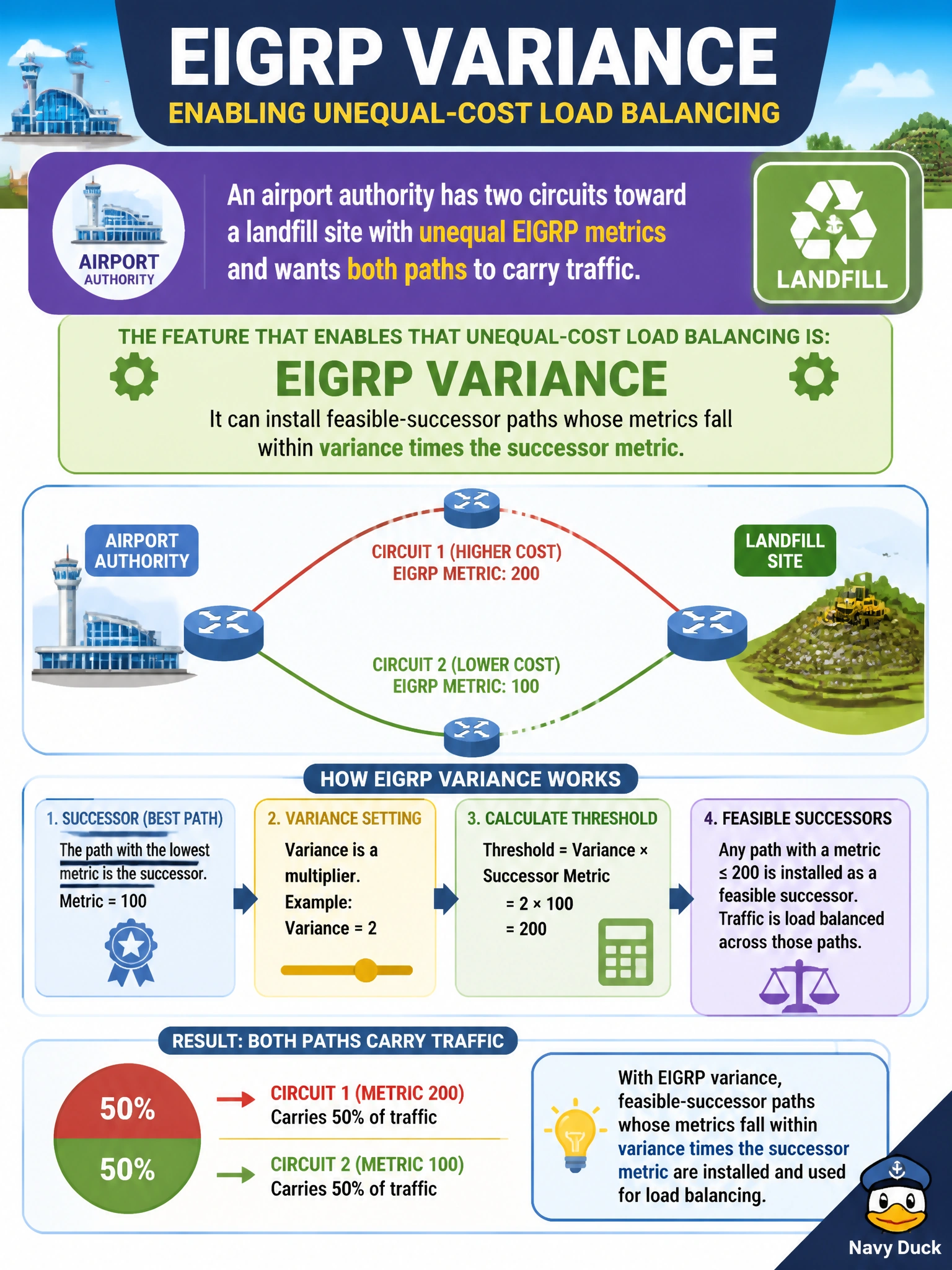
Variance is the airport’s "close enough" knob: if the backup runway metric sits inside successor-metric times variance—and it is still a feasible successor—EIGRP will share the load. Leave variance at 1 and only equal-cost birds fly.
Full Explanation
EIGRP variance enables unequal-cost load balancing by allowing feasible-successor paths whose metrics fall within (variance × successor metric) to be installed for forwarding. At an airport authority with two circuits toward a landfill site at unequal metrics, raising variance appropriately—while keeping the feasibility condition intact—lets both paths carry traffic instead of leaving the worse-metric FS as backup-only. Variance of 1 (default) permits only equal-cost multipath; unequal metrics need variance > 1 plus FS qualification.
Applying OSPF type-1 external metrics inside the EIGRP process fails by concept: OSPF external metric types are not the EIGRP unequal-cost control. BGP multipath relax with identical AS_PATH is a BGP mechanism, not how EIGRP balances landfill circuits. Disabling the feasibility condition so any higher-metric path installs automatically fails because ENARSI designs keep the feasibility condition for loop safety; variance only considers paths that already qualify as feasible successors.
Exam caveat: variance without an FS does nothing useful for that worse path, and overly large variance can pull in undesirable paths—size variance to the metric ratio you intend. Operational check: from the airport hub, show EIGRP topology for the landfill prefix, note successor metric and FS metrics, set variance so FS metrics ≤ variance × successor, confirm both next hops appear in the RIB, and monitor share before declaring success.