
A transit authority sees Stuck-in-Active after a summary flap on the civic WAN. What does SIA indicate for operators?
Select an answer to reveal the explanation.
Short Explanation
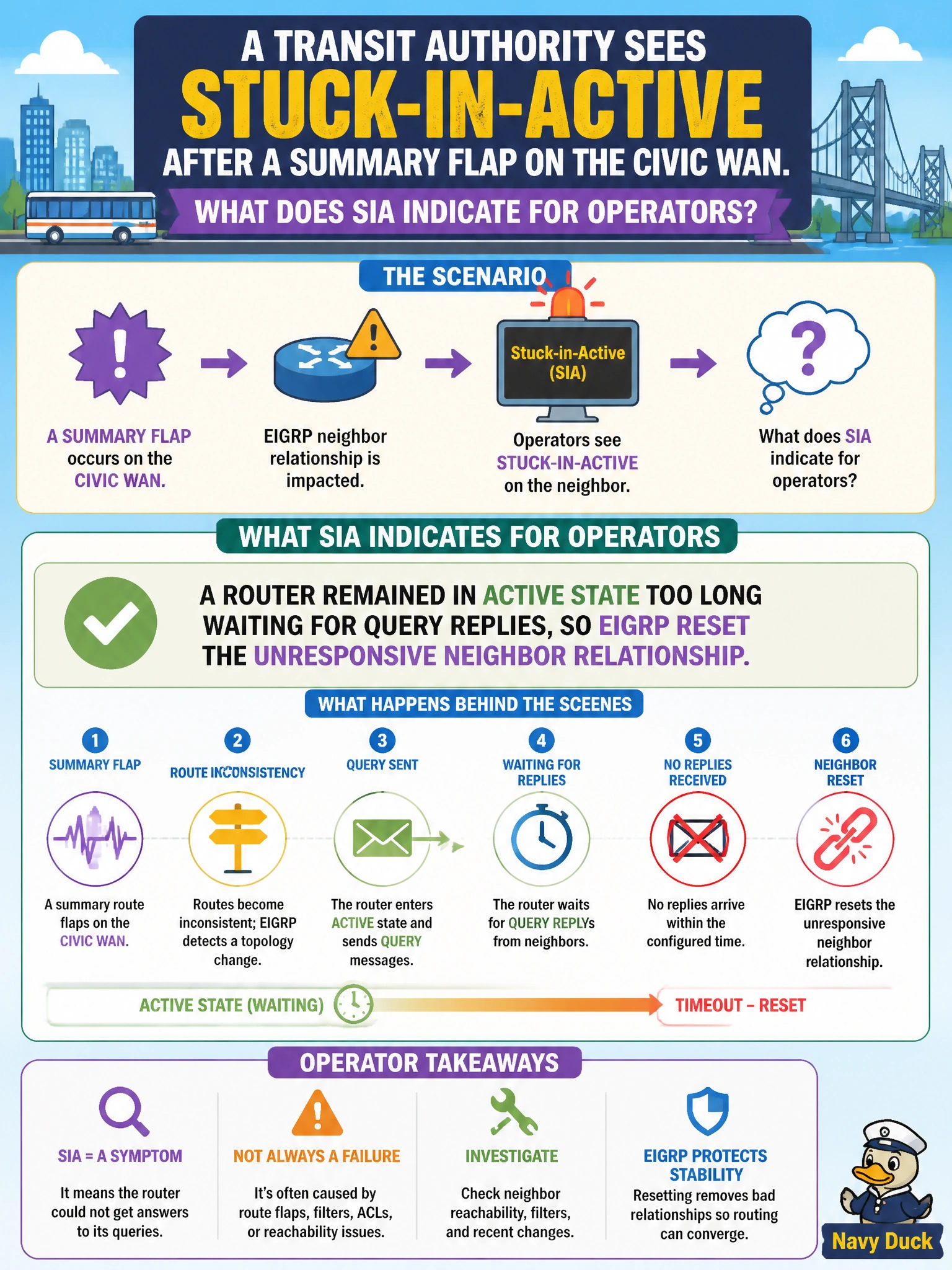
Active is EIGRP asking the room "who still has a path?" Stuck-in-Active is when somebody never answers before the timer pops—so the transit router drops that quiet neighbor and moves on. Summary flaps that fan queries wide make SIA more likely.
Full Explanation
Stuck-in-Active (SIA) means a router stayed in active state too long waiting for query replies about an alternate path, so EIGRP resets the relationship toward the unresponsive neighbor. On a transit-authority civic WAN, a summary flap that fans queries widely increases the chance some spoke or peer never answers before the active timer expires—hence SIA events and neighbor resets. Operators should treat SIA as a query-scope and reply-responsiveness problem (stub design, summarization boundaries, overloaded or unreachable query targets), not as a mysterious permanent DUAL disable.
Claiming EIGRP permanently disables DUAL and must be restarted on every transit hub fails by concept: SIA resets specific unresponsive neighbor relationships; it does not abolish DUAL globally. Claiming SIA merely means the successor metric improved and ECMP is recomputing fails—metric improvement is a different event path than active/SIA. Claiming SIA means authentication keys expired and must be rotated fails because key failure presents as adjacency/auth problems, not as the active-timer query-reply failure mode.
Exam caveat: SIA is a symptom of query diameter and non-replying peers; summarization and EIGRP stub at remote sites are common design mitigations, but the definition itself is the overtime active wait and neighbor reset. Operational check after a civic WAN summary flap: identify which neighbors were SIA-reset, review query paths and stub/summary placement, confirm remote sites that should not be queried are stub, and re-validate successor/FS state for affected prefixes.