
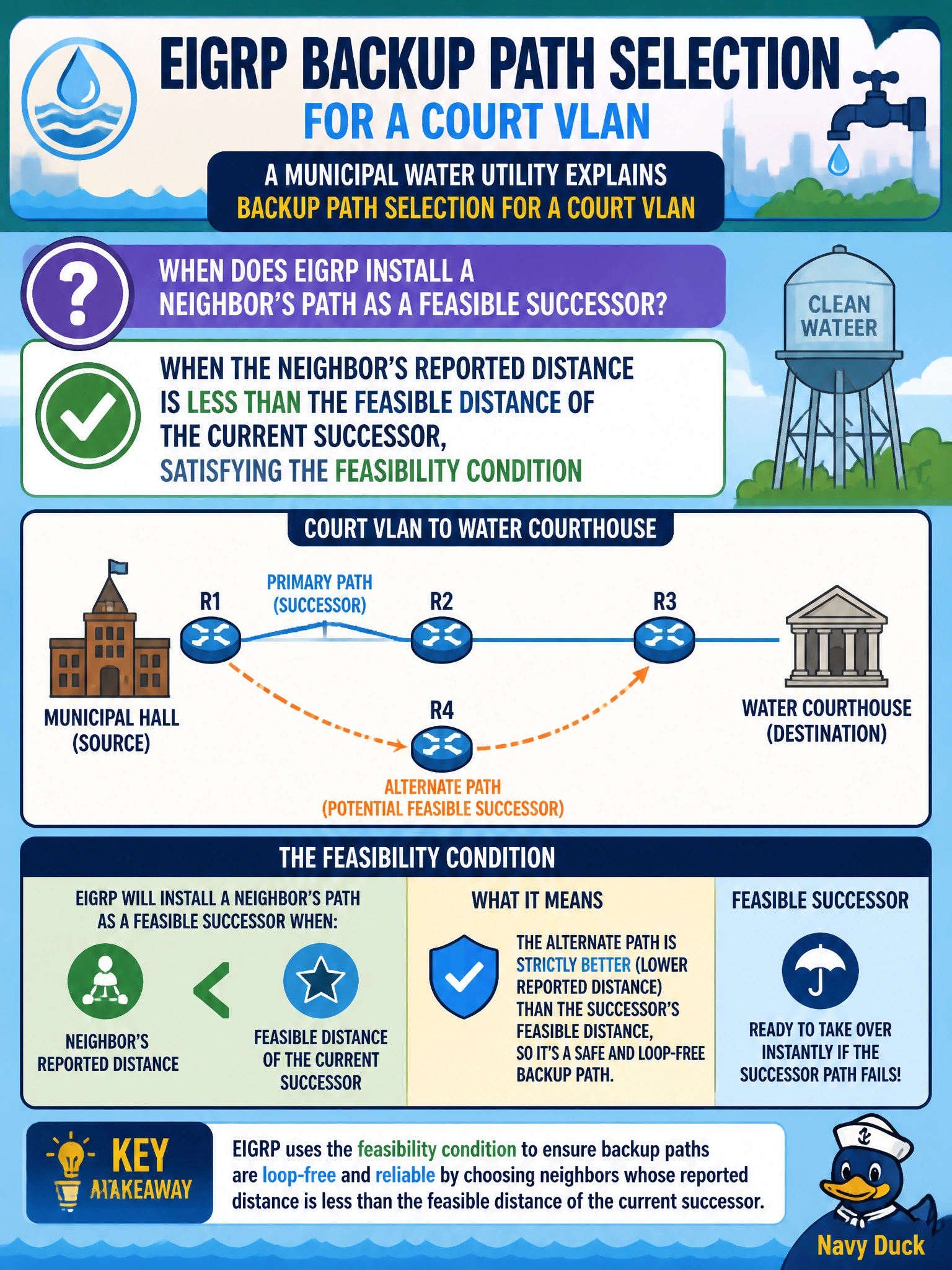
A municipal water utility explains backup path selection for a court VLAN. When does EIGRP install a neighbor’s path as a feasible successor?
Select an answer to reveal the explanation.
Short Explanation
Feasible successor is the understudy that already proved it is closer to the destination than you currently are—reported distance under your feasible distance. That feasibility condition is the loop-safety handshake before EIGRP trusts the backup for the court VLAN.
Full Explanation
EIGRP installs a neighbor’s path as a feasible successor only when that neighbor’s reported distance (RD) is strictly less than the feasible distance (FD) of the current successor—the feasibility condition. That inequality is the loop-safety handshake: the neighbor claims a distance to the destination better than your best known FD, so the alternate is considered loop-free without needing an active query in many failure cases. For a municipal water-utility court VLAN backup path, an FS in the topology table is the warm standby that can promote quickly when the successor fails.
Whenever RD equals FD, the path fails the classic strict feasibility condition and is not installed as an FS regardless of “connectivity looks fine.” Waiting only after Stuck-in-Active completes and clearing the topology table is not how FS qualification works—FS is computed from RD versus FD during normal DUAL operation. Setting variance to 1 with a worse-than-successor metric does not create an FS; variance affects unequal-cost installation of already-qualified feasible successors, not the feasibility condition itself.
Exam caveat: feasible successor ≠ any backup next hop; without RD < FD the path may exist in the topology table as a non-FS entry and still require active querying on successor loss. Operational check before relying on court VLAN backup: show the EIGRP topology for the prefix, identify successor FD and each neighbor’s RD, confirm at least one FS meets RD < FD, and document which hub would take over after a primary failure.