
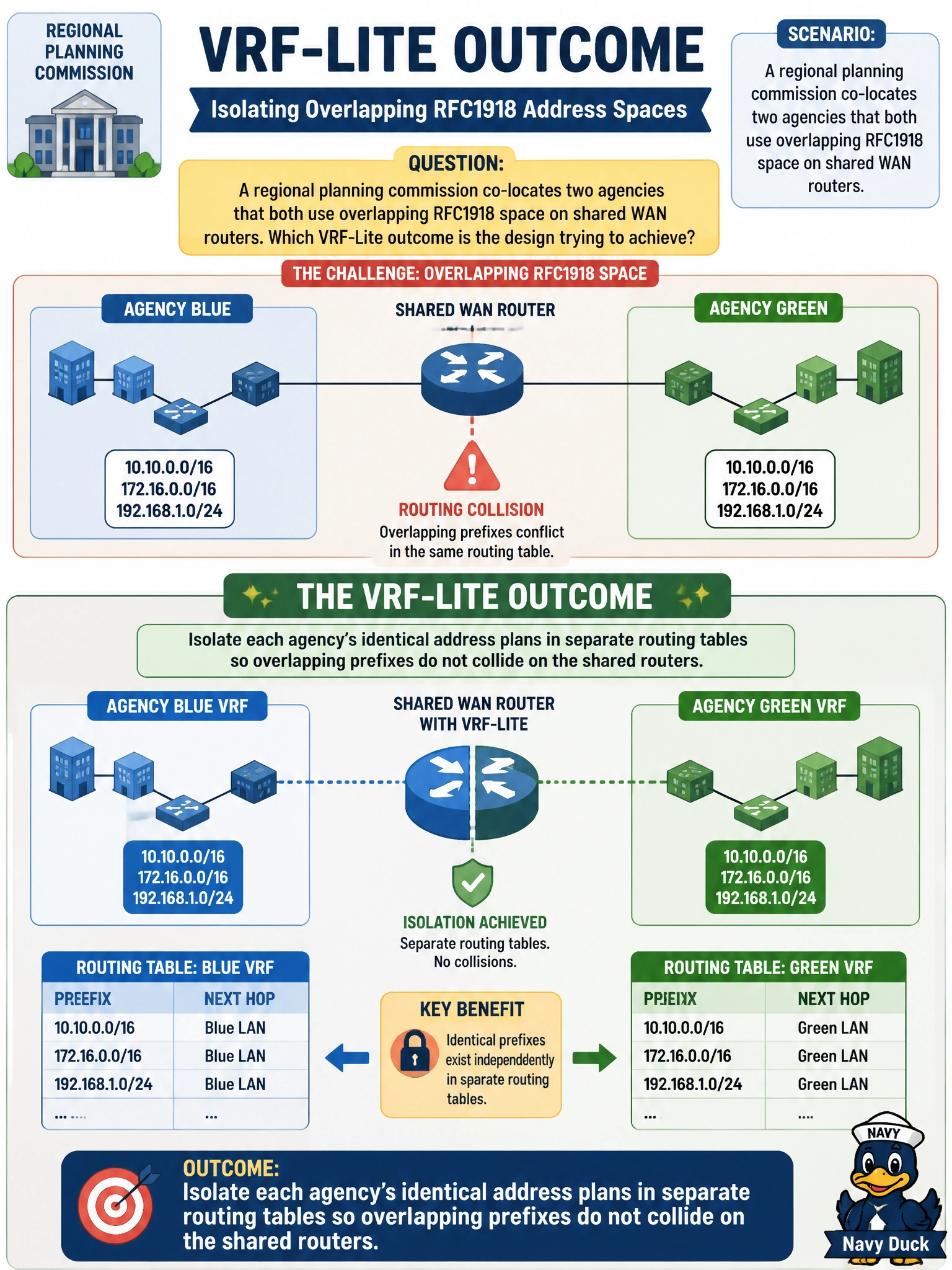
A regional planning commission co-locates two agencies that both use overlapping RFC1918 space on shared WAN routers. Which VRF-Lite outcome is the design trying to achieve?
Select an answer to reveal the explanation.
Short Explanation
Two agencies, same private IP numbers, one set of WAN boxes—VRF-Lite gives each agency its own map so 10.1.1.0/24 in Agency A is not Agency B’s 10.1.1.0/24.
Full Explanation
The regional planning commission’s VRF-Lite design isolates each agency’s identical RFC1918 plans into separate routing tables on shared WAN routers so overlapping prefixes do not collide. Agency A’s 10.1.1.0/24 and Agency B’s 10.1.1.0/24 can coexist because each VRF has its own RIB and interface membership, which is the core overlapping-address outcome VRF-Lite provides without MPLS.
Forcing both agencies onto a single OSPF area 0 backbone with identical router-IDs merges domains and guarantees prefix collision rather than isolation. Replacing overlapping space with NAT on every access port before VRF membership is not required for VRF-Lite—the point of VRFs is to keep overlaps without mandatory per-port NAT, though NAT may still appear at Internet edges. Advertising both agencies’ duplicates into one BGP table with the same RD only collapses separation; distinct tables (and distinct RDs if MPLS VPN is later used) are required to keep duplicates unambiguous.
Exam caveat: VRF-Lite solves overlap on the shared box; extending multi-hop isolation may later add MPLS L3VPN with unique RDs/RTs. Management access and shared services still need deliberate leak or out-of-band paths.
Operational check: place identical prefixes in each agency VRF, verify both RIBs install their own copy via show ip route vrf, and confirm no cross-installation in global or the peer VRF without a configured leak. Ping within each VRF succeeds while cross-VRF ping fails absent policy.