
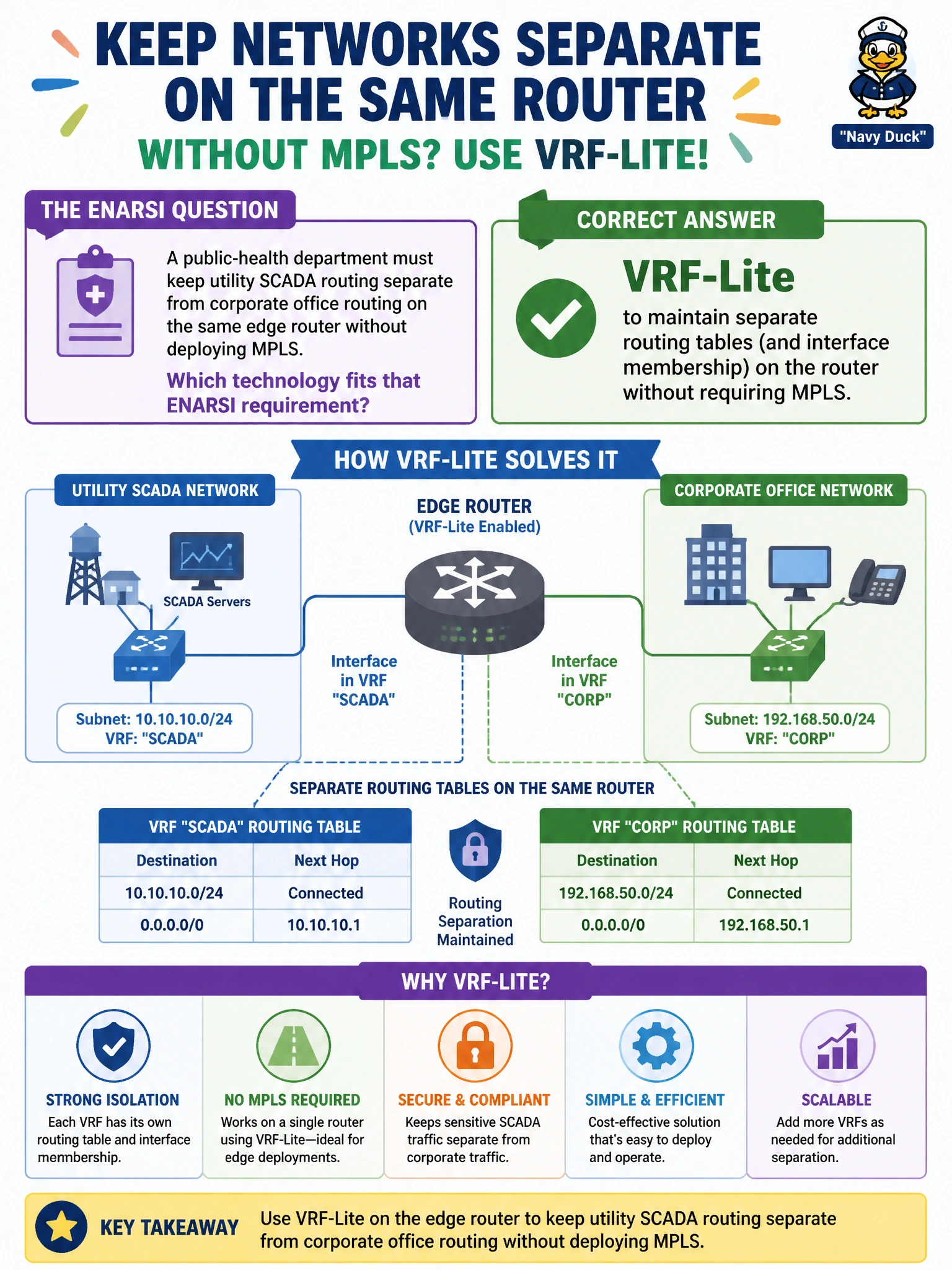
A public-health department must keep utility SCADA routing separate from corporate office routing on the same edge router without deploying MPLS. Which technology fits that ENARSI requirement?
Select an answer to reveal the explanation.
Short Explanation
VRF-Lite is like separate filing cabinets in the same office building—one for SCADA, one for office—without needing a full MPLS courier service.
Full Explanation
VRF-Lite fits the public-health department’s need to keep utility SCADA routing separate from corporate office routing on the same edge router without deploying MPLS. Each VRF maintains its own routing table and interface membership, delivering control-plane and forwarding isolation on a single box—ideal for municipal SCADA versus office separation at ENARSI depth.
A single global EIGRP AS with passive-interface on SCADA VLANs only reduces adjacency formation on those VLANs; it does not create a separate routing table, so SCADA and office prefixes still share one RIB and can collide or leak by redistribition mistakes. GRE tunnels alone without routing-table separation can overlay transport but do not by themselves provide VRF-like table isolation for overlapping or sensitive domains. PBR that rewrites SCADA destinations into office VLANs mixes domains at forwarding time rather than isolating routing tables and is the opposite of separation.
Exam caveat: VRF-Lite needs no RD/RT/MPLS core for local isolation; those appear when you extend to MPLS L3VPN. Do not confuse VRF-Lite with VLAN segmentation alone—Layer-2 separation without per-VRF L3 tables is incomplete for overlapping IPs.
Operational check: define VRFs, assign SCADA and office interfaces with ip vrf forwarding, configure distinct routing per VRF, and verify show ip route vrf SCADA versus show ip route (global/office). Confirm no unintended overlapping routes between tables unless explicitly leaked.