
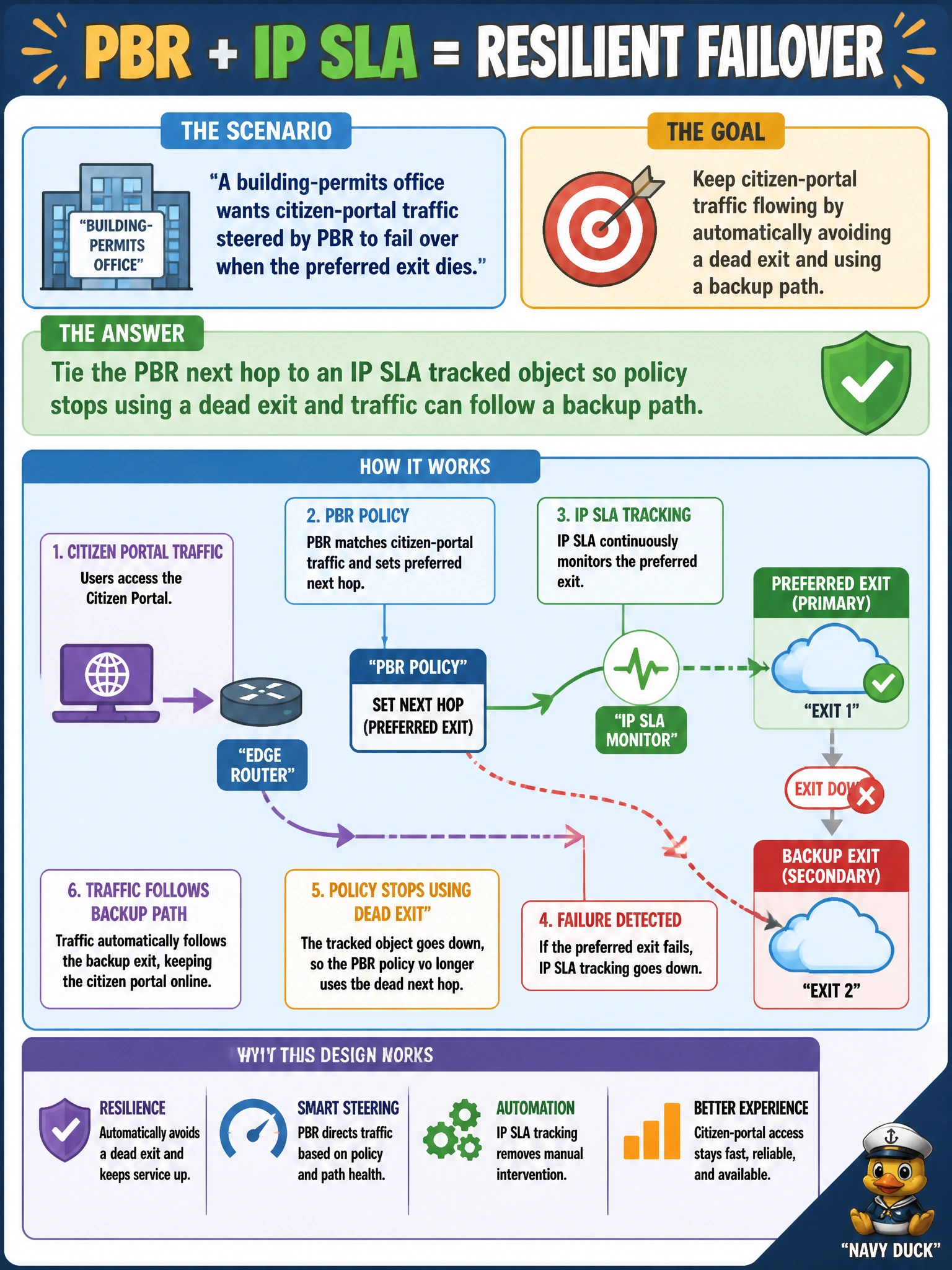
A building-permits office wants citizen-portal traffic steered by PBR to fail over when the preferred exit dies. Which design combines resilience with PBR?
Select an answer to reveal the explanation.
Short Explanation
IP SLA is the heartbeat monitor on the preferred door. When the heart stops, tracking tells PBR to quit shoving citizen-portal traffic through a dead exit.
Full Explanation
Resilient PBR for the building-permits citizen-portal design ties the preferred next hop to an IP SLA–tracked object (object tracking) so that when the exit dies, the policy stops using the dead hop and traffic can follow a backup clause or normal routing. Tracking converts PBR from a brittle static detour into a monitored policy that respects path liveliness.
Disabling CEF to rely on process switching for failure detection every second is operationally harmful and is not the ENARSI resilience pattern for PBR. Hard-coding two set interface statements without tracking still risks steering into a dead path if the router does not know the exit is down. Replacing PBR with RIP poison reverse to withdraw citizen-portal prefixes globally abandons selective steering and uses the wrong protocol tool for the stated goal.
Exam caveat: configure IP SLA probe, track object, and set ip next-hop verify-availability track <object> (platform syntax varies) so the route-map clause is conditional. Provide an ordered backup set clause or accept RIB fallback deliberately.
Operational check: show track and show ip sla statistics should reflect probe state; flap the preferred exit and confirm citizen-portal flows move to the backup path without manual route-map clearing. Unmatched traffic should remain on destination routing throughout the test.