
A police records bureau configures PBR on a border router’s ingress interface so only ACL-permitted packets are policy-routed to an alternate next hop. Which combination is required?
Select an answer to reveal the explanation.
Short Explanation
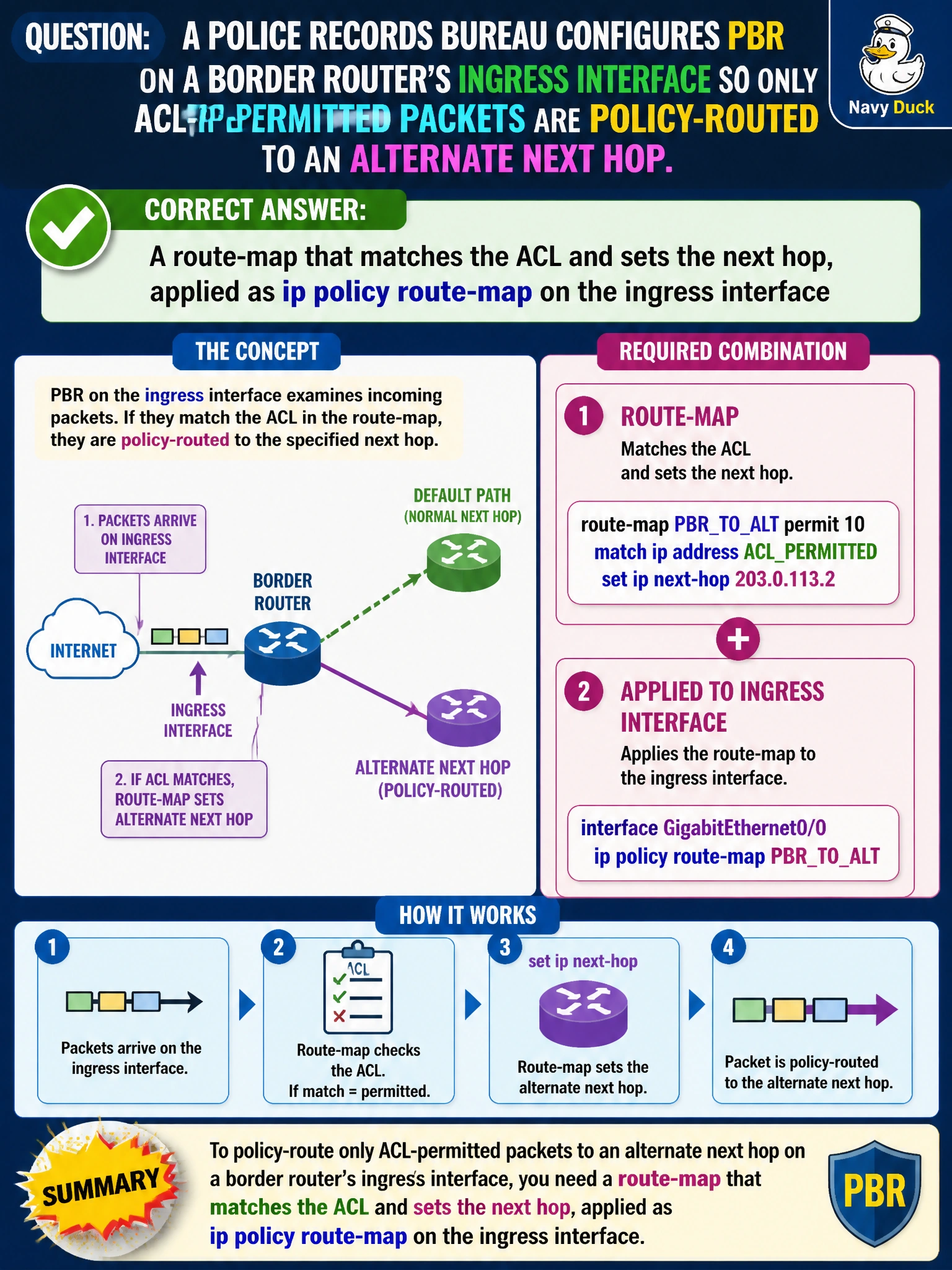
ACL says who qualifies, the route-map sets the detour, and you pin that policy on the inbound doorway—otherwise the packets never see the detour sign.
Full Explanation
Classic PBR on the police records bureau border requires a route-map that matches the ACL and sets the next hop (or interface), applied with ip policy route-map on the ingress interface where subject packets arrive. Without the match, set, and ingress application together, ACL-permitted packets will not be policy-routed to the alternate next hop.
An EIGRP distribute-list filters prefixes advertised or accepted by EIGRP; it does not set per-packet next hops based on an ACL without a PBR route-map. An OSPF area filter-list controls Type-3 summary advertisement between areas in the LSDB sense—it does not rewrite next hops for ACL hits on transit packets. A CoPP class-map protects the control plane by rate-limiting to-the-box traffic; it is not a substitute for PBR forwarding of through traffic to an alternate WAN.
Exam caveat: policy must sit on ingress; egress PBR is not the usual model for this pattern. Order of route-map sequence numbers matters when multiple clauses exist. set ip next-hop versus set interface versus set ip default next-hop change failure behavior—know which the bureau configured.
Operational check: show running-config interface for ip policy route-map, show access-lists hit counts, show route-map, and a controlled probe that matches the ACL to confirm the alternate next hop while a non-matching probe follows the RIB.