
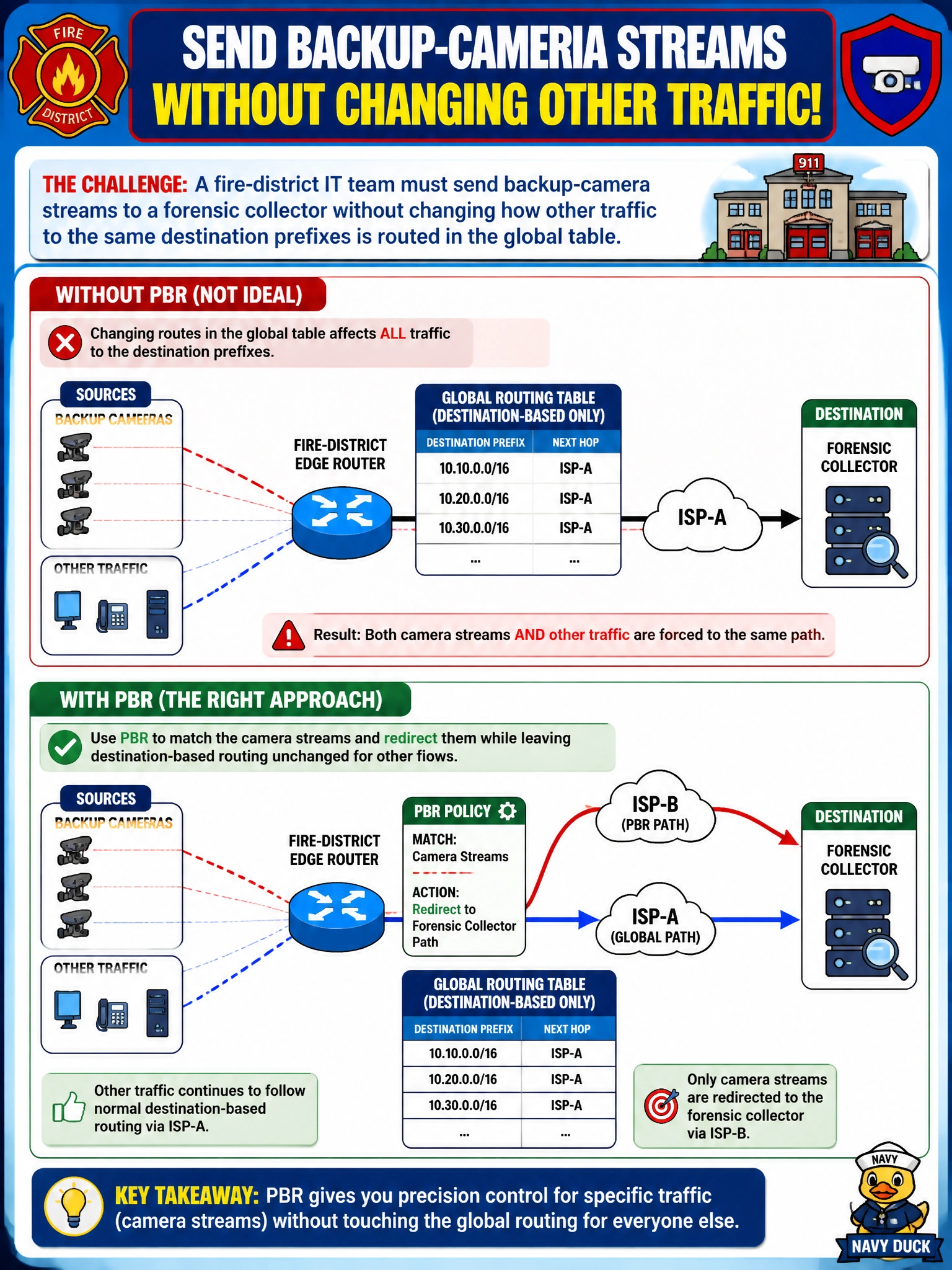
A fire-district IT team must send backup-camera streams to a forensic collector without changing how other traffic to the same destination prefixes is routed in the global table. Which approach fits?
Select an answer to reveal the explanation.
Short Explanation
You can steer only the backup-camera streams to the forensic collector with PBR, while other traffic to the same prefixes keeps its destination-based route. That gives you the selective forwarding the fire-district team needs without changing the global table.
Full Explanation
The requirement is selective steering: backup-camera streams must reach the forensic collector without changing how other traffic to the same destination prefixes is routed. Policy-based routing (PBR) can match only the camera streams—for example, by source address, DSCP, or an ACL—and redirect those packets, while unmatched flows continue to use destination-based routing. This is a per-flow forwarding override, not a change to the global routing table. A static route for the collector that overrides all user traffic citywide would alter forwarding for everyone and violate the requirement. Redistributing camera subnets into BGP with local preference 200 would influence path selection for those prefixes broadly, rather than redirecting only camera streams. Advertising a summary route for the camera subnet to Null0 would send matching traffic to a discard interface, not selectively deliver streams to the collector, harming reachability instead. Exam caveat: PBR redirects matched packets; it does not make a separate copy of them, so distinguish a requested redirect from a packet-copy requirement. For a practical check, match only camera streams in an ACL, configure the collector path as the PBR next hop, and apply the policy at the camera ingress interface. Then verify that matched streams take the collector path and unmatched user traffic to the same destinations still follows its ordinary route.