
A municipal water utility redistributes selected BGP SaaS prefixes used by the permits office into OSPF on the edge ASBR. How do those redistributed BGP prefixes typically appear inside OSPF?
Select an answer to reveal the explanation.
Short Explanation
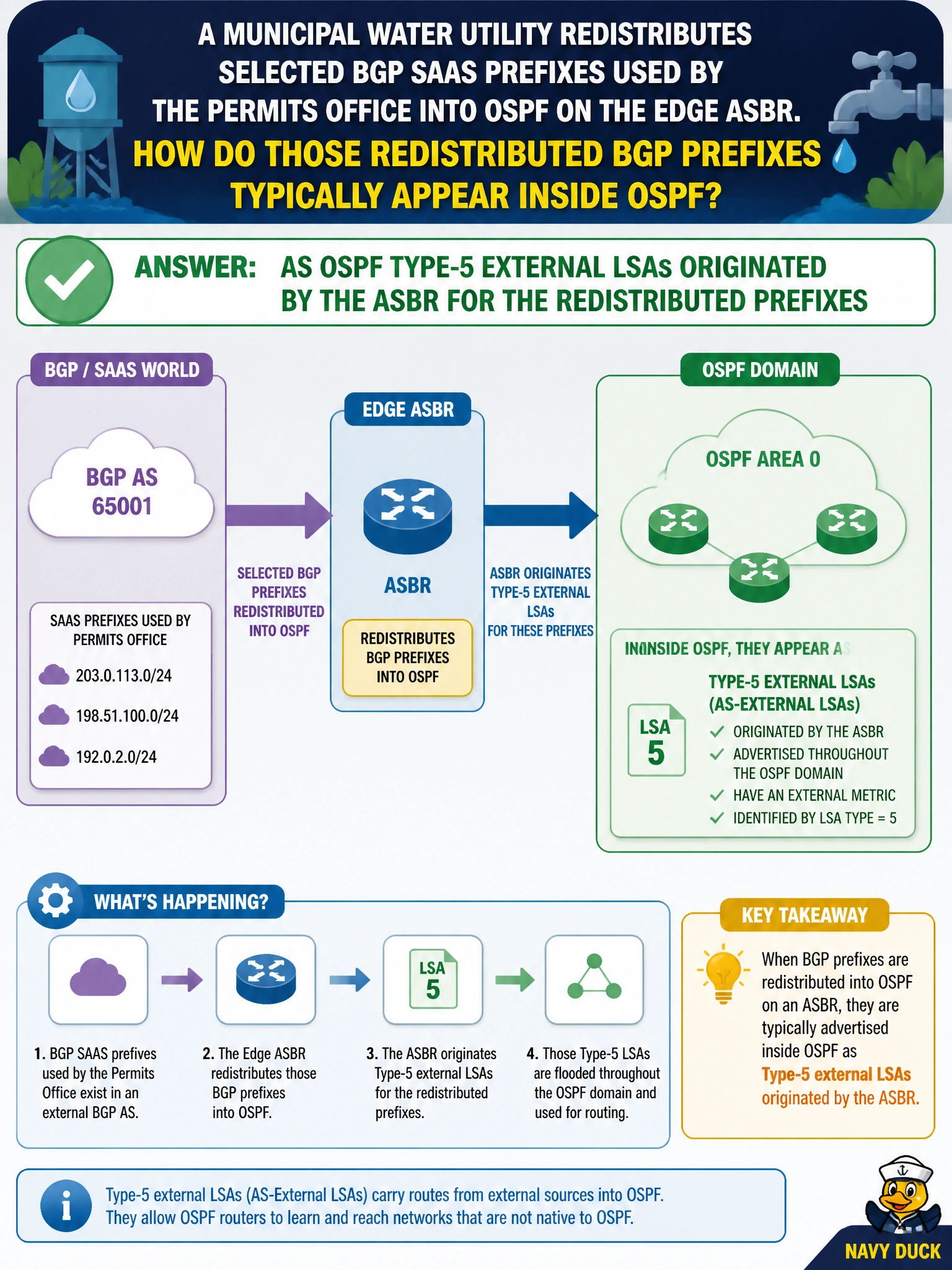
When you redistribute BGP routes into OSPF, the ASBR advertises those prefixes as Type-5 external LSAs—like visitor badges for routes that did not grow up inside the OSPF neighborhood. You can think of the ASBR as the boundary that brings those external prefixes into OSPF.
Full Explanation
On the municipal water utility ASBR, the selected BGP SaaS prefixes used by the permits office are typically originated into OSPF as Type-5 external LSAs, assuming a normal area that allows external routes. The ASBR is the redistribution boundary: it injects the prefixes as external routes so interior routers can install them with an external path type and a forwarding next hop toward the ASBR; across areas, Type-4 information can help resolve the ASBR. Type-1 router LSAs describe a router’s links within an area, so they are not the primary advertisements for redistributed BGP prefixes. Type-3 summary LSAs carry inter-area reachability or summarization; ABRs do not use them to carry the BGP AS path for these external routes. Type-4 ASBR-summary LSAs advertise the ASBR’s location to other areas so Type-5 routes can be resolved, but do not carry the SaaS prefix list themselves. Exam caveat: stub and totally stubby areas block Type-5 LSAs, and filtering or route maps can prevent redistribution, so this answer assumes the prefix is actually injected into a standard area. Practical check: on the ASBR, use show ip ospf database external and check show ip route for the O E1/E2 entry. In remote areas, verify Type-4 reachability if a Type-5 is present but not installed, and confirm the source prefix still exists in the BGP table.