
A township public works team redistributes OSPF into EIGRP for parks and roads VLANs and must set a seed metric so operators are not surprised by unequal-cost candidates. Which action correctly supplies the EIGRP composite seed metric on redistribution?
Select an answer to reveal the explanation.
Short Explanation
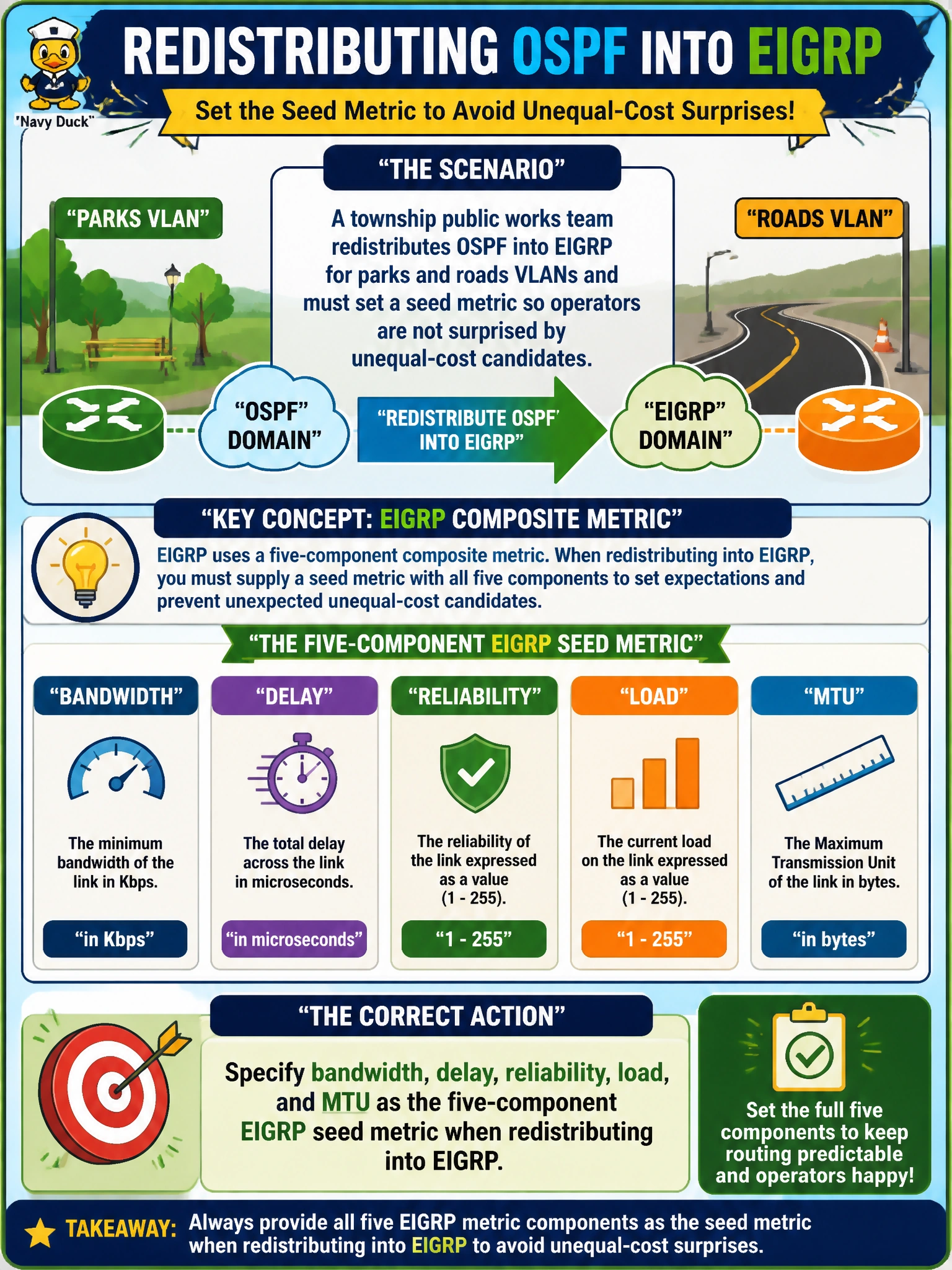
Think of EIGRP as a recipe that needs every ingredient on the card. When OSPF routes walk into that kitchen, you have to hand EIGRP bandwidth, delay, reliability, load, and MTU or the dish has no usable metric.
Full Explanation
When the township public works team redistributes OSPF parks-and-roads prefixes into EIGRP, EIGRP cannot invent a usable composite metric from OSPF cost alone. The correct action is to supply the five-component EIGRP seed metric—bandwidth, delay, reliability, load, and MTU—either on the redistribute statement or via a route-map that sets metric. Those five values become the starting metric for the external candidate; without them, the injected route typically lands with an infinite/unreachable metric and never becomes a usable successor for parks VLAN traffic.
Omitting any seed metric and expecting OSPF cost to morph into the EIGRP composite fails because the protocols use different metric models; there is no automatic cost-to-composite translation on redistribution. Setting only bandwidth while leaving delay, reliability, load, and MTU at zero is equally unsafe: zeroed components commonly produce an infinite metric rather than a partial composite the router “fills in.” Advertising the OSPF routes with administrative distance 170 does not create an EIGRP seed metric at all—AD only ranks already-installed RIB sources and cannot turn an OSPF-learned prefix into a properly metered EIGRP external successor.
Exam caveat: default metric and route-map set metric are both valid ways to satisfy the five-component requirement; the exam focus is that all five must be defined for redistribution into EIGRP, not that a particular CLI form is unique. Also distinguish seed metric (how the external is scored inside EIGRP) from administrative distance (how the RIB chooses among protocols).
Operational check: after the change window, confirm the redistributed parks prefixes appear in show ip eigrp topology (or named-mode equivalent) with the expected external metric components, then verify show ip route shows the EIGRP code and a sensible next hop. If the topology entry is missing or the metric is infinite, revisit seed-metric or route-map configuration before blaming OSPF adjacency or VLAN ACLs.