
A public-library branch network injects a static null0 summary into OSPF so remote counties learn an aggregate for the city supernet. Why is redistributing that discard static useful?
Select an answer to reveal the explanation.
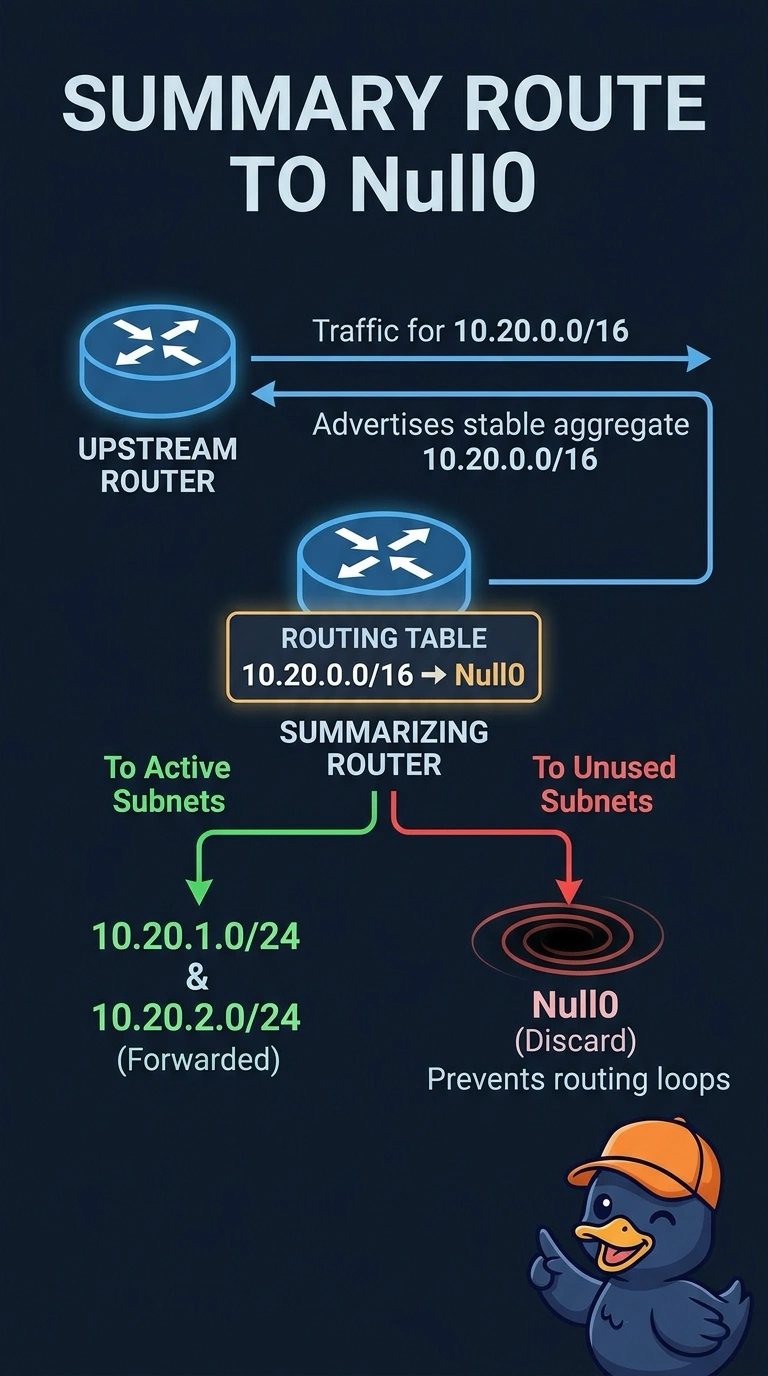
Short Explanation
You advertise one big city supernet to remote counties, and the null0 static drops anything inside that summary that doesn't match a real subnet. That keeps the aggregate stable and stops the summarizing router from looping uncovered holes.
Full Explanation
The correct choice is the one that says it advertises a stable aggregate while null0 prevents blackhole forwarding for uncovered holes on the summarizing router. Redistributing a static to null0 summary into OSPF advertises a stable aggregate, the city supernet, to remote counties while the local discard route ensures that if traffic arrives for a hole inside the summary that has no more-specific match, the summarizing public-library router drops it instead of following a default and looping. The null0 static is therefore both an advertisement source for the aggregate and a safety blackhole for uncovered destinations on that router.
The choice claiming it forces every branch to become an ASBR with BGP only is incorrect: injecting a null0 static into OSPF does not force every branch to become a BGP ASBR. The choice claiming it converts OSPF into a distance-vector protocol for the supernet is false; OSPF remains link-state, and redistributing a summary does not convert OSPF into a distance-vector protocol. The choice claiming it raises the AD of all more-specifics to 255 automatically does not happen: redistributing a discard static does not raise AD of more-specifics to 255; more-specifics continue to forward normally with their own ADs.
Exam caveat: advertise the summary only where aggregation is intended; remote counties should rely on the aggregate plus any needed more-specifics. Ensure more-specific library subnets exist locally so real users are not discarded to null0. On IOS, an IP routing entry to null0 with the summary prefix plus redistribute static, usually with a route-map matching only that summary, is the common pattern; alternatively OSPF area range or summary-address may apply depending on internal vs external summarization design.
Operational check: show ip route <city-supernet> showing Static to Null0 on the summarizing router, and show ip ospf database external, or inter-area as applicable, showing remote learning of the aggregate. traceroute to a covered more-specific should hit the real subnet; traceroute to an unused hole inside the supernet should blackhole at the summarizer rather than loop. show route-map confirms only the discard summary is redistributed if selective.