
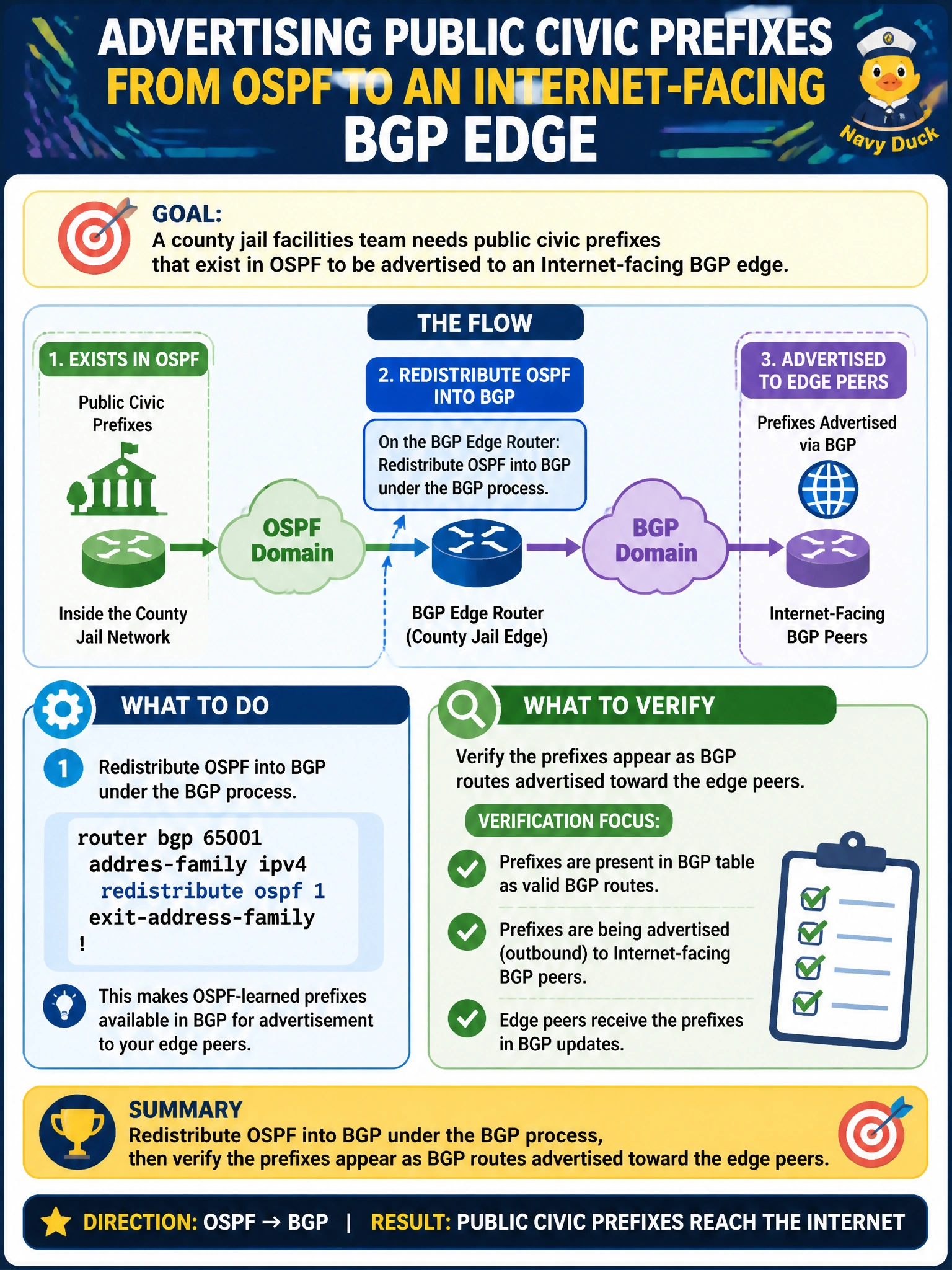
A county jail facilities team redistributes selected OSPF civic prefixes into BGP so the Internet edge can advertise public services. Which verification cue best confirms those OSPF routes were successfully injected into BGP?
Select an answer to reveal the explanation.
Short Explanation
Want proof the jail's OSPF nets made it into BGP? Check the BGP table—you should see those prefixes as redistributed BGP routes with a sensible next-hop and a non-IGP origin, not watch BGP sessions flip to Idle.
Full Explanation
Successful redistribution of selected OSPF civic prefixes into BGP means those prefixes appear in the BGP table as BGP routes sourced by redistribution, commonly with origin incomplete (a non-IGP origin, depending on platform/policy), with a next hop consistent with the jail facilities design (for routes redistributed from OSPF this is normally the OSPF next hop, unless a route-map or next-hop-self policy changes it). The verification cue is therefore show ip bgp displaying those prefixes with attributes that match the redistribution design—not merely OSPF database contents or unrelated static ownership.
The check that only inspects show ip ospf database for Type-1 router LSAs for the BGP peers does not prove BGP injection; OSPF can be healthy while redistribute into BGP fails due to route-maps or address-family mistakes. The check where show ip route static suddenly owns every jail VLAN suggests statics, not OSPF-to-BGP redistribution success. The symptom where BGP neighbor state flips to Idle whenever OSPF SPF runs is a failure symptom, not confirmation of successful injection.
Exam caveat: by default, redistribute ospf into BGP injects only internal OSPF routes; OSPF external routes need match external (or match internal external) keywords. Also check the correct BGP address family (IPv4 unicast / VRF) matching where redistribute ospf was configured. Origin code may be incomplete (?) for redistributed routes—do not expect igp origin unless set. Outbound route-maps toward the Internet edge may still filter prefixes after they exist in the local BGP table; confirm both local BGP presence and advertised-routes to the peer if the goal is public advertisement of services.
Operational check: show ip bgp | include <civic-prefix> and show ip bgp <prefix> for origin, next hop, and status codes. show run | section router bgp to verify redistribute ospf and any route-map. show ip bgp neighbors <edge> advertised-routes confirms the Internet edge receives the jail public service prefixes. Compare against show ip ospf database / show ip route ospf to ensure the source OSPF routes exist.