
A municipal fiber consortium removes redistribution route tags that previously blocked feedback between campuses and soon sees loop-like instability return. What does that symptom most strongly indicate?
Select an answer to reveal the explanation.
Short Explanation
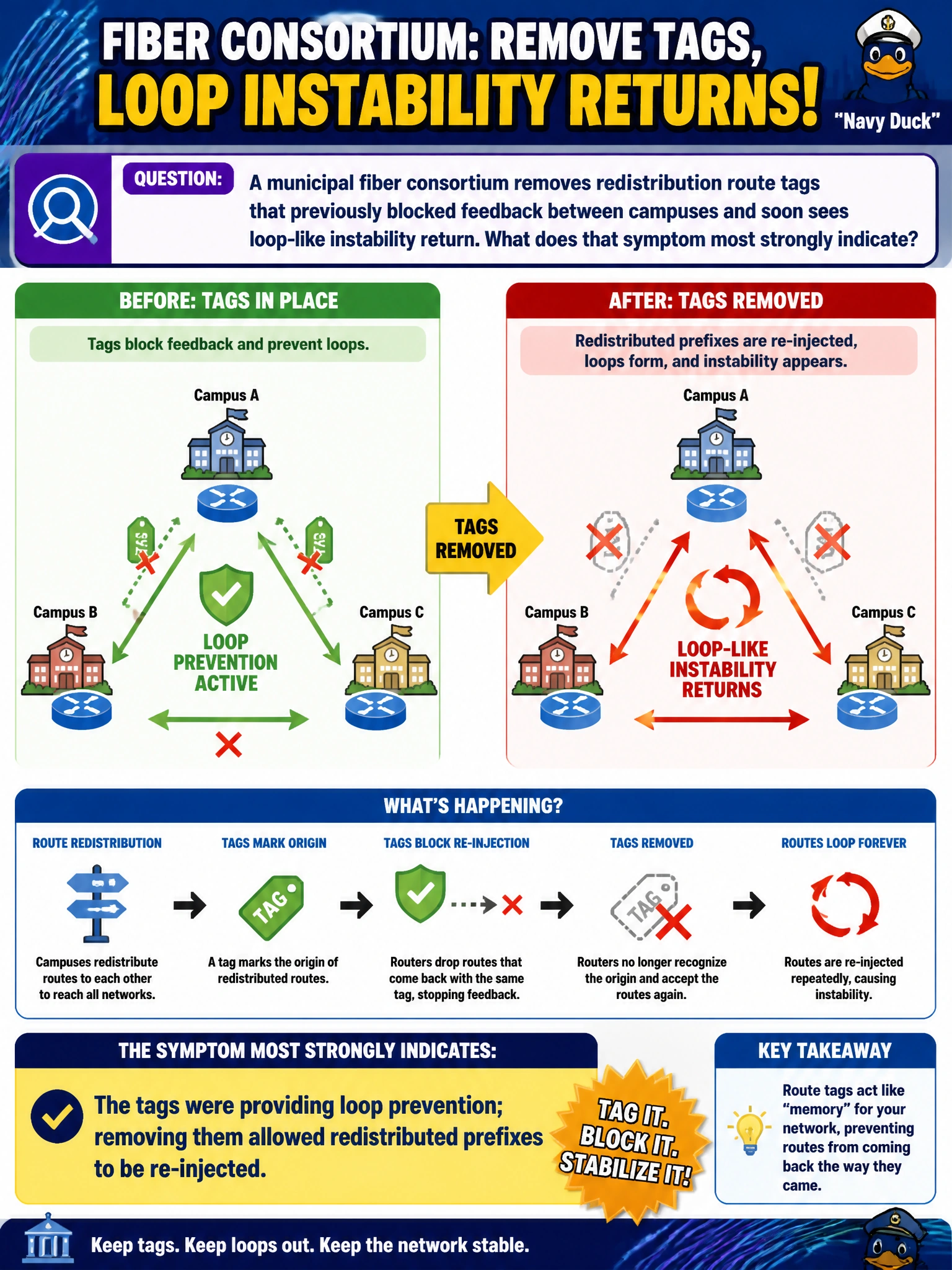
You’re seeing the consequence of removing a loop-prevention safety check: redistributed campus prefixes can be re-injected into another protocol and feed back. The timing strongly points to the tags, not a need to disable BFD or replace tagging with EIGRP stub.
Full Explanation
When loop-like instability returns soon after redistribution route tags are removed, the strongest indication is that the tags were preventing re-injection of redistributed prefixes. A prefix moved from one campus’s protocol into another can otherwise be redistributed back at a boundary, recreating feedback. The timing points to lost loop prevention, not an unrelated OSPF virtual-link problem. BFD is a liveness mechanism, so it does not need to be disabled before tags can be removed; it is orthogonal to this feedback. EIGRP stub limits query scope and advertisement roles, but is not a universal replacement for a mutual-redistribution tagging policy. OSPF virtual links alone do not explain why instability returned in connection with tag removal, and tags can affect whether prefixes loop between campuses. Exam caveat: before removing tags in a production fiber consortium, provide equivalent loop controls; otherwise instability may show up as CPU SPF thrash, oscillating route next hops, or secondary neighbor-adjacency flaps in syslog. Document the tag policy so cleanup does not erase a safety check. Practical check: restore the previous set-tag/match-tag deny policy and confirm stability returns; compare routes for an affected campus prefix before and after, and review change diffs for removed redistribution route-map clauses.