
A threat hunter at a fintech firm suspects an adversary has established stealthy persistence inside a cloud account that relies heavily on serverless compute rather than traditional virtual machines. Which control-plane audit activity best indicates this persistence technique?
Select an answer to reveal the explanation.
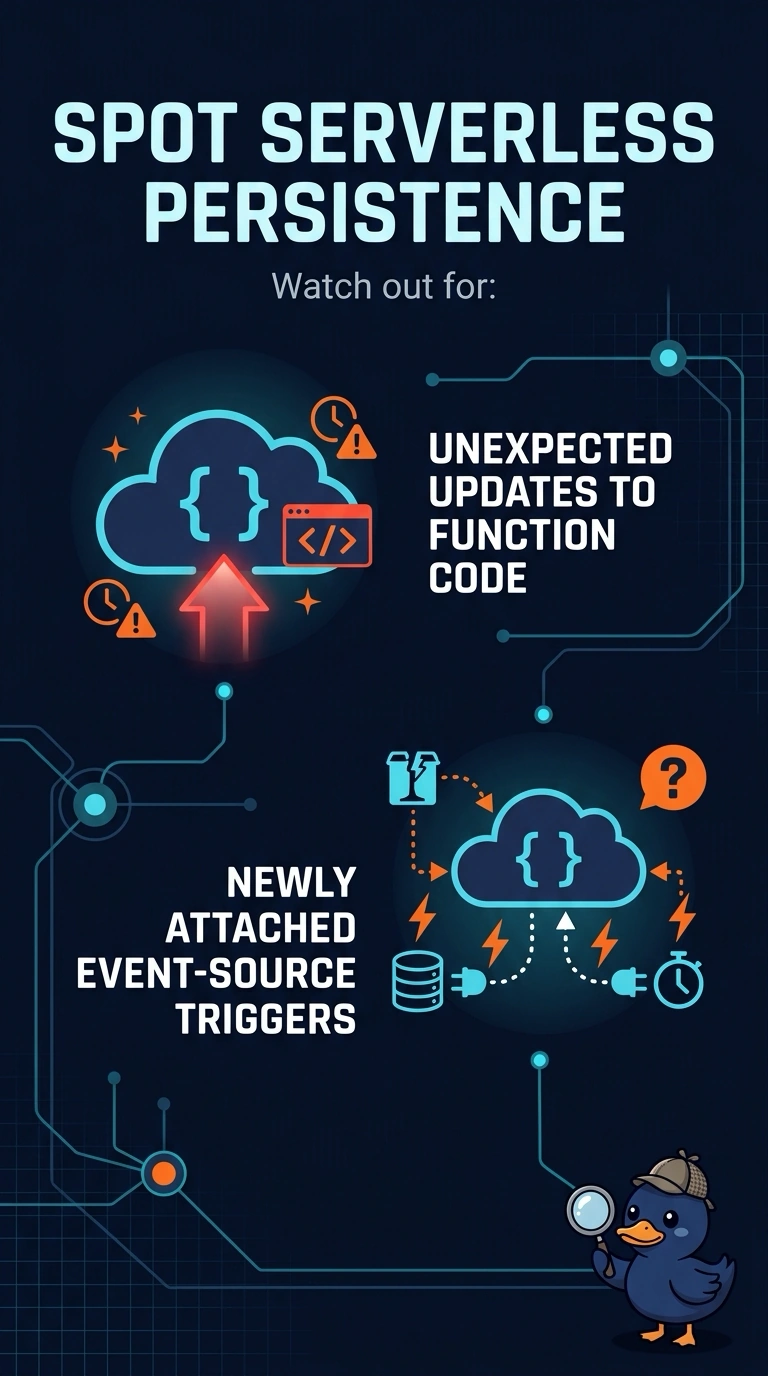
Short Explanation
When there are no virtual machines to plant a scheduled task on, attackers hide persistence inside the cloud's automation plumbing itself—so you have to watch the serverless control plane. The trap is looking for host-style artifacts while your attacker quietly attaches a hidden trigger to a legitimate function.
Full Explanation
Serverless execution environments are often ephemeral, but functions can mount persistent storage. Code/configuration updates and event triggers are important persistence opportunities; ephemeral compute does not force all persistence into the control plane. Unexpected updates to serverless function code or newly attached event-source triggers indicates that an attacker either injected backdoor logic into an existing function or configured an automated trigger—such as a storage upload or scheduled timer—to invoke malicious code repeatedly. Routine auto-scaling events during peak customer transaction hours is incorrect because capacity scaling reflects normal workload demand rather than unauthorized code or trigger modification. Normal outbound TLS handshakes from an authorized payment gateway is false because expected encrypted traffic from a known service does not signal serverless persistence. Scheduled container image vulnerability scans by the security platform is wrong because routine security scanning is expected operational activity and does not alter serverless execution paths. As a caveat, legitimate continuous-deployment pipelines also update function code, so analysts must distinguish authorized releases from manual or anomalous API calls. For an operational check, query cloud audit logs for function-update and trigger-creation API events and correlate the caller identity against approved deployment pipelines.