
During an incident, a security team blocks a compromised server's command-and-control IP address at the perimeter firewall but leaves the server online without investigating local persistence. Why is this remediation incomplete?
Select an answer to reveal the explanation.
Short Explanation
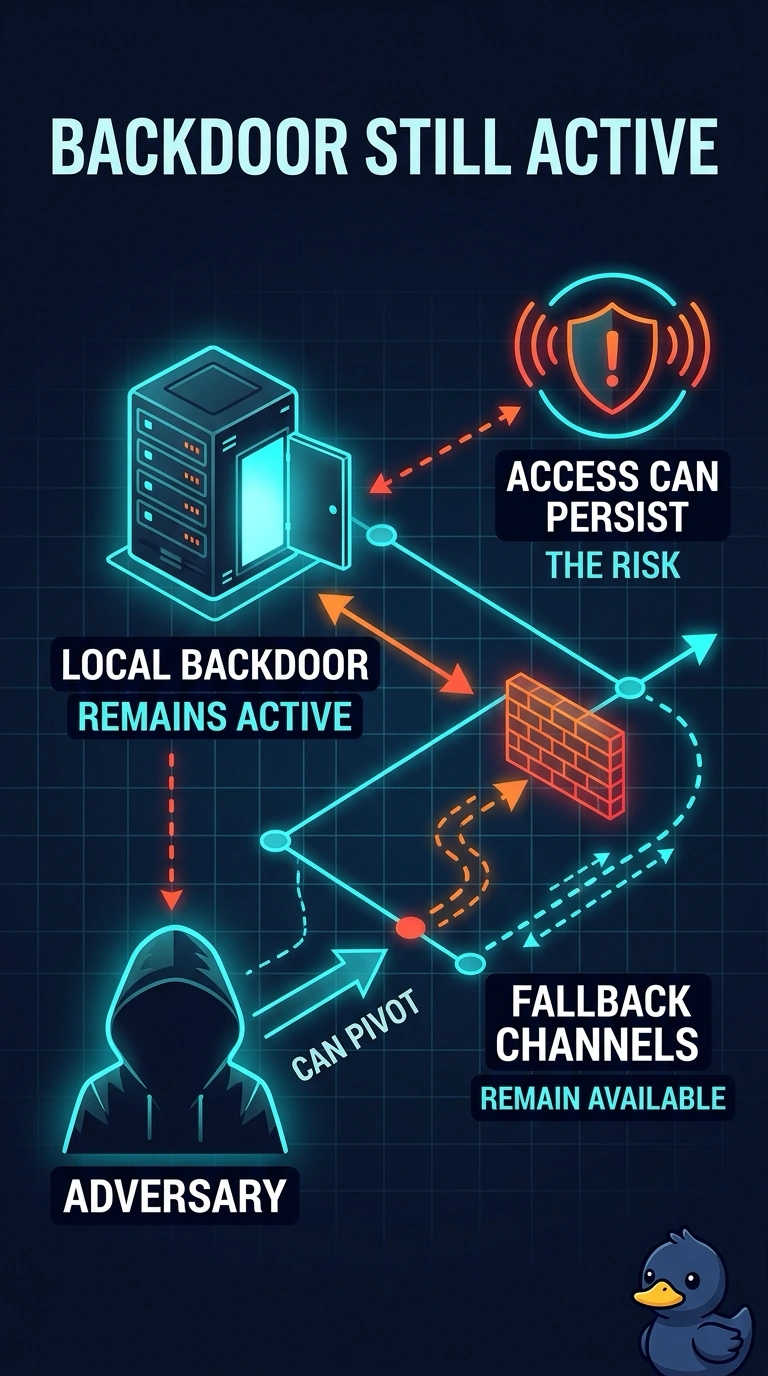
Blocking one phone number does not remove the intruder sitting inside your server room, and your firewall rule only stops a single address. The trap is mistaking network containment for full host eradication.
Full Explanation
Recognizing that The adversary's local backdoor remains active and can pivot to fallback channels explains why perimeter IP blocking alone fails to eradicate an intrusion. Modern implants routinely include secondary domains, alternate protocols, or dormant persistence mechanisms that survive a single firewall rule and re-establish access through different infrastructure. Claiming that Perimeter firewalls cannot block outbound TCP connections is false, because egress filtering is a standard firewall capability even though it cannot cure an already-infected host. Asserting that Blocking an IP address automatically erases volatile memory confuses a network control change with host-level memory clearing or rebooting. Stating that Local persistence mechanisms only run on external cloud hosts is incorrect, as persistence artifacts reside directly on compromised internal endpoints and servers. As a caveat, blocking known malicious infrastructure is still a useful immediate containment step while responders prepare host isolation. Perform an operational check by isolating the compromised server, inspecting startup and scheduled persistence locations, and verifying no outbound beacon attempts persist after cleanup.