
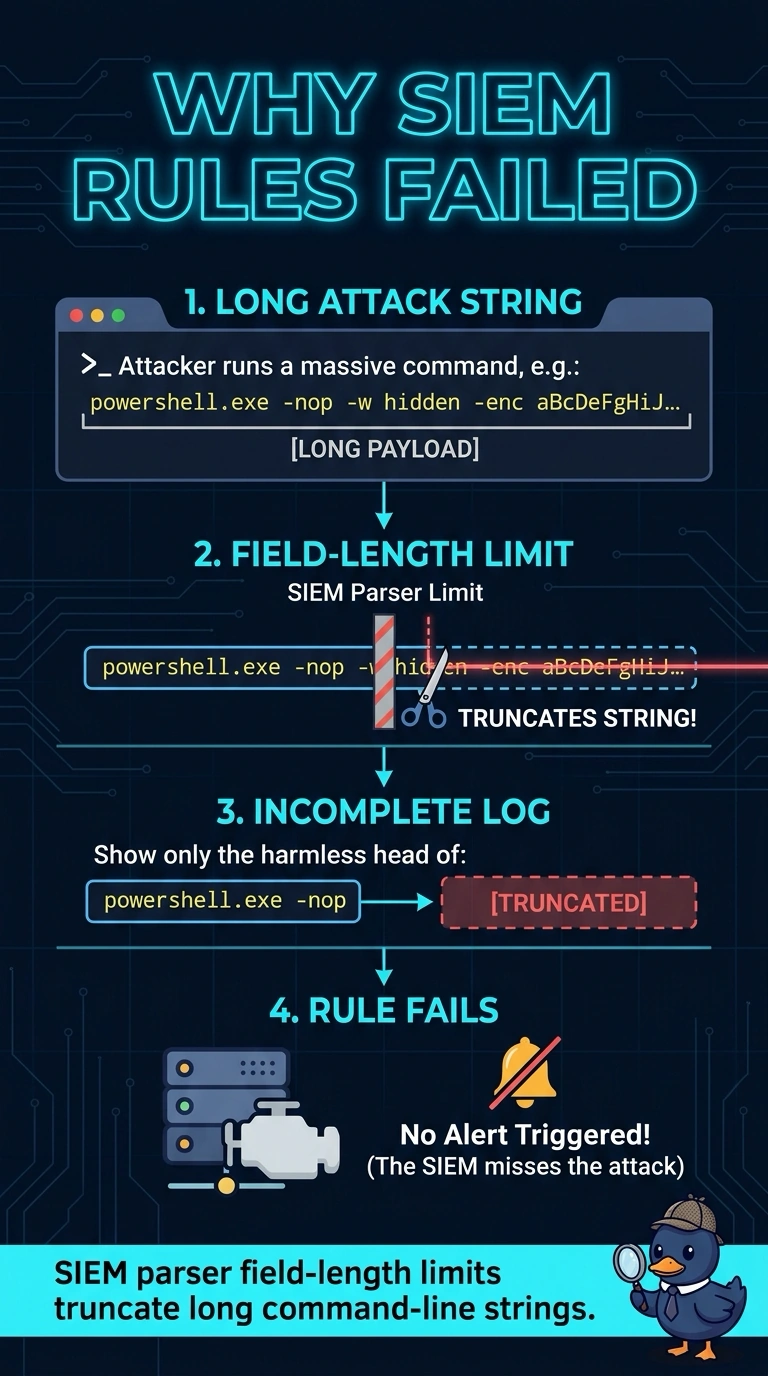
During a post-incident review, a threat hunting team discovers that endpoint agents captured full obfuscated script command lines, yet SIEM correlation rules failed to trigger because the ingested log fields were cut off mid-command. Which analytical gap caused this failure?
Select an answer to reveal the explanation.
Short Explanation
You’ve found a parser blind spot: when long command lines are truncated during SIEM ingestion, your rules can miss the obfuscated script details they need to match. The endpoint agent captured the full evidence, so the failure is not the agent but the clipped field in the SIEM.
Full Explanation
SIEM parser field-length limits truncating long command-line strings create a silent analytical blind spot: obfuscated scripts and encoded payloads can extend beyond default character cutoffs. When ingestion drops trailing arguments, behavioral rules looking for encoded flags or suspicious parameters may not match, even though the endpoint captured the full event. Excessive log retention policies archiving older events too slowly affect access to historical data, not the length of individual fields during ingestion. Overly aggressive endpoint firewall rules blocking local loopback traffic might disrupt local inter-process communication, but they do not truncate command strings already captured by the agent. Duplicate alert suppression merging unrelated user authentication failures changes alert grouping, not the text length of parsed process-creation fields. A caveat is that raising field-length limits across high-volume log sources can increase SIEM storage and indexing load, so tune limits selectively for process and script telemetry. As a practical check, compare a raw endpoint command-line record with its parsed SIEM field for a long test command to confirm that no text is truncated.