
During a post-hunt review at a regional hospital, analysts discover that SIEM correlation rules fail to link endpoint process-creation events with firewall egress alerts, even though both log sources arrive intact in the SIEM. Which issue should the team investigate first to diagnose this analytical gap?
Select an answer to reveal the explanation.
Short Explanation
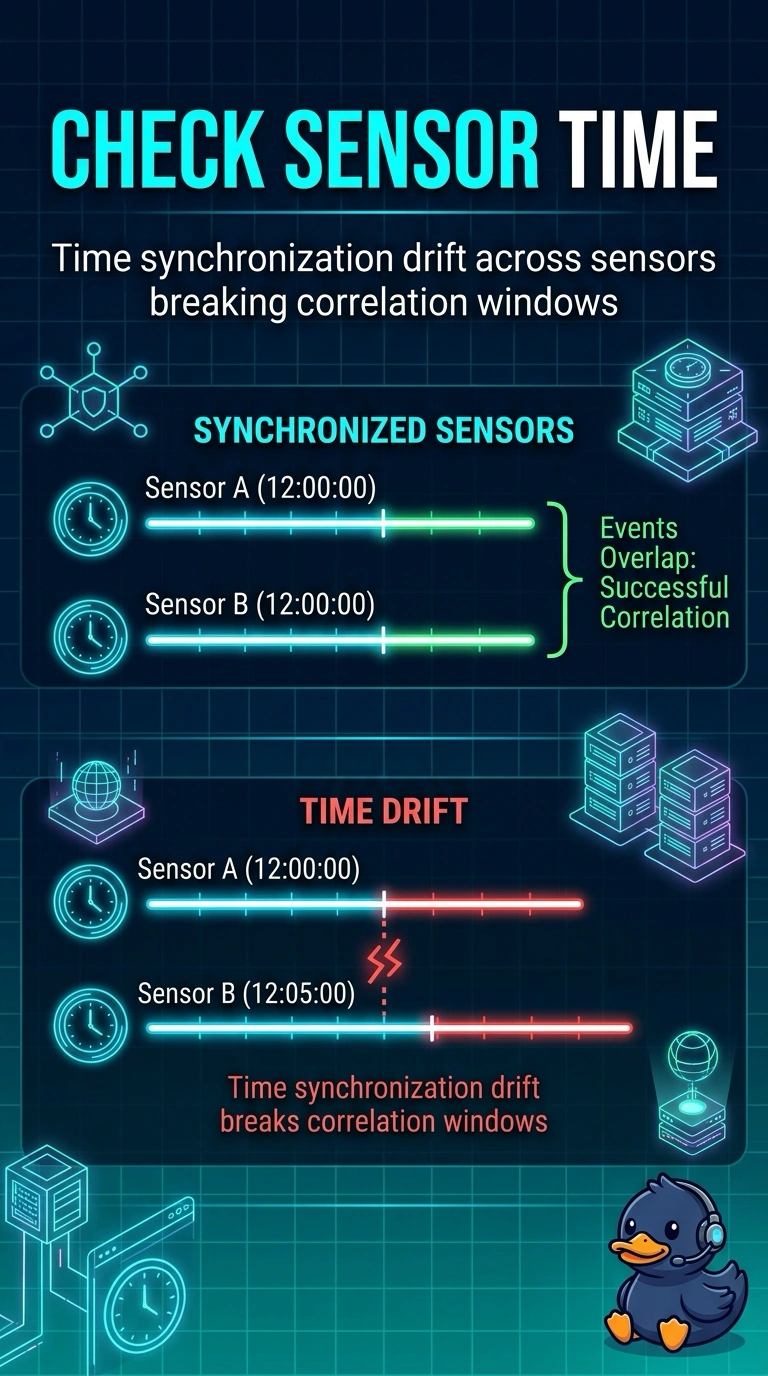
Trying to stitch together security events when your sensors disagree on the clock is like assembling a puzzle with warped edges. It’s easy to assume that because logs arrive in the SIEM, they can automatically be correlated across sources. You should verify consistent time synchronization across endpoints and network appliances so correlation windows align accurately.
Full Explanation
Time synchronization drift across sensors is the primary issue to investigate when intact logs fail to join across security tools. Multi-stage SIEM rules rely on tight time windows to match an endpoint process-creation event with a corresponding outbound firewall connection; even minor clock skew can place related records outside the correlation window and hide the attack chain. Insufficient SIEM cold-storage retention for historical compliance archives affects long-term investigations of past months, rather than recent cross-sensor rule matching. Missing antivirus signature updates on the perimeter email gateway can degrade malware blocking at ingress, but do not explain why the SIEM cannot join endpoint and firewall telemetry. Excessive dashboard widget refresh intervals on the analyst console can delay visual updates on a screen, but do not prevent the underlying correlation engine from firing alerts. One caveat is that mismatched time-zone offsets in log parsers can mimic clock drift even when host clocks are accurate. As a practical check, query recent events from both sensors in the SIEM and compare their raw event timestamps with ingestion time and NTP status.