
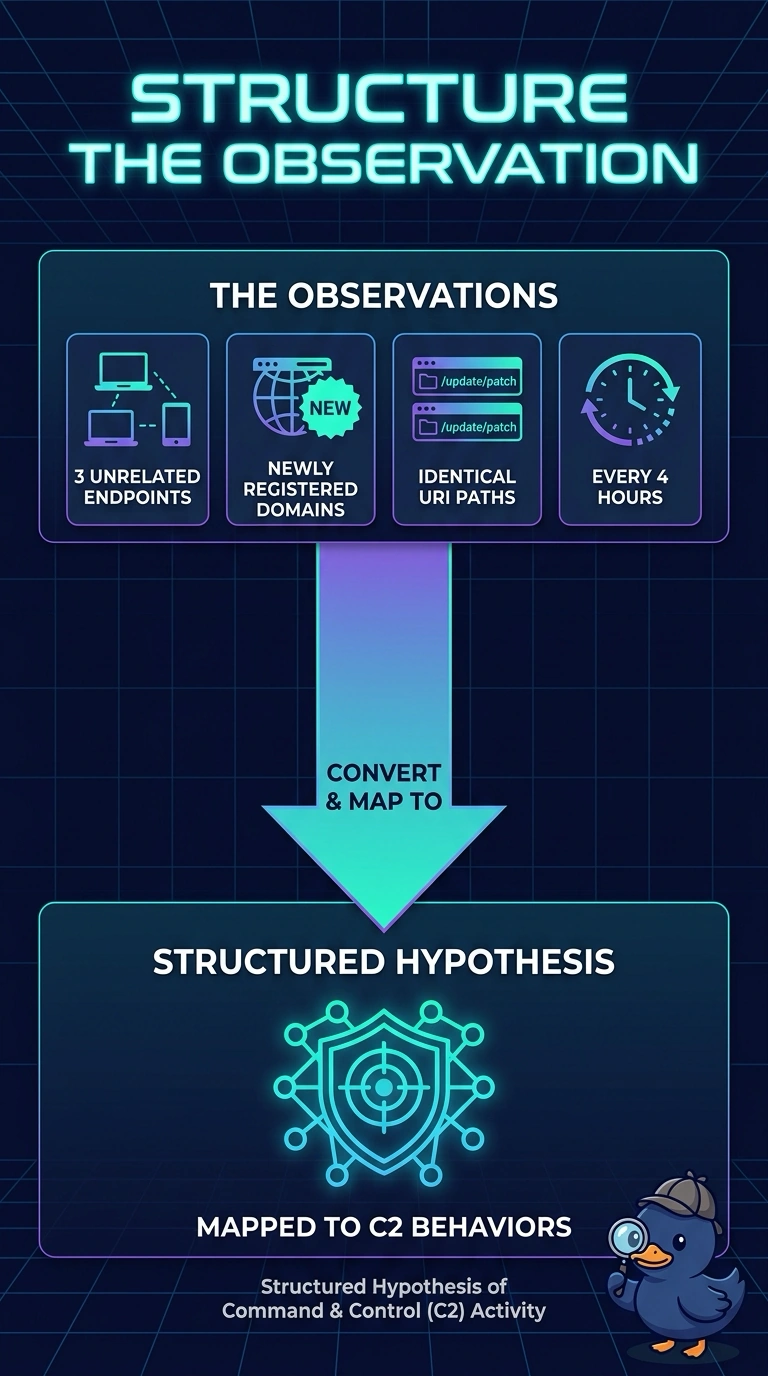
While performing an exploratory review of outbound proxy logs, a threat hunter notices three unrelated endpoints connecting to newly registered domains using identical URI paths every four hours. How should the hunter adapt the investigation process next?
Select an answer to reveal the explanation.
Short Explanation
Unstructured hunting is great for spotting smoke, but once you see a repeatable pattern, you need a blueprint to find the fire. Staying in ad-hoc browsing mode—or waiting for an outside report—lets the intruder keep beaconing unchecked.
Full Explanation
Unstructured threat hunting relies on curiosity and baseline anomaly detection, which is ideal for discovering unexpected signals. Once a repeatable pattern such as periodic beaconing over identical URI paths appears, the hunter should Convert the observation into a structured hypothesis mapped to C2 behaviors so the team can systematically test scope, affected hosts, and persistence across the environment. Choosing to Close the exploratory review immediately because no malware alert fired in EDR mistakes the absence of an automated alert for the absence of a compromise. Choosing to Continue purely random log browsing without documenting expected adversary steps wastes investigative time and prevents repeatable correlation across other telemetry sources. Choosing to Wait for an external threat intelligence vendor to publish a matching indicator surrenders the advantage of proactive internal visibility when custom infrastructure is already active. As a caveat, a structured hypothesis should remain falsifiable in case the traffic turns out to be an undocumented software updater. Search proxy or application logs for the URI pattern; pivot through DNS logs using the associated domains and through endpoint DNS/network events using host, process, and timestamps. Standard DNS query logs do not contain HTTPS URI paths.