
A threat hunting team spends three days testing a hypothesis that an adversary is abusing a specific remote management protocol on finance servers. The available telemetry yields no evidence of unauthorized activity during the scoped period. Why should the team still formally document this negative hunt result?
Select an answer to reveal the explanation.
Short Explanation
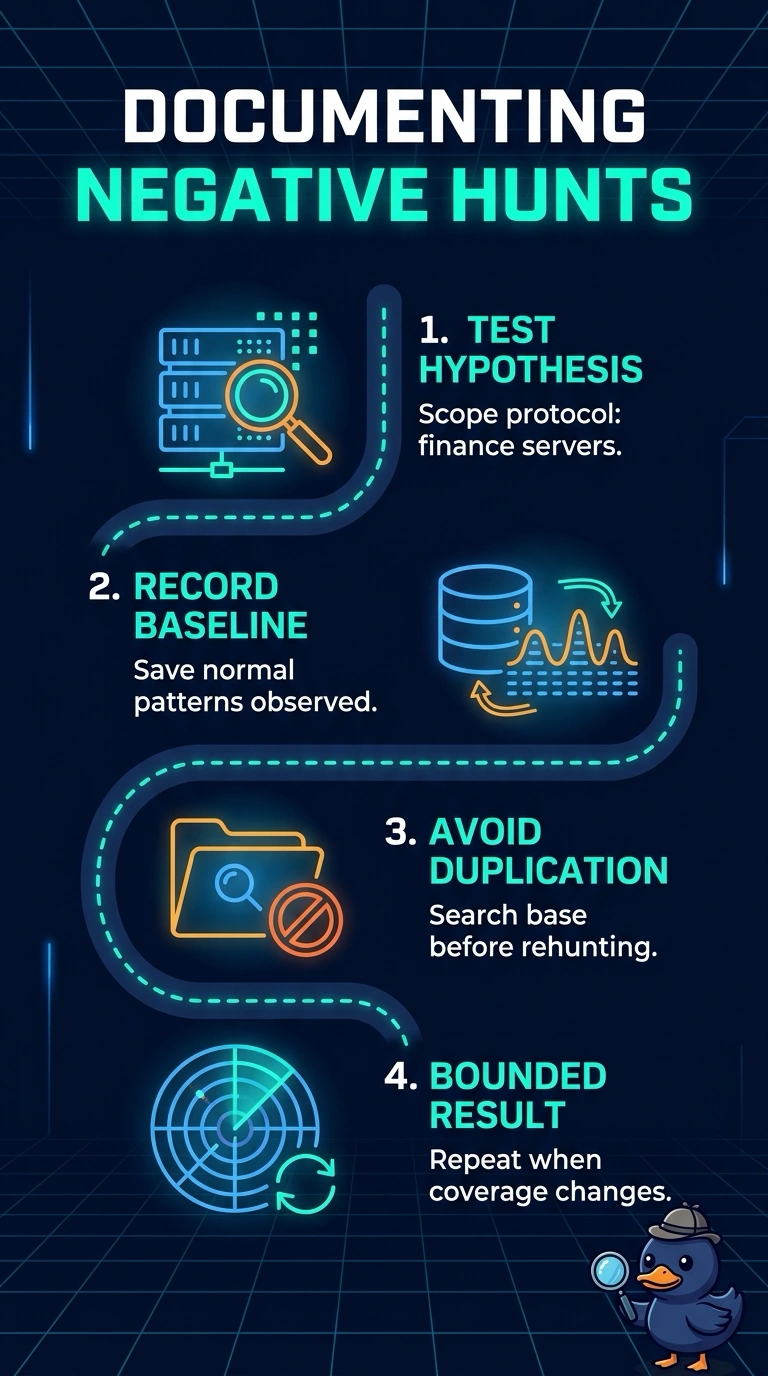
A hunt that finds no intruder is not a wasted shift unless you forget to write down what normal looked like. The trap is skipping documentation on negative results, which forces your team to re-run the same queries months later.
Full Explanation
To record baseline normal behavior and prevent teams from repeating the same hunt is the primary value of documenting negative threat hunting outcomes. Recording the tested hypothesis, queried data sources, time window, and benign patterns observed builds institutional knowledge and sharpens future baseline expectations. To prove that the organization no longer needs automated endpoint detection agents is incorrect because a single clean hunt only evaluates one hypothesis over a specific timeframe and never replaces continuous monitoring. To justify deleting historical authentication logs from the central SIEM repository undermines future investigations that require long-term lookback for slow-moving intrusions. To automatically escalate the finance servers for immediate forensic reimaging wastes response resources when evidence shows no compromise occurred. A negative hunt is bounded by telemetry coverage and the hypothesis; repeat it when risk, coverage, or behavior changes. As an operational check, store completed hunt summaries in a searchable knowledge base tagged by tactic, data source, and date so future analysts can review prior coverage before starting.