
Cisco Umbrella classifies a domain as malicious while the related file hash is still unknown. Why does that Umbrella result fail to convict the file by itself?
Select an answer to reveal the explanation.
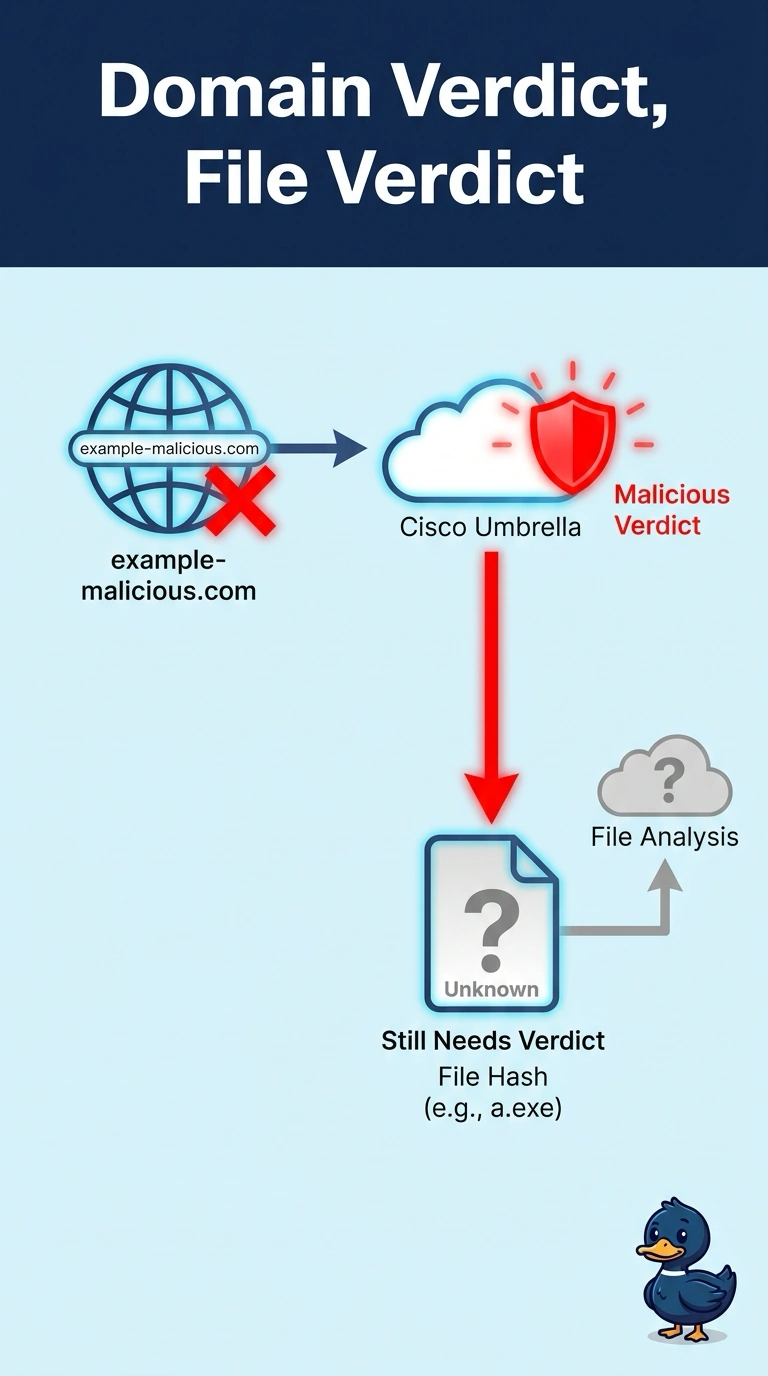
Short Explanation
A bad street address does not prove the package in your hand is dangerous, and you still have to inspect the package. Umbrella judged the domain, while the file hash is still unknown, so the domain result is not a verdict on that file. Copying the domain label onto the hash, assuming a sandbox detonation, or skipping the hash lookup collapses two different facts.
Full Explanation
Umbrella judged the domain, so the unknown file hash still needs its own verdict. A domain classification says something about the name that was queried, and it does not assign a disposition to a hash that the endpoint product still calls unknown. It is false that a malicious Umbrella domain assigns a malicious disposition to that same file hash; copying the label across is a bookkeeping error. It is false that the domain result means Threat Grid already detonated the file and scored it; an Umbrella domain hit is not a sandbox report. It is false that DNS reputation replaces a separate file-hash verdict on the endpoint product, because a name and a set of bytes are different evidence. Unknown stays unknown until an endpoint or malware-analytics lookup says otherwise. Exam caveat: the domain hit is still a reason to investigate the host and the file, and it is a lead rather than a conviction of the hash. Operational check: place the Umbrella domain result beside the Secure Endpoint lookup for the hash and record unknown when that is what the hash lookup shows.