
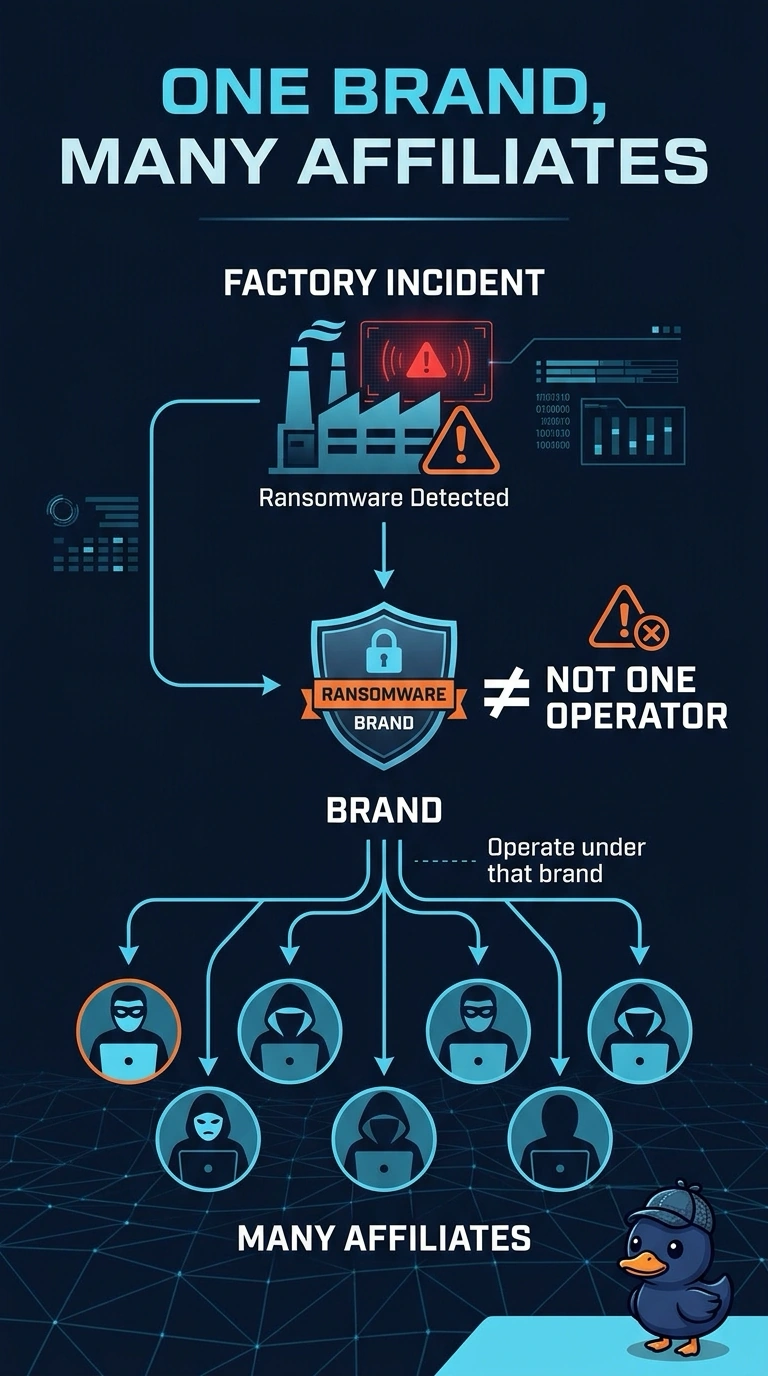
A ransomware brand found in a factory incident is known to be operated by many affiliates. Why is the brand name not the same thing as one operator profile?
Select an answer to reveal the explanation.
Short Explanation
A franchise name on the door does not tell you which person is running that shop today. You treat a ransomware brand used by many affiliates as a label, not as one operator profile. The trap is filling motivation, capability, and infrastructure from the brand name alone.
Full Explanation
A ransomware brand can be a service name used by many crews. Many affiliates can operate under that brand, so the name is not a single operator profile. The name groups a family or a service. Each affiliate can bring different motivation, capability, infrastructure, and even different targets. Treating the brand name as one operator profile, complete with motivation, capability, and infrastructure details, copies service-level facts onto a person or crew the brand does not identify. The brand name does not prove a government sponsor tied to the country where the affiliates happen to register. Registration geography is not sponsorship, and affiliates need not share a government. The brand name is not only a file hash, and it does have a place in a written actor profile: as the label of the service or family, with a note that affiliates differ. Exam caveat: a single incident can still support a profile of the affiliate who ran it, and that profile should not be collapsed into the brand. Operational check: list the brand once, then list the infrastructure and techniques from this incident separately, and mark whether other affiliates are known to use the same name.