
A factory incident includes a script whose comments are all in one language, and binaries whose compile timestamps cluster like one local workday. Why is that weak attribution?
Select an answer to reveal the explanation.
Short Explanation
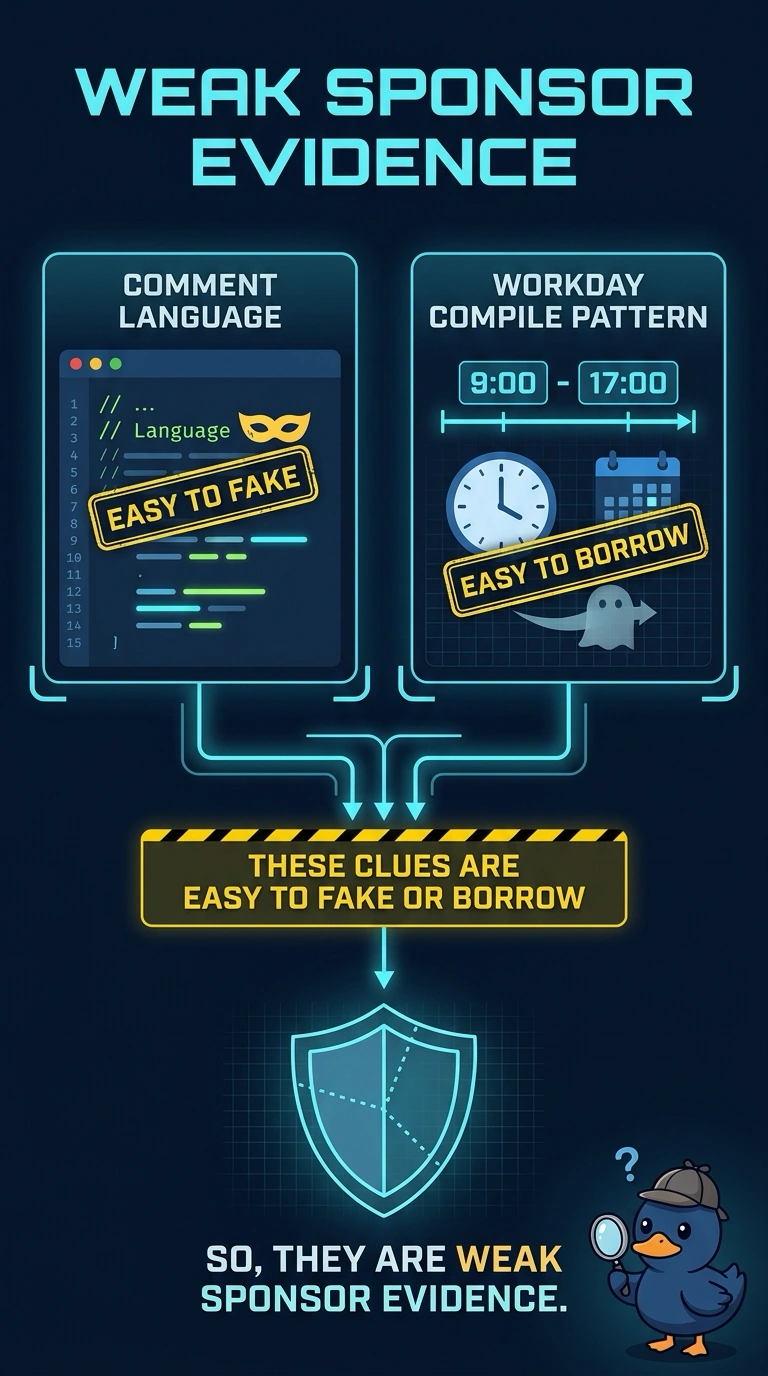
An accent and a wristwatch are easy to copy, so they are a weak way to name a person. You treat one comment language and a workday compile pattern as low-confidence context, not as a sponsor identification. The trap is promoting those soft clues above harder overlaps such as repeated tool marks.
Full Explanation
Comment language and a workday pattern in compile timestamps are soft clues. Those clues are easy to fake or borrow, so one comment language and a workday compile pattern are weak sponsor evidence. Comments can be copied, machine-translated, or planted as a false flag. Compile timestamps are commonly stored in UTC, and a cluster that looks like a local workday can come from a shared build server, a copied project, or a clock that was changed. They do not prove the developer lives where that comment language is an official national language, because a language is not a residence. They do not prove the build system was a government host inside the presumed local time zone, because a workday shape is not a government seal. They also do not outweigh a repeated set of techniques and tool marks gathered from related incidents; those overlaps are harder to copy than a comment or a clock. Exam caveat: soft clues can still support a lead when they agree with stronger overlaps, and alone they should not name a sponsor. Operational check: record the language and the inferred workday as low-confidence context, and place any repeated tool marks beside them before the profile names a sponsor.