
Intel for a software company gives the SOC one domain from an active campaign. Where should that name be blocked, and where should prior lookups be searched?
Select an answer to reveal the explanation.
Short Explanation
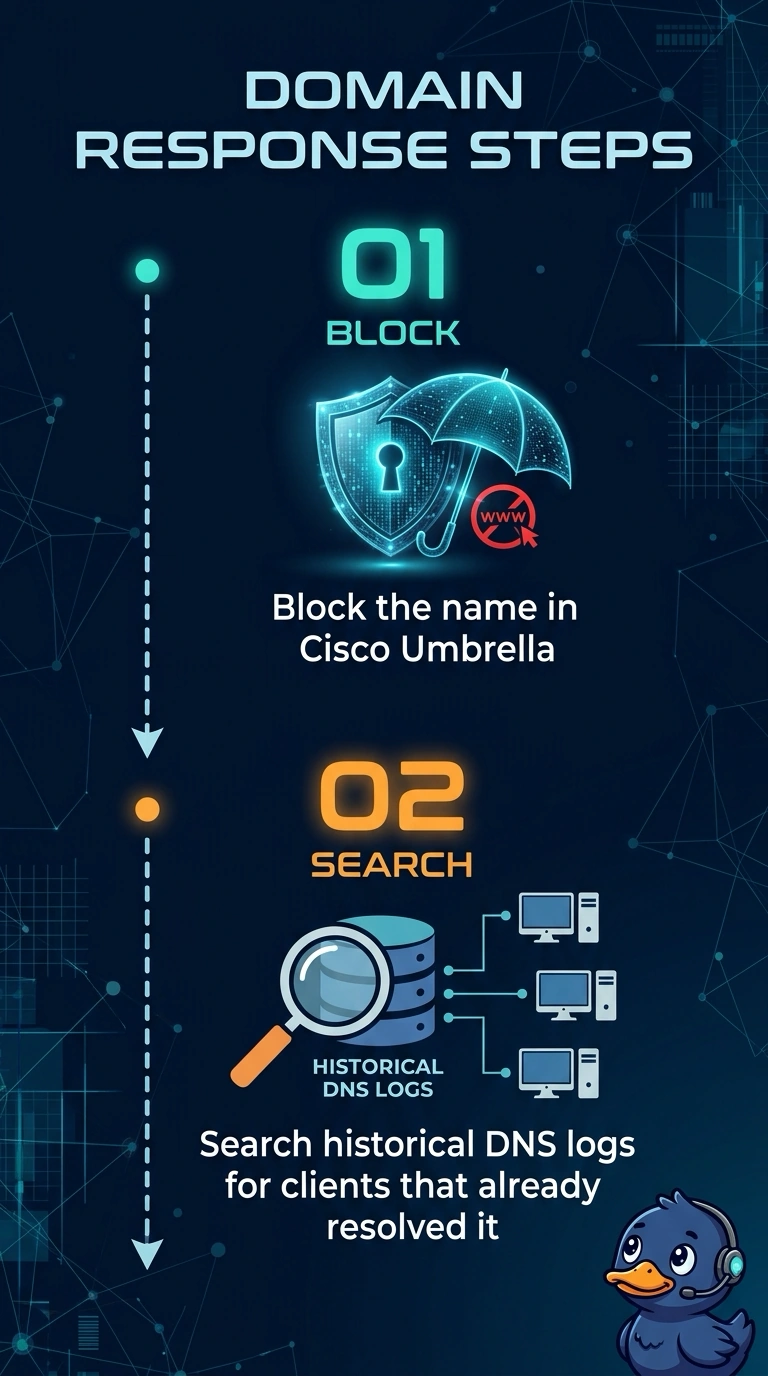
You’re asking the right question: a domain name is a street sign, and the useful clue is who already asked for directions. Block it in Cisco Umbrella and search historical DNS logs for clients that resolved it; loading the name into a NetFlow filter doesn’t itself enforce a drop. DNS gives you the place to block and the trail to investigate.
Full Explanation
A domain is enforced where names are resolved and investigated where those lookups were recorded. Block the name in Cisco Umbrella so protected DNS requests receive the configured block response rather than the malicious destination address; Umbrella may return a block-page IP. Search historical DNS logs for clients that already resolved it so the scope includes hosts that asked earlier. Loading the domain text into a NetFlow filter cannot itself drop a matching conversation: a filter on exported flow records does not enforce packet drops, and the records must contain a domain field before they can be searched by name. Quarantining every endpoint rests on the claim that a domain means each host stored the file, which a name lookup does not establish. Pasting the domain into a YARA condition and scanning memory for matching byte counts looks for a byte pattern on a host, not DNS clients or a block at resolution time. Searching prior lookups means reading the queries the organization already made, a different task from deciding whether an endpoint stored a file. Exam caveat: a domain can change addresses, so blocking the name at resolution is more directly relevant than relying on a fixed address. Practical check: confirm the name is on the Cisco Umbrella block list, then query the organization’s historical DNS logs for clients that already asked for it.