
Plant controllers sit on the same flat VLAN as office laptops, so any laptop can reach the controllers directly. Which mitigation reduces that exposure?
Select an answer to reveal the explanation.
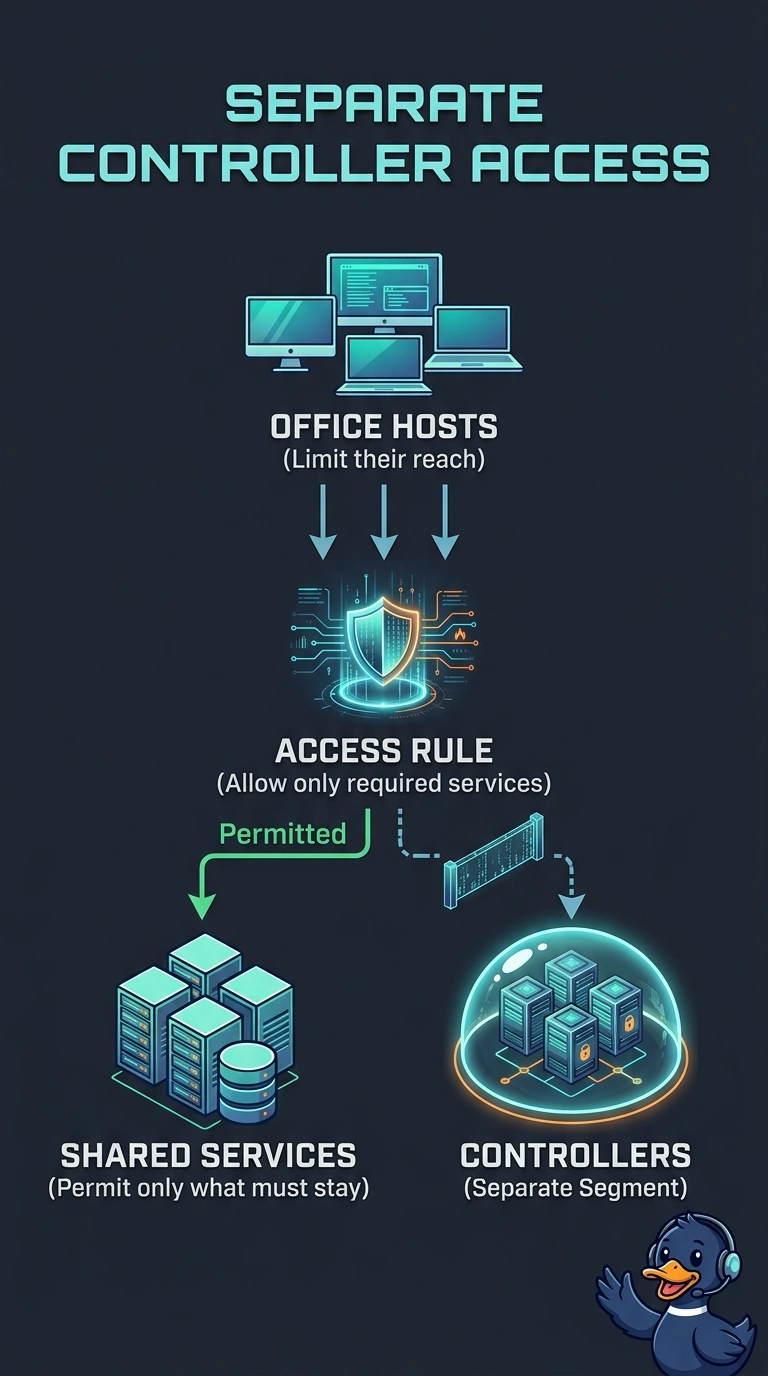
Short Explanation
One big room with no interior walls lets every visitor touch the machinery. You put the controllers on a separate segment and permit office hosts to reach only the services that must stay shared. Hiding the logs or posting the addresses leaves the same open floor.
Full Explanation
A flat VLAN shared by plant controllers and office laptops means any laptop can send traffic straight to the controllers. The mitigation that reduces that exposure is to put the controllers on a separate segment and permit office hosts to reach only the services that must stay shared. Moving every laptop onto the controller VLAN so all of that traffic stays in one broadcast domain makes the flat network larger, not smaller. Quieting the plant switch logs so the shared VLAN produces fewer tickets for the analysts hides the symptom and leaves the path. Listing the controller addresses on the office intranet and leaving the single flat VLAN in place publishes targets and does not segment anything. Draw the boundary so office laptops are not on the controller segment, and list the few services that still have an explicit permit across it. Exam caveat: required plant services can stay reachable, but they should be explicit permits rather than a wide open segment. Operational check: show the controllers on their own VLAN and the rule that allows only the named office flows.