
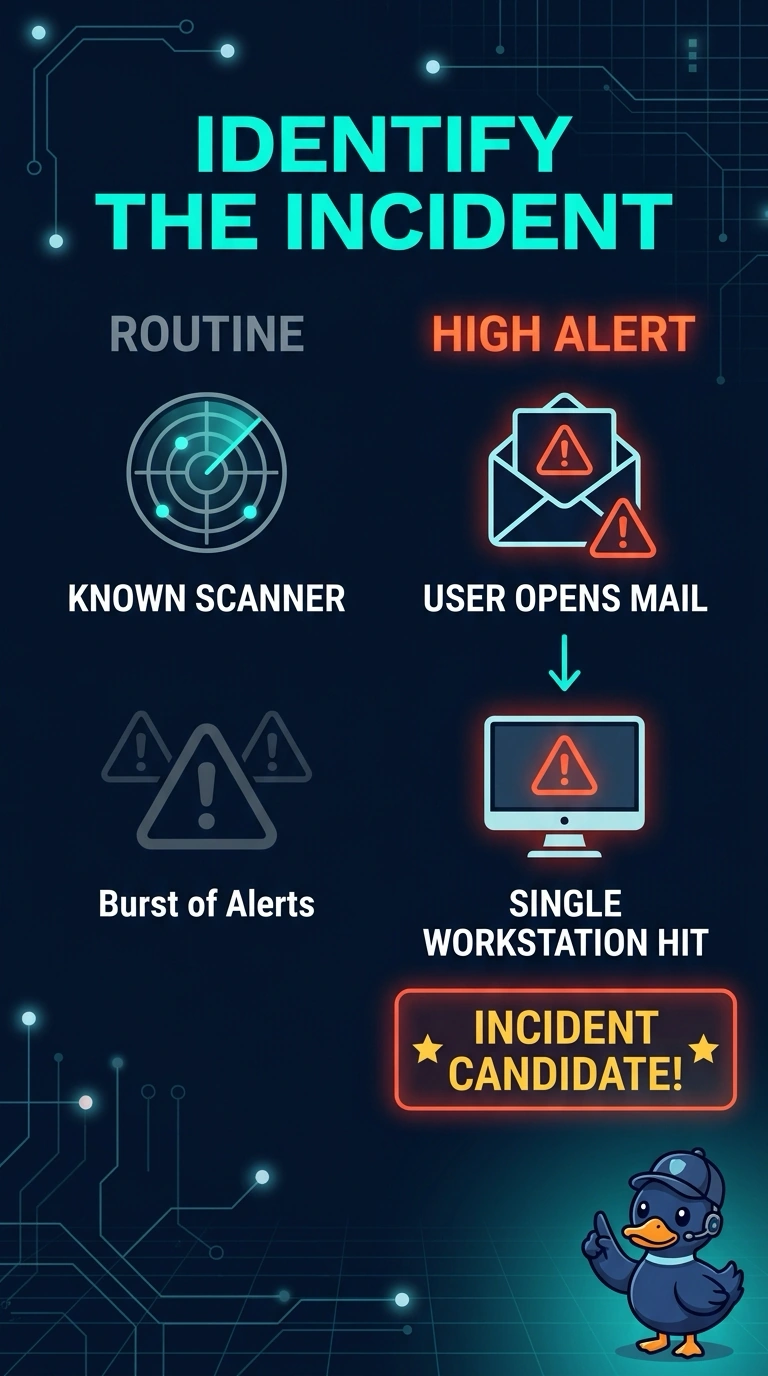
One exploit signature produces a burst of hits from the vulnerability scanner, and the same signature hits one workstation once after that user opened mail. Which pattern is the incident candidate?
Select an answer to reveal the explanation.
Short Explanation
A mailroom that scans every envelope is walking its route, and one person opening a suspicious letter is the event you stop for. You should treat the single workstation hit after the user opened mail as the incident candidate, not the burst from the known scanner. Volume from the scanner is expected activity, not a stack of compromises.
Full Explanation
The same signature can be routine in one setting and urgent in another. The single workstation hit after the user opened mail is the incident candidate: it follows a person opening mail on one host, not the burst that came from the known scanner. Treating the scanner burst and that high volume as proof every scanned host is already compromised confuses probes with a successful intrusion. Treating both patterns equally, as if every signature match were an incident that is already confirmed, ignores the source and the mail context that separate them. Setting neither pattern aside until the signature name itself contains the word ransomware in the rule title waits for a label the rule may not carry. The candidate is defined by the host and the mail, not by that word. Paging follows the mail-related host. Exam caveat: document the scanner burst so it is not later mistaken for a new event, and do not page that burst as the incident. Operational check: split the hits by source, tie the single workstation event to the mail-open time, and page that host rather than the scanner population.