
The same IDS signature fires every night from the vulnerability scanner subnet and from no other source. The scanner job history and packet details confirm these events are the approved nightly scan from inventory-verified scanner hosts. How should those hits be classified before anyone is paged?
Select an answer to reveal the explanation.
Short Explanation
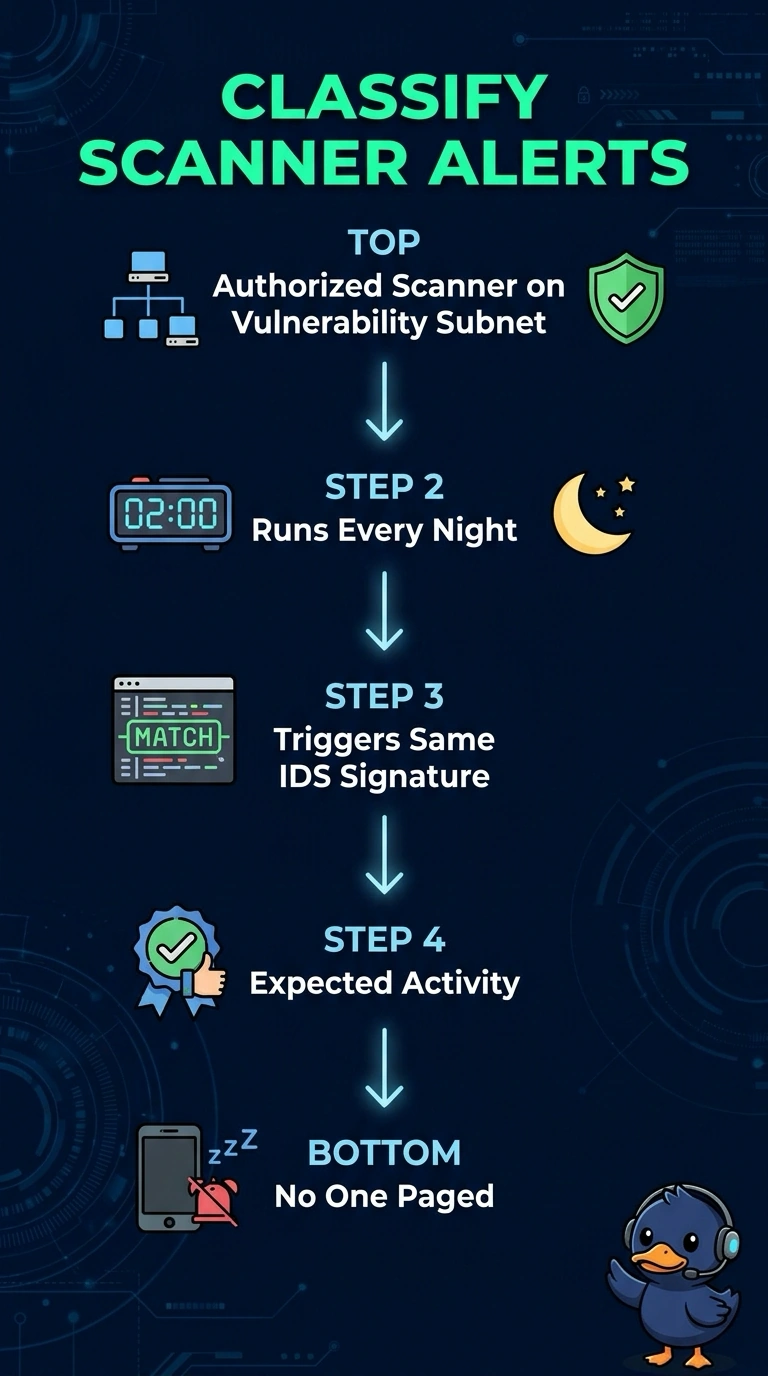
The night guard walking a known route should not set off the burglar alarm in your head. You classify these nightly hits as expected activity from the authorized scanner before anyone is paged. Deleting the signature, or calling every scanned host compromised, throws away a control you still need.
Full Explanation
A signature that fires every night from the vulnerability scanner subnet, and from no other source, matches the scanner doing its job. That is expected activity from the authorized scanner, and it should be classified that way before anyone is paged. It is not a confirmed compromise of every host the vulnerability scanner contacted during that nightly window; a probe is not a successful intrusion on each target. It is not proof the signature is defective and should be deleted from the sensor before the morning shift begins. The signature can be matching real scan traffic, and deleting it would hide the same pattern from an unexpected source. These hits are not inbound exploitation of the scanner subnet by an external actor reusing that same nightly signature, because the source is the scanner subnet itself. Source range and timing alone do not prove authorization: validate the job and activity before suppressing pages, and continue monitoring for compromised scanners or unexpected behavior. Operational check: compare the source addresses with the scanner inventory, record the nightly window as expected, and leave the signature in place for other sources.