
A software company must list every laptop that has seen one file hash and must also show the current disposition of that file. Which Secure Endpoint view answers both needs?
Select an answer to reveal the explanation.
Short Explanation
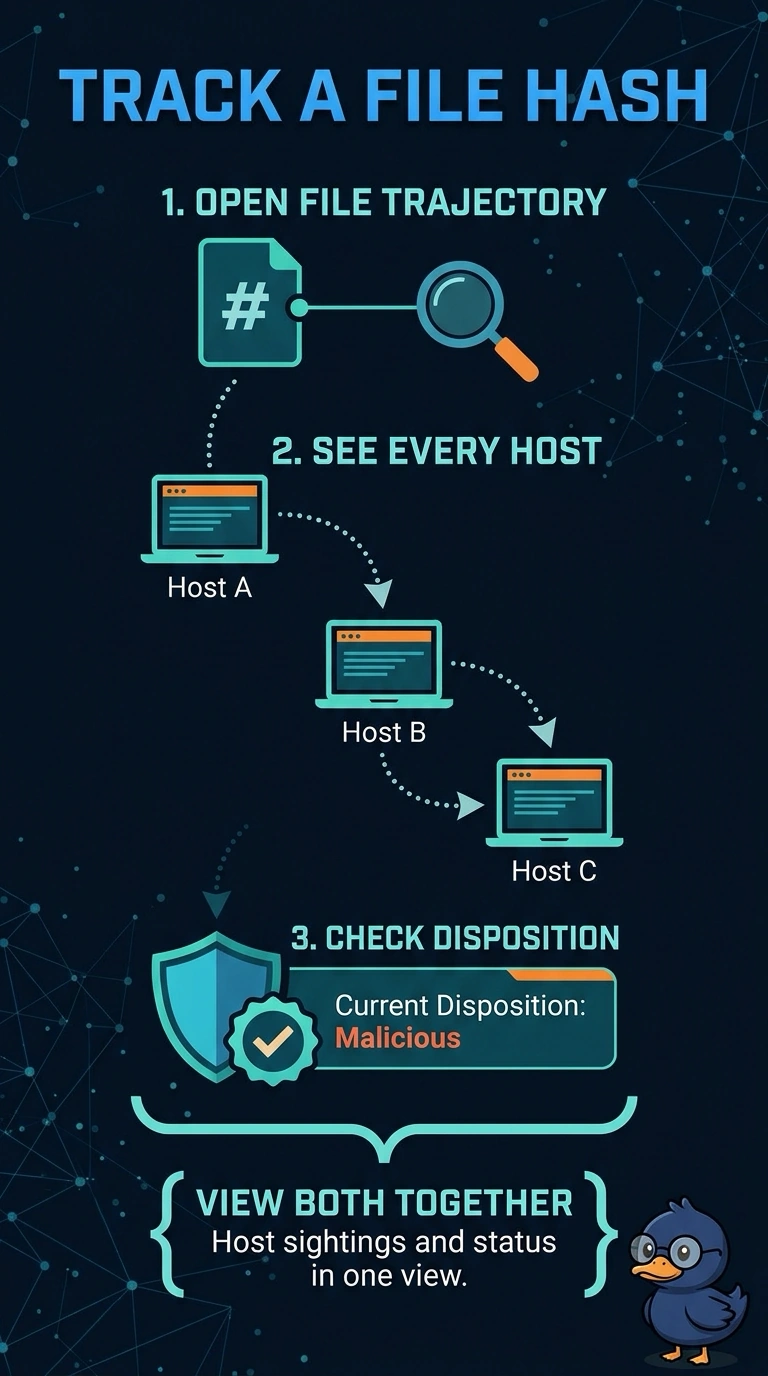
You want the library card that lists every borrower of this one book, plus whether the book is banned. File trajectory is that card for a hash: each host sighting and the current disposition. Device trajectory is one reader's whole day, and quarantine or an exclusion does not search the fleet.
Full Explanation
File trajectory is the Secure Endpoint view organized by hash. It shows each host sighting, meaning computers whose connector reported that file, together with the current disposition of the file. That is the pair of facts the software company asked for. Device trajectory for one computer, listing processes that ran on that single host today, answers what happened on one laptop, not which other laptops have seen the hash. An exclusion entry that hides this hash from later scans and does not list any host sightings suppresses future detection; it is not a historical map of where the file went. A quarantine action that moves one local copy and leaves the rest of the fleet unsearched keeps a copy on one machine and does not enumerate other computers or replace the disposition lookup. Exam caveat: file trajectory only includes hosts whose connector observed the hash, so an offline laptop or a file that was never scanned can be absent. Operational check: search the hash in File Trajectory, read the computer list and the disposition, and do not stop at one computer's Device Trajectory.