
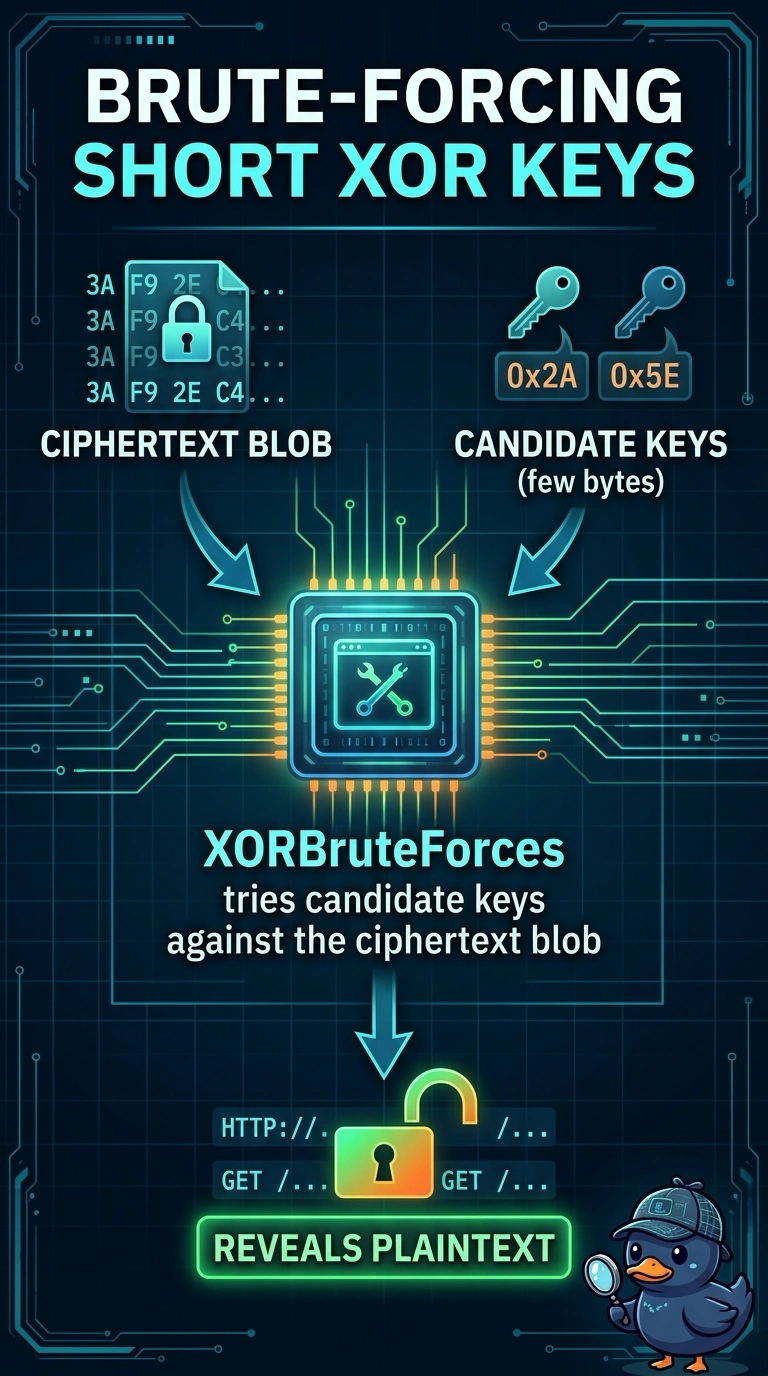
The official Cisco blueprint names “XORBruteForces”, but no public tool-author/vendor documentation has yet established which implementation that denotes or its support for unknown-length multi-byte brute force. The XOR key length is unknown but is believed to be only a few bytes, and the plan is to brute-force candidate keys. Which blueprint-named tool matches that job description rather than an unpacker?
Select an answer to reveal the explanation.
Short Explanation
You are matching the blueprint name to the job description, not running a tool yet. The blueprint names XORBruteForces for this short-key trial job, but its implementation and support for unknown-length keys are not established in public docs, so you HOLD any execution claim. You still rule out an unpacker because it strips a stub rather than testing keys.
Full Explanation
The official Cisco blueprint names “XORBruteForces”, but no public tool-author/vendor documentation has yet established which implementation that denotes or its support for unknown-length multi-byte brute force. For exam-topic matching, XORBruteForces aligns with the described plan to try candidate short XOR keys against the ciphertext blob when length is believed to be only a few bytes, as a name-to-job association rather than a validated execution reference. HOLD the operational invocation/capability claims until that implementation and documentation are supplied; the exam-topic name alone is not an execution reference. xortool pressed into service as the unpacker for a compressed packer stub fails by function because unpacking strips a compression stub while this task is described as testing XOR keys. Ghidra set to brute-force login passwords stored in a browser profile fails by target and store because browser credential secrets differ from ciphertext blob decoding. A packer unpacker that strips a compression stub instead of testing XOR keys fails by problem type because it addresses packing, not XOR key trial. If frequency analysis already yields the key, brute-force remains optional confirmation rather than a reason to discard recovered plaintext.