
A YARA rule lists an author, a date, and a case identifier in meta, and the strings are specific to one family. What does that meta section give the next analyst?
Select an answer to reveal the explanation.
Short Explanation
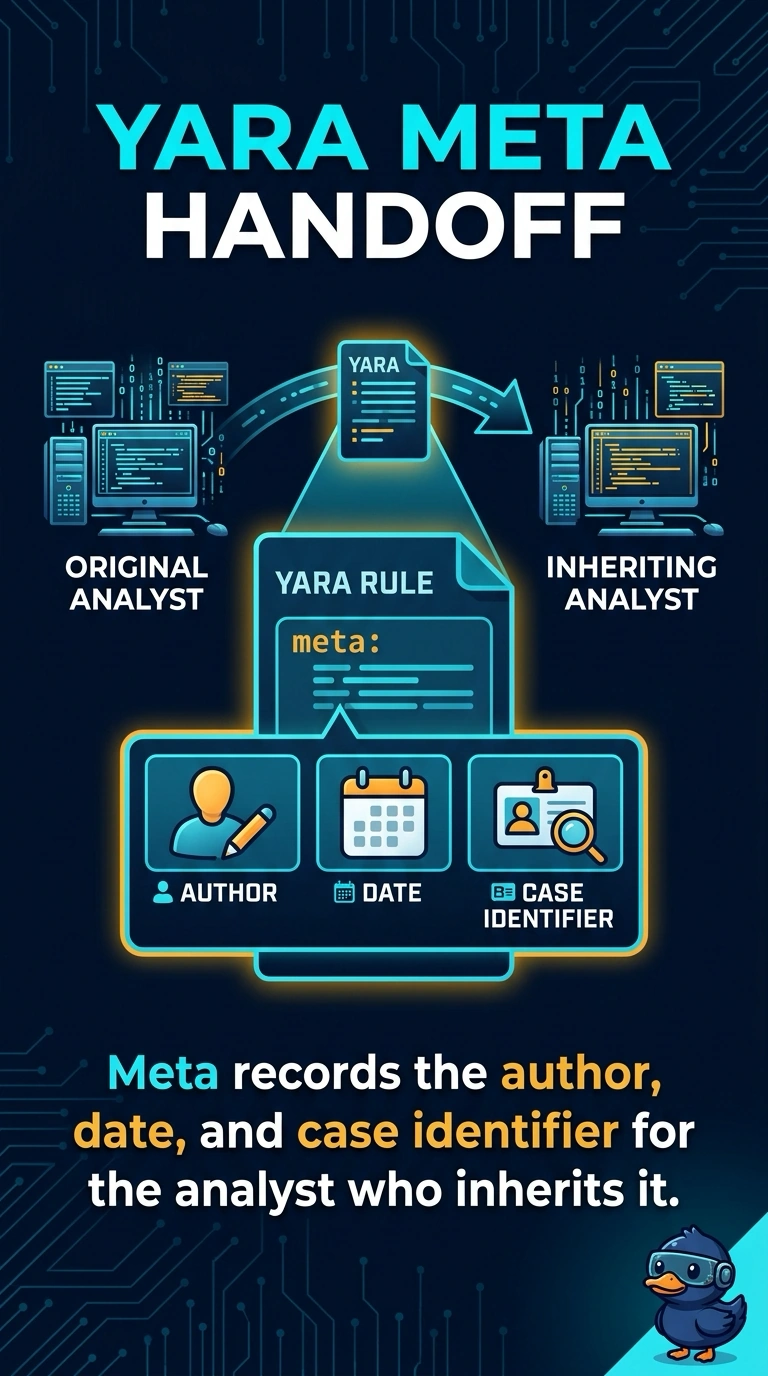
Think of meta as a note carried with the rule, not the test of whether a file matches. It records the author, date, and case identifier for you when you inherit the rule; the strings and condition do the matching, and meta does not encrypt or hide the strings.
Full Explanation
Meta is documentation carried beside the rule. It records the author, date, and case identifier for the analyst who inherits the rule, so you can see who wrote it and which case it served. Meta does not supply the boolean test that decides whether a file matches; the condition does that. It does not encrypt the strings or require you to unlock them before scanning, because the strings are available for the scanner to read. Nor does meta hold the strings compared with file bytes during the scan; those live in the strings section. Editing meta can make the case easier for you to resume and should not change which files match. A date in meta is a note for people, not a timer enforced by the matching engine. You can use the note for provenance, but you still need to read the strings and condition to understand what the rule matches. Exam caveat: detailed meta, even alongside strings specific to one family, never decides a match. Practical check: show a teammate the author and case identifier in meta, change only that note, and confirm the same sample still matches.