
A phishing kit's JavaScript builds a download URL by concatenating single characters. How does that obfuscation differ from a packed native binary?
Select an answer to reveal the explanation.
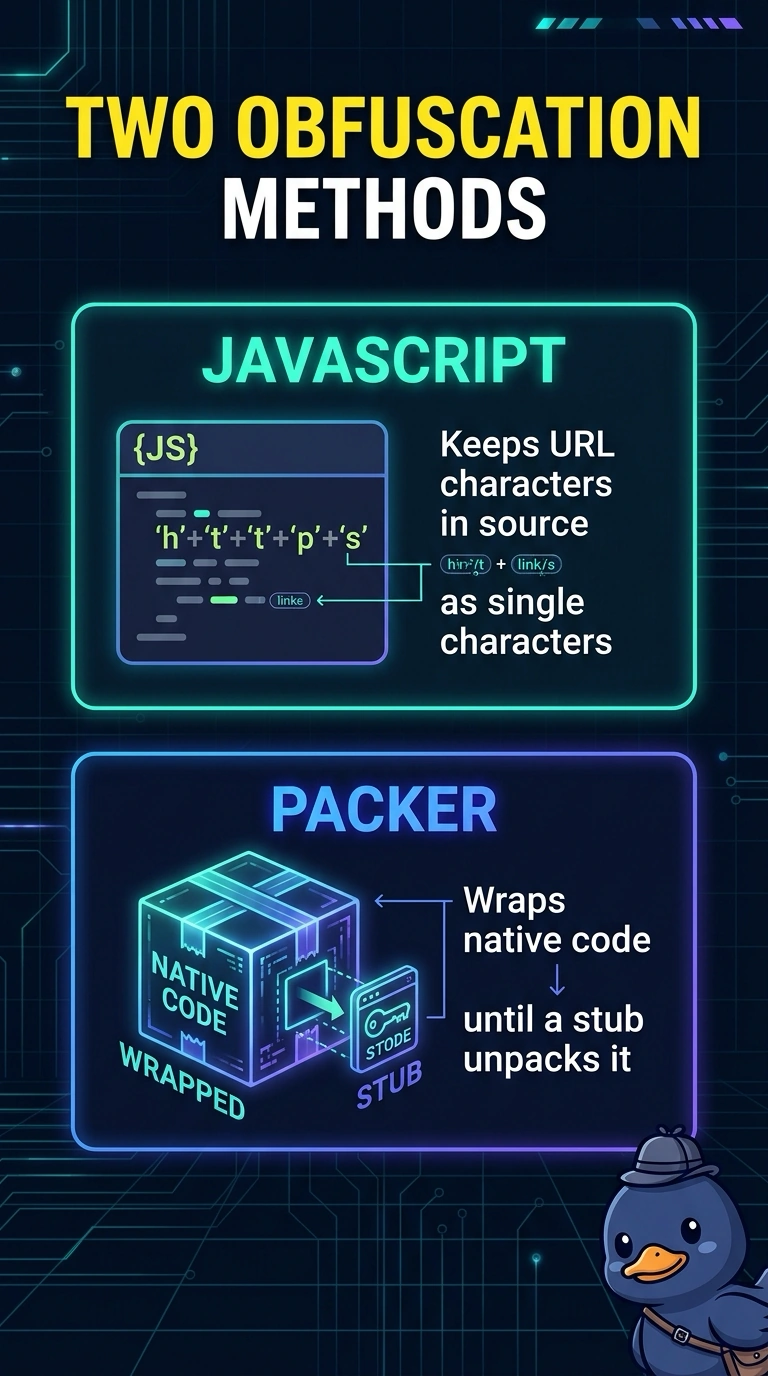
Short Explanation
Splitting a URL across characters is like chopping a sentence while the letters stay on the page. You can still recover those pieces from the script source, whereas a packed binary stays wrapped until a stub unpacks it. Those are different tricks, and neither one is a rewrite of the program's own body.
Full Explanation
Concatenation hides a contiguous URL from a simple string search, but the script keeps URL characters in source, and an interpreter joins them when the script runs. A packed native binary is a different layer: a packer wraps native code until a stub unpacks it, often in memory, so the original instructions are not sitting in the file as readable pieces. Saying both techniques encrypt the payload with a password that static review cannot recover confuses obfuscation and packing with password-based encryption; character splits are an encoding-style disguise, and a packer is not proof of a user password. Calling character splits metamorphic in that the script rewrites its own machine-code body misuses metamorphic, which means malware that rewrites its own body; this JavaScript does not present a machine-code body to rewrite. Saying a packer only renames the file, while concatenation changes the download protocol itself, shrinks a packer to a filename edit and invents a protocol change the split URL did not require. Exam caveat: once you join the characters you still have a URL, not proof the download succeeded on a host. Operational check: extract the script, concatenate the character pieces in a text editor, and compare that URL with the packed binary's need for an unpacking stub before any execution.